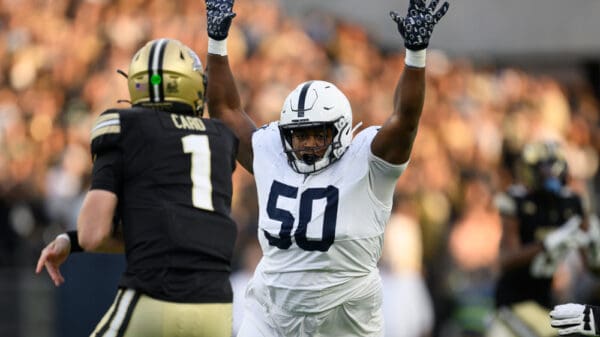

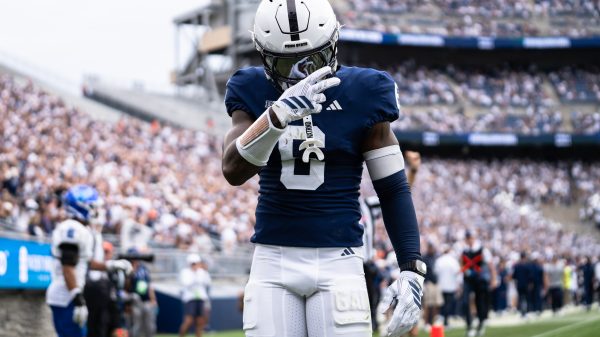











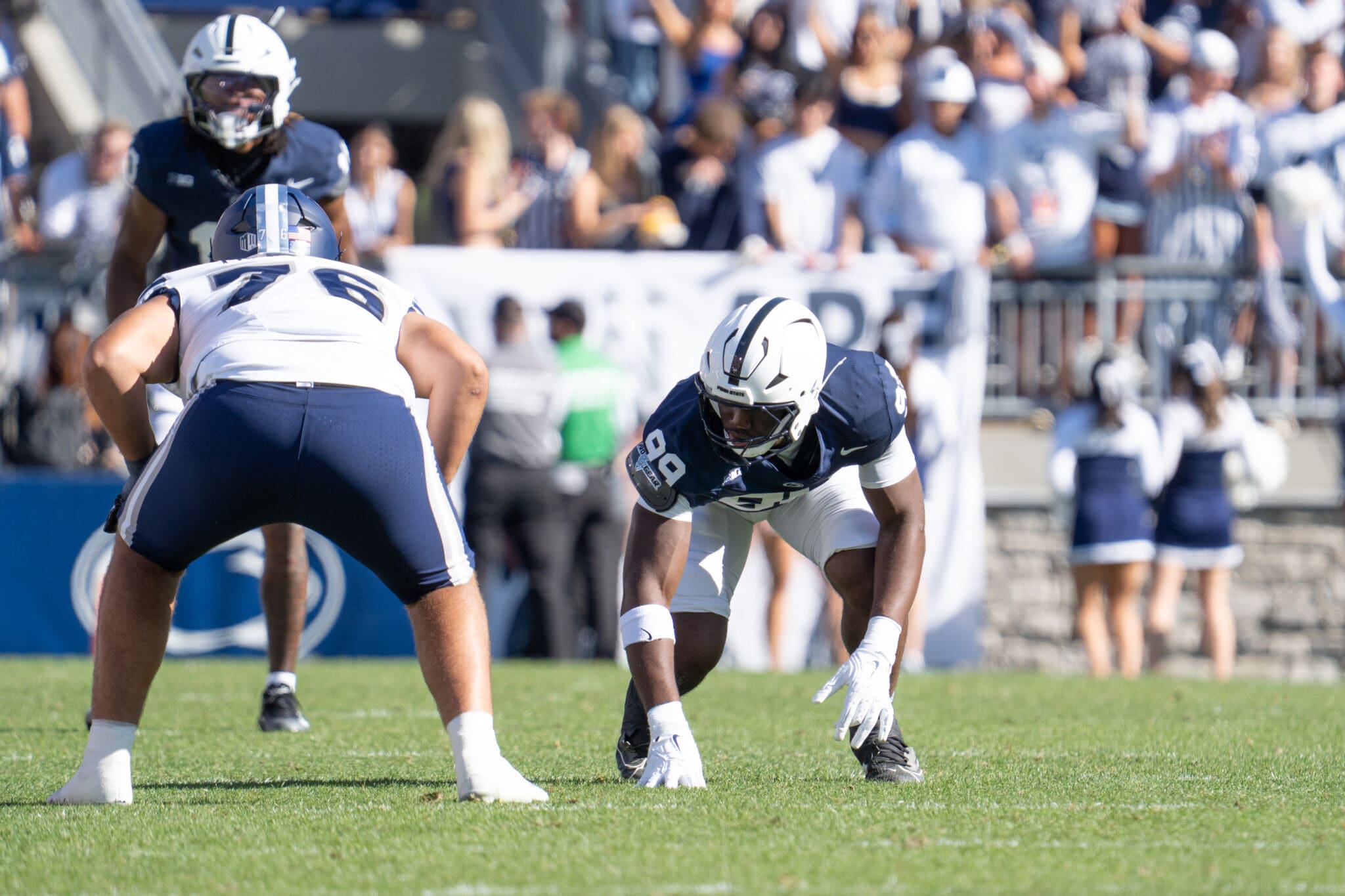
Yvan Kemajou arrived at Penn State with the timeline of a typical freshman defensive end.
Learn the system. Add weight. Adjust to the speed of major college football. Watch older players handle the pressure. Develop behind the scenes until the opportunity came.
That plan did not last long.
Kemajou was pushed into action earlier than expected during his freshman season, a baptism by fire that has already changed the way he views himself inside Penn State’s defensive line room. Now, after one year in the program, the sophomore from Burtonsville, Maryland, finds himself in a very different role.
He is no longer just the young player trying to catch up.
He is one of the voices others are listening to.
“It’s almost like I’m a senior now,” Kemajou said after Penn State’s Blue-White practice Saturday. “It’s interesting being around a group of guys where we’re all leading each other and helping each other.”
That quote says a lot about where Penn State’s EDGE group stands entering the summer. The Nittany Lions are transitioning into a new defense under coordinator D’Anton Lynn. They are replacing production, learning new techniques and trying to identify who will emerge as the next disruptive presence off the edge.
Kemajou is one of the clearest candidates.
As a freshman, Kemajou played 238 total snaps, including 120 as a pass rusher and 117 against the run, according to Pro Football Focus data. His overall defensive grade settled at 66.6, with a 66.8 run-defense grade and 62.8 pass-rush grade. The numbers suggest what the film and circumstances did: a young player who was not overwhelmed, but also one still growing into the full weight of the position.
The flashes were there. Kemajou produced 10 total pressures, including one sack, one quarterback hit and eight hurries. He added 10 tackles, six assists and 11 defensive stops. For a true freshman EDGE thrust into a larger role than originally expected, it was a valuable foundation.
Now comes the harder part.
Penn State does not merely need Kemajou to be promising. It needs him to be ready.
The Nittany Lions’ EDGE room is full of talent, but also uncertainty. The departure of proven veterans has created opportunity, and Kemajou has moved from developmental piece to potential tone-setter. That shift can be difficult for a second-year player, but Kemajou sounded comfortable with the responsibility.
“It’s all a new deal for us, so we’re all helping each other learn and get the defense down, all the techniques down,” Kemajou said. “We’re just bouncing ideas off each other, helping each other and giving tips on how to get the play right.”
That collaborative approach matters because Penn State’s defense is not simply reloading personnel. It is learning Lynn’s structure, language and expectations.
Lynn arrives with one of the more intriguing defensive resumes in the sport. At UCLA in 2023, he transformed a defense that ranked No. 87 nationally in 2022 into one that finished the regular season ranked No. 10 in the country. The Bruins led the nation in rushing defense at 69.6 yards per game, ranked second in yards per rush allowed at 2.33 and finished third in sacks per game at 3.42.
That defense also produced 41 sacks, fourth nationally, and 99 tackles for loss, also among the best marks in the country. Most importantly for Kemajou and Penn State’s edge defenders, Lynn helped guide Laiatu Latu into one of college football’s most dominant defensive players. Latu led the nation in tackles for loss per game, ranked fourth in sacks per game, won the Lombardi Award and became a national defensive centerpiece.
That is the standard Penn State’s young edge players are now studying.
“Every defense is different,” Kemajou said. “Each coach has different things they do. It’s interesting learning it all. I’ve only been through two so far, but I’ve seen some differences. I just like playing defense. They give me a plan.”
That last line is important.
Kemajou does not sound like a player overwhelmed by a new system. He sounds like one simplifying the transition. Learn the plan. Trust the technique. Play fast.
That was one of the lessons from his freshman season. When a young defender is thinking too much, the game can become heavy. The snap slows down. Reads come late. Pass-rush counters lose timing. Run fits get cloudy.
 Add Nittany Sports Now as a preferred source in Google! Click here to add us.
Kemajou’s next jump will likely come from confidence as much as strength or skill. His freshman PFF profile showed a player who had enough baseline ability to survive Big Ten football, but the next step is becoming more disruptive on a down-to-down basis. He had one of his better run-defense showings against Villanova, grading at 73.6 in that category, and was solid in multiple Big Ten appearances. His best tackling grades also pointed toward a player with a real physical foundation.
The question is whether that foundation can become production.
Kemajou’s mindset suggests he understands the challenge.
“You never settle,” Kemajou said. “You stay humble. Stay with that mentality and you can actually turn it on.”
Penn State will need that mentality across the defensive front. The Nittany Lions have added size and versatility inside, and Kemajou likes what he has seen from the interior defensive linemen around him.
“The transfers are great guys, great ballplayers,” Kemajou said. “They can occupy space, but they can also move in space. If need be, they can penetrate gaps. It’s amazing to see them around.”
That could become one of the most important pieces of Lynn’s defense. If Penn State’s interior linemen can command double teams, dent the pocket and force protections to respect the middle, edge players such as Kemajou will have more room to rush. The best pass-rush systems rarely rely on one player winning alone. They create pressure through structure, spacing and conflict.
That is where Kemajou’s growth intersects with the larger defensive transition.
He does not have to be a finished product in April. But he does have to become one of the players who helps Penn State get from installation to execution. That means knowing the defense well enough to play fast and helping younger players do the same.
One of those young players is Max Granville, another highly intriguing EDGE option.
Granville reclassified in 2024 and joined Penn State during its College Football Playoff run, but injuries delayed his full introduction. That has made him one of the roster’s bigger mysteries. The former four-star prospect from Sugar Land, Texas, still carries significant upside, but much of the conversation around him remains projection.
Kemajou made it clear that Granville is more than just another name in the room.
“That’s my guy,” Kemajou said. “It was tough for him, too. I know he wants to play football, especially coming off a long-term injury. We’re there for each other.”
That relationship could matter. If Granville gets healthy and Kemajou takes the next step, Penn State may have the foundation of its next dangerous EDGE tandem. Granville has already spoken with confidence about his body responding, saying he feels athletic, fast and stronger after adding muscle.
For now, Kemajou is the steadier projection because he has already been on the field. He has taken real snaps. He has been tested. He has learned what happens when development is accelerated by necessity.
That experience may have aged him faster than expected.
A year ago, Kemajou was a freshman trying to find his way. Now he is a sophomore talking about leadership, technique, communication and helping others learn a new defense.
“It’s been good,” Kemajou said. “Just learning everything.”
Penn State does not need Kemajou to pretend he is a senior. It needs him to play with the urgency of someone who understands that his time is no longer somewhere down the road.
It is here.
And for a young EDGE room searching for leadership, Kemajou’s early arrival may prove to be exactly what Penn State needed.