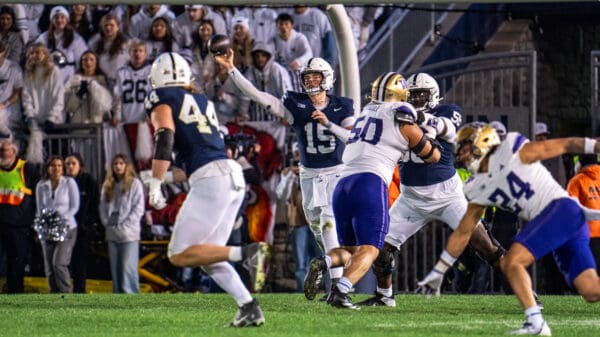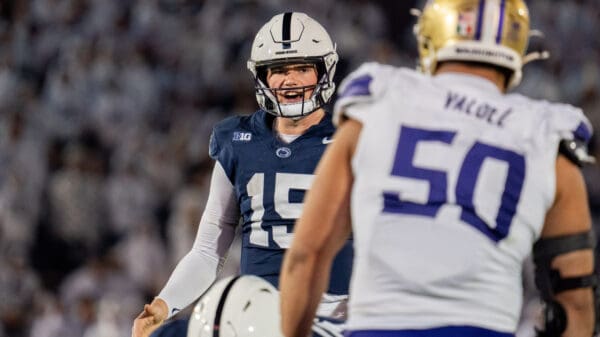

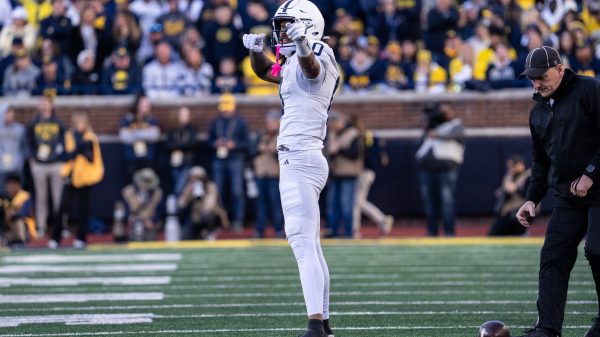
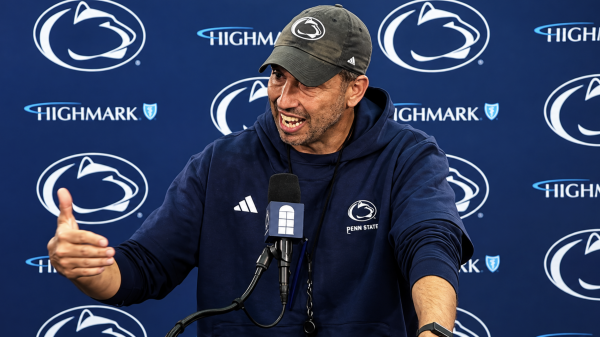
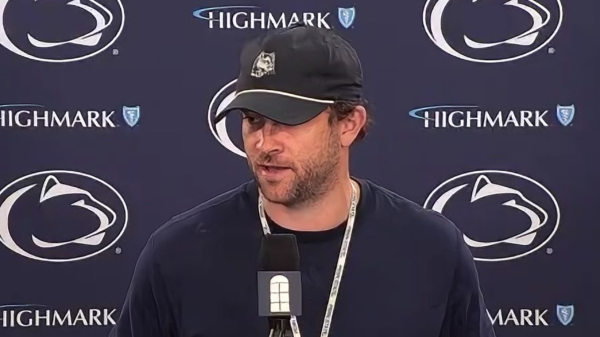












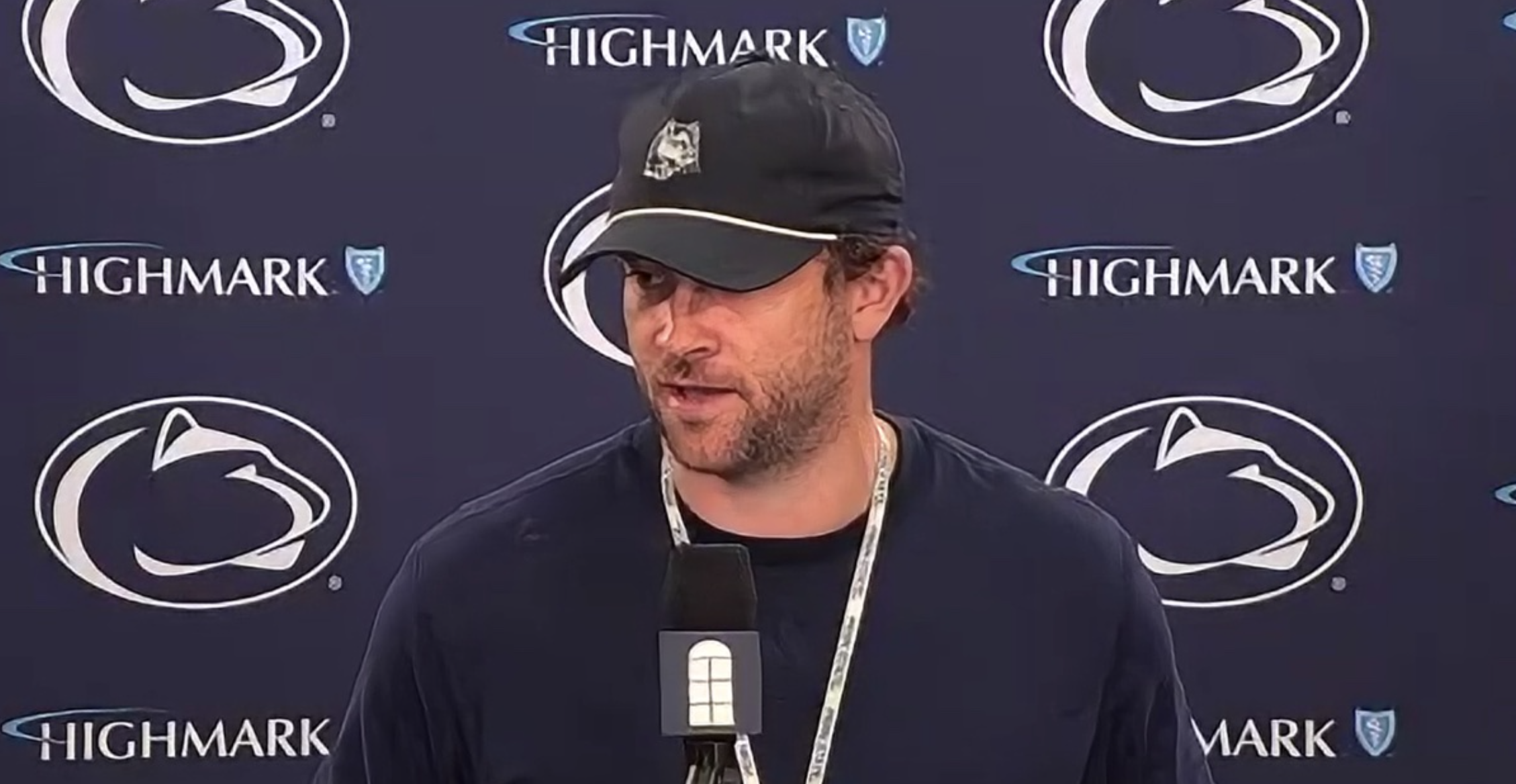
UNIVERSITY PARK, Pa. – Penn State heads to Seattle to face the Washington Huskies who come in with a 5-3 record. Offensive coordinator Taylor Mouser went to the podium to field questions from the media during his bi-weekly press conference that saw the offense come to life against Purdue in a 31-17 win.
Here is what Mouser had to say:
After watching the film, what stood out about Cam Wallace’s game? With James Peoples, Carson Hansen and Quinton Martin Jr. also in the mix, how do you see the running back rotation going down the stretch?
Mouser: Really proud of Cam and Carson. We’ve really challenged those guys for a long time, the whole running back room, to have somebody go and draw a line in the sand and say, “I’m gonna be the guy,” or, “We’re gonna be the guys.” Those guys did a great job over the bye week of doing that. They had a great week of practice, then went to the game and left no doubt in my mind.
It’s the overall attitude and effort that those guys play with. Even when it wasn’t perfect, that’s the level I see our running backs having to play at, just from a physicality, an attitude and an effort standpoint. You’re not gonna get tackled by one guy. You’re gonna run hard. Just really proud of the way those guys responded to a tough few weeks, then came out after a bye week and did a great job.
You’ve talked about simplifying the offense. What did the bye week allow you to do that you might not have time for during a regular game week?
Mouser: You go back and see what the first six weeks looked like. Then you go back and see what you did well in the past, throughout different seasons, and the different schemes we’ve been good at. We’ve run them all in my time with Coach Campbell. For us, it was about simplifying things and being able to let our guys play fast.
On Tuesday, I told the whole offense what I envisioned the run game looking like, and this is what we were gonna sink our teeth into. If anybody had a problem, come and we’ll talk about it. I wanted them to buy into the mentality it takes to run the ball. Yeah, we have to simplify it so those guys can play fast, but those guys have to be excited and sprint to the line of scrimmage. It’s gonna be physical. It’s gonna be violent. It’s gonna be downhill. It doesn’t matter what the calls are.
We had a really, really physical couple of bye-week practices. It wasn’t an off week for our guys. It was gonna be who the most physical and violent runners are, who the most physical and violent blockers are. It was probably more of a challenge mentally than it was physically.
Matt Campbell was more aggressive on fourth down Saturday. How much say do you have in those decisions, and what does his confidence in you mean as a play caller?
Mouser: I always want to go for it. There are times where I try to call a play before he sends the punt team out, just so he knows I’m confident in it and I want to keep the offense on the field. He usually asks me if I have a play I like, and I’ll always say yes, even if I don’t. I have a lot of trust in our guys. I’m too competitive to ever say no.
You look at the time of possession. That was probably what I was most proud of from our guys. We had the ball for 43 minutes and really were able to play complementary football at a high level. I always want to go for it on fourth down and keep the offense on the field. Hate kicking field goals, always, even though it’s good to put points on the board. It’s something I’m pretty passionate about.
How do you develop a game plan when you don’t know until late in the week whether players like Koby Howard and Chase Sowell will be available? Do you look for one-for-one replacements, or does the scheme change?
Mouser: The scheme changes. As long as I’ve been with Coach Campbell, we’ve catered it around the people that we have. You have to find a way to create explosive plays. When you don’t have some of your most explosive athletes, like Chase and Koby, it makes things hard. Ben and Gabe and Brett and A.J. did a good job of creating explosive plays in there.
They know their number’s gonna get called, no different than it is with the running back situation. You might have a carry or two carries, and you have to take advantage of the opportunity you have. Those guys are gonna come back, and you don’t know if your opportunity’s gonna be there if you don’t take advantage of it now.
We always cater to the people we have, whether that’s the running backs or the wide receivers or the tight ends. It’s not necessarily, “This is the system that we run, and we just plug new people into it.” How can we formation things to help? If we’re gonna play in mostly 12 personnel because that’s what fits our team, we want to run the schemes those guys can execute.
What went into getting Audavion Collins a touch at the beginning of the fourth quarter? How long had that been in the works?
Mouser: We didn’t have a ton of guys that could run like A.C. He’s one of those guys that’s always barking at me throughout spring ball. I’ve been thinking about it for a long time, because if he’s on offense, then we can’t play against him on defense in practice. That was kind of the initial fun of it.
He’s one of the faster guys we have, so it was good to see him go out there and create an explosive play for us. I just like what that kid’s about. He’s a guy that loves football. He’s tenacious. “Give me the ball. It’s gonna be a touchdown.” He said that every single time. Maybe it wouldn’t be a touchdown, but I knew something good was gonna happen with the ball in his hands. He’s one of my favorite people we have on the team.
How long have your players used wristbands to get the play calls? When you simplified the offense, did you take plays off the wristbands?
Mouser: We started using the wristband in [Nate] Scheelhaase’s first year as offensive coordinator, in ’22 or ’23. We got it from a Division II school in Missouri that was doing it, and then they went to Tulane and Tulane was doing it.
Our stuff got pretty wordy, and we felt like it was hard for us to signal it all out. Even in a huddle, it was hard because we do a lot of checks and kills and alerts. If we put it on the wristband and allow our guys to play fast, we can go no-huddle. We like to be able to dictate the tempo.
We started taking some things off it. Even with the stuff that’s on the wristband, we can put little tidbits in there for a guy who might be a freshman, like A.J. — not that we need to, because he’s a pro. When we’ve had young guys play in the offense, we could put specific notes on their wristband where it still has the whole play.
You don’t play the telephone game where I tell the quarterback and the quarterback tells it to you. It goes through three different people, and you go out there and can’t remember it. For our offense, you have to be able to read three numbers and a couple words. I think it allows our guys to play faster and get on the field quicker.
 Add Nittany Sports Now as a preferred source in Google! Click here to add us.
What were you thinking when the fake field goal was called? And in the red zone, where you scored four touchdowns in four trips, what changed beyond the fourth-down decisions?
Mouser: I was pissed that we didn’t convert on third down, but I was excited. Just watching it in practice, the underhand spin looked insane to me. I felt like I hadn’t seen it. I liked the creativity those guys came up with. Getting the ball to [Ben Brahmer] was obviously a good deal. He was gonna go do something good with it.
For us in the red zone, kind of like the run game, to be good down there, it’s a mentality. There’s tight windows. Very rarely are you gonna get anybody wide open in the red zone. You’re gonna have 50-50 balls, and you have to go make those plays. Rocco, you have to trust the guys to go make those plays.
You have to be able to run the ball in the red zone. We hadn’t done that in any of the games, necessarily. We did the quarterback run a couple times. We handed it off. You have to be able to hammer double-teams and win your gap. Those gaps are gonna shrink down, and people are gonna plug the line of scrimmage. I haven’t done a good enough job of emphasizing that, in my opinion. When you can’t run the ball, you’re gonna struggle down in the red zone.
The last time you spoke with us, you said you were searching for answers. You sounded frustrated, maybe even desperate. What did it mean to you as a play caller to see the offense control the ball for 43 minutes Saturday?
Mouser: It meant everything. When you say desperate, I would say that I was desperate. When you’re not winning here and you’re not living up to the standard, you feel like you’re letting a lot more people down than just the players, the coaches. The alumni, those people built the standard here that you have to live up to. When you don’t do it, you feel like you’re letting everybody down. We weren’t playing to the standard that I had set or envisioned for the offense.
For me, it was about those guys going out there and playing with a level of physicality, a level of violence, conviction with each other, and being able to see real chemistry at the line of scrimmage and real communication. We looked like a real football team at times in the game.
I was happy with the way those guys practiced. Even through the losing streak, nobody was pointing fingers or blaming anybody. We knew at some point we were gonna get the rock to turn over, as Coach Campbell had said. It meant a lot to me to celebrate with the guys after the game, even for a couple minutes in the locker room. It was good to be able to go and love those guys and hug them and tell them you appreciate the hard work and sacrifice.
You felt like we were a play away at times, here and there, but the consistency factor is what we lacked. Those guys did a great job over the two weeks of taking the bye week seriously.
How much did you simplify the offensive line’s run blocking? What did the linemen get out of the bye week?
Mouser: I wouldn’t say we cut out a whole bunch of different schemes, necessarily. We were just gonna block double-teams for 20 straight minutes. We don’t need to do pass pro. I don’t need to throw the tight ends balls. We’re gonna hammer these double-teams versus these different looks, as many different ways as we can, for 20 straight minutes. We’ve done it every day through the bye week until today.
We would get together before, but it’s like, no, we’re gonna get together and we’re just gonna freaking yell at these guys and get sweaty and run our face into people for a long, long time, until these guys feel really good about what it looks like. With those three or four schemes, we did it against different looks — over, under, blitz. We did that for two weeks.
From your perspective on offense, how much have Penn State’s cornerbacks improved, and how have they helped your players?
Mouser: They’re so flexible in what they can do and the amount of different coverages they can get into. Coach Terry [Smith] does such a good job with those guys. His meeting room’s right across the hallway from mine. I hear the way that guy coaches, and it helps me be a better coach. I see him getting after those guys and the standard he comes to meetings with every day.
They do a great job preaching running to the football. We have to run to the ball more. With A.C., it’s gonna be tight. You have to want the ball more than he wants the ball. He does a good job of making everyone else around him better because he’s the hardest-working guy on the field at all times.
Even when we had that jet sweep to him, whether it was gonna work or not, everybody on our offense and everybody on defense was excited about the play. It got our guys excited about something, and he brings that every single day.
Coach Terry’s been at Penn State for a long time. He knows exactly what it should look like and how you go about doing it. Our guys need to see that as many ways as possible. They’re a lot of fun from a competition standpoint. They’re not afraid to let me know when they lock everybody down. We’ve been dinged up at wide receiver. Those guys don’t care who’s out there at receiver. You’ve got to go make plays. There’s blood in the water there a lot of times. We need that to rub off on our offensive guys.
Now that future opponents have seen you run the ball successfully, what does that open up for the offense?
Mouser: I think it’s happening at a time where you feel like we’re getting healthier at wide receiver. You’re hopefully getting Koby and Chase back. They’re getting better at practice, seeing those guys run around.
We want to be a play-action pass team and be able to move Rocco. When you can’t do that, you have to drop back every time. It doesn’t matter who the quarterback is. It makes it really, really hard when you’re just in the gun and there’s no threat to run the ball and everybody knows you’re gonna throw it every single time.
It’s hard on the offensive line. Everybody talks about the quarterback. When the D-line has their ears pinned back and they’re in pass-rush mode the whole time, it’s tough. When you’ve got young offensive linemen or you have a new nucleus on the offensive line, a young center, it makes it really, really hard.
I think it helps the passing game. It helps the receivers out. More than anything, it really helps the offensive line out, and you can play complementary football better that way. We have to make sure we continue to harp on the right things offensively from a mentality standpoint. It was good to be able to do some of that to help open some other doors.