
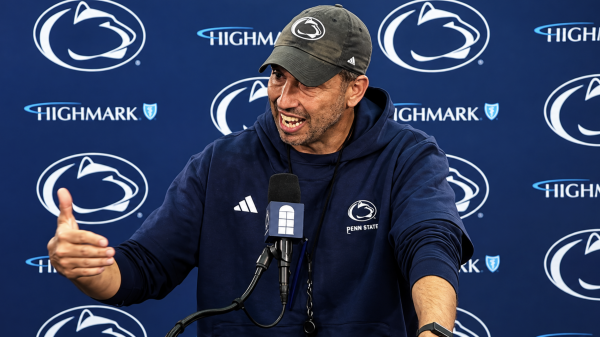
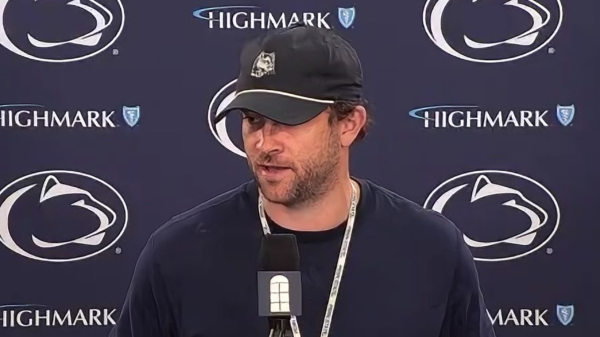








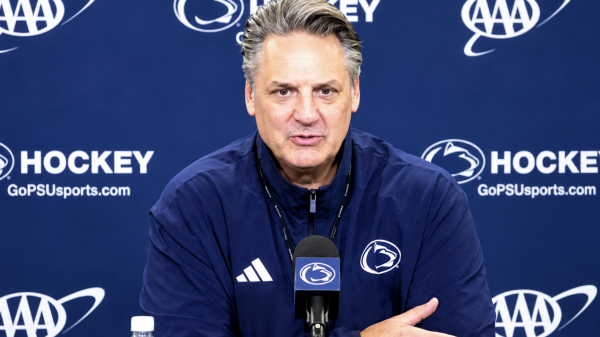




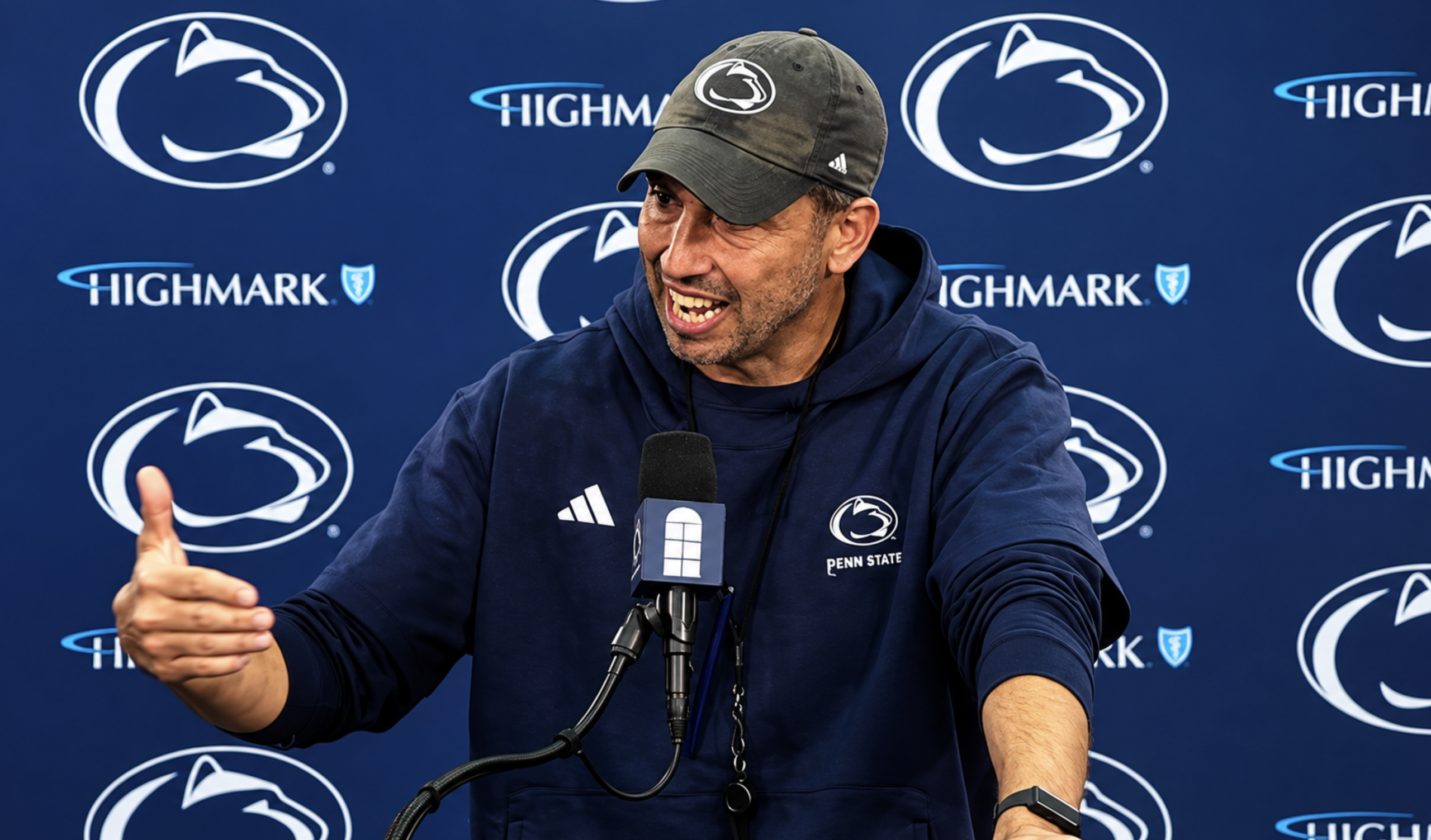
UNIVERSITY PARK, Pa. – Penn State head coach Matt Campbell met with reporters Tuesday to discuss the trip to Washington, the status of receivers Chase Sowell and Koby Howard, and what Cam Wallace showed in practice before his breakout game against Purdue.
How do you prepare for a trip like this, between the drive to Harrisburg and a roughly six-hour flight? Have you leaned on anyone for advice?
Campbell: We’ve had unique travel this year. We’ve had unique travel in our past, having to go east to west and west to east. Those are things you try to do a great job of in the offseason, knowing what’s on your schedule, what’s coming and trying to be a great planner. Penn State has had this trip the last couple of years, going to the West Coast. You try to take all the information and make the best travel plans possible.
The time of the game, all those kinds of things, are situations you want to navigate and handle. I don’t think it’s a debilitating situation.
You were more aggressive on fourth down Saturday. You’ve talked about game flow before. What about the flow of this game made you want to go for it?
Campbell: I think all of it is truly feel. Even in the game, there was the same fourth-and-one. One I went for, one I didn’t. Same place on the field, same deal. What was the difference? Early in the football game, it’s a close football game. You’re running the ball with some consistency, and you feel like there’s a momentum-maker opportunity.
If you look at our last four years, we’ve been right at the top of the country in fourth-down conversions. I think the reason for that is you’re trying to do what’s best for the moment and the situation. The reason I didn’t go for it later in the game was you’re up two scores, you’re playing good defense, and, man, you don’t want to give them the momentum coming back into the game.
Those are all situational, in my opinion. My responsibility is to try to get the flow and the rhythm of the game to give us a chance to win the football game. That’s how I take those decisions.
Do you have an update on Chase Sowell and Koby Howard? And how did Amarion Jackson play in his first significant action?
Campbell: You look at the two big runs. His blocks are at the forefront. Push-crack on the safety. They’re both coming off his big blocks. I’d start there.
I thought he did a great job with his opportunities. He made the most of them. That’s a little bit of the theme of last Saturday. Guys got their opportunity, and they made the most of it. I’ve always said that is college football. It’s our job to prepare them for their opportunities when they come their way.
Back to Chase and Koby, I think “probable” is the word I would use for Chase. I think he’s in a really good spot. I think Koby is still probably in the “questionable” category. We’ll have to see where he’s at. It’s the same thing I’ve said the last couple weeks. When he’s ready, we’re gonna try to make sure he’s on the field, but we’re gonna make sure he’s ready to go.
The defensive line got to Purdue’s ball carriers and quarterback behind the line of scrimmage. How did that group improve over the bye, and what can it build on against a Washington team that might be without its starting center?
Campbell: On both sides of the football, we really dug a mile deep. We have every step of the way, but I think it gave us some really great, tangible evidence of what we’re doing when we’re at our best.
We were able to simplify on both sides, especially on the defensive side. What was hurting us on some of those big runs that have come out against us? What are we doing really well when we’re playing great run defense? I thought we did a great job of that last week against a team that had shown the ability to run the ball really well against some good opponents.
Washington, they’re a physical front no matter who’s in the football game. Between their quarterback and the litany of backs they can put in the football game to run the football, we’re gonna have to do a great job of continuing to show that we can stop the run. It’s certainly the emphasis for who we want to be and what we want to become on both sides of the ball.
How has Alex Manske done in practice? Now that it’s November, do you want to get him some series to prepare him for the future?
Campbell: From a practice standpoint, Alex is growing. The question you’re asking is the right question. When the lights come on and you get the opportunity to play, what does it look like? If we get those opportunities to foster that, that’ll be great.
That is not my intent. My intent is this team playing its best football down the stretch. That continues to be our priority for our whole football team. But if those opportunities do exist, we’re gonna do everything in our power to try to get Alex in the football game.
How did you go about simplifying the run game during the bye week? And how did Brock Riker play? He looked more comfortable and healthier.
Campbell: The last thing you said is right. He’s healthy. If you look at his video from USC on, and then you look at the first three games, before he gets hurt at Buffalo, and you look at how that guy’s played the last three, I think you see a confident, healthy football player and a guy that’s playing really good football.
From the simplicity of the run game, it’s exactly what I said about the defense. You’re trying to figure out what the players can do. How do you best put them in position to be successful? Sometimes, as coaches, and I’m as at fault in this as anybody, you’re trying to over-scheme to put yourself in the best position in the moment.
 Add Nittany Sports Now as a preferred source in Google! Click here to add us.
When you get the ability to really sit down and digest it all, you go, OK, this is what we’re best at. Let’s make sure we’re fundamentally teaching and growing at what we can do best. That’s been the emphasis from USC on, to be quite honest with you. We had a little bit more time to fundamentally attack it during the bye week. We were able to find a little bit better rhythm in terms of how we want to run the football and what that needs to look like.
Why did you decide to leave for Washington on Thursday instead of Friday?
Campbell: The time of the game was really big. It’s a 12:35 start there, which would be 3:35 here. I felt like if we got in Friday, boy, you’re gonna be really pushing it.
In our past, we’ve done this trip a couple times. Even though we were in a different time zone, the Central time zone, if it was a day game, we tried to go on Thursday to get ourselves there, get settled in and, from a sleep standpoint, get on the best rhythm we possibly can and not lose sleep.
If it was a later game, maybe it would have been a different approach. But with the game time, plus the travel time, we felt like this was the best situation for us.
How did you get to know Cam Wallace and what he went through earlier in his career? What do you remember about the week he spent in the transfer portal in January and your conversations about keeping him in the program?
Campbell: The first time I met Cam was in the first 24 to 48 hours I was here. I met with every player here. I remember that conversation distinctly because there was frustration with where he was at, what was going on, obviously the injury. What I appreciated about him, it wasn’t like bitching and complaining. It was some of the situations that occurred with the injury, the frustration. I really appreciated him telling me his story a little bit that day, who he is, what’s going on in his own family, let alone the injury situation.
When we were putting the finishing touches on this roster, I called his aunt, who is a huge piece of his life. She’s been a great anchor. She and his grandmother have been a critical piece of his upbringing. They really wanted him to stay at Penn State. They wanted him to finish his degree. They wanted him to have the opportunity to compete.
I told him Saturday night after the game how proud his mother would be, how proud his grandmother and his aunt would be, because of the resilience, how he got his opportunity. You’ve got to earn it. Man, how’d this guy practice? What you guys saw Saturday is what was on the practice field for the last two weeks. It was cut and dried. It was easy.
As coaches, when it’s not cut and dried, it’s really hard to make tough decisions, especially when there’s competition and everybody’s competing to get on the field. When you leave it gray, we can make mistakes. When you don’t leave it gray, boy, you put yourself in a great situation, and then you capitalize on it.
That’s what college football is still about. These are young student-athletes growing into their best selves. It’s awesome to watch. It’s been a great sense of reality for the young players in our program to hear his story, to see it, to see the success and to see how it got earned. McDaniels has got a little bit of that with what happened to him Saturday night. Same thing. Earned the right to get on the football field, played really well in his moment. We talked about Amarion. That is college football. You hope you’re in a program where that’s getting evaluated every day. If it’s done right, those guys are getting on the field to get their opportunity.
Those are the two moments I distinctly remember about Cam. Once I talked to his aunt, 24 hours later he called and said he wanted to come back. We’re talking Sunday before the team meeting is when he decided to come back. Really grateful that he did, and really grateful to have him be a great example of what we want this program to look like and feel like on the inside.
Zay Robinson fair-caught two punts inside the 10 on Saturday. One led to a 96-yard touchdown drive. What did you tell him about when to make the fair catch and when to let the ball bounce?
Campbell: You don’t want to start on the 1. So you’ve got to figure out what you want to live with. The first one is a fair question. We knew they had a really good pooch punter. We put his heels on the 5. That first punt is drifting a little bit, but he’s not really backing up. We talked about it in the team meeting on Sunday.
I could’ve gone either way. If he chose to let that ball hit, it would’ve hit on the 3. But if you really studied the video, they were in a great position. It’s not like he was backing up to get it. He’s drifting across the 5-yard line, and it’s right on the 3. I’d rather have it on the 3 than the 1. You’re talking to the guy that’s lived on coming out at Kinnick on the 1-yard line, and that’s not real fun. We’ve lived that battle many a time. I trust our offense a lot more on the 3 than I do on the 1-yard line.
I think that’s a 50-50 decision. If he would’ve let that ball hit, I would’ve been fine. The other one, he came up to get it. It is inside the 10-yard line, but I think it’s all on the punter. What’s his consistency in the pooch-punting, sky-punting situation? If it’s an inconsistent punter, you’re gonna move your heels up to the 7 and allow a little bit more grace. The Purdue punter showed he was a really good pooch punter. That’s how we evaluate that each week. The first one, probably 50-50. The other one, I think he made a great decision.
How have starting cornerbacks Audavion Collins and Daryus Dixson improved? What have they given your defense, and what more do you want to see from them?
Campbell: Those two are very similar to the great players I’ve been around. What you see every single day in practice — Tuesday, Wednesday, Thursday — is exactly what you’re getting on Saturday. They are pros’ pros, in my opinion. These are guys that are mature. They love the game of football. Their detail, their precision, their consistency — it’s elite. They have been outstanding.
It’s really hard to be perfect, but I think those guys have played as close to great football every step of the way. They’re gonna continue to get challenged. A really talented receiving corps across the board, and a really good quarterback, or quarterbacks, that can get them the ball. What more you’d want is for them to consistently finish the way they’ve played all year. If they do, you’ve got a really special story to tell.
What those guys are teaching the young players in our locker room, I’ve always felt it when the best players are your best leaders. They prepare the same way. A.C.’s had to go up the rough side of the mountain to become a great football player. Nothing’s been handed to A.C. Collins. He’s demanded it every step of the way. I felt that way in spring ball. I felt that way at the end of fall camp. I’ve felt that way every day in practice. That guy loves football and demands to be his best.
With Daryus, the maturity. We gave him one of our spring practice awards, and it was an award for consistency. Every special teams rep, every rep he has. He was a 4.0 student in the spring. Those guys are the standard-bearers. This is the expectation. If we want to be great here, we want to play championship-level football, you’ve got to have championship humans at the top. Those two certainly stand for that for us.