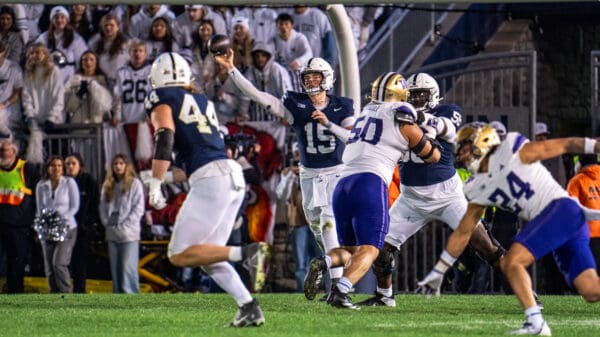












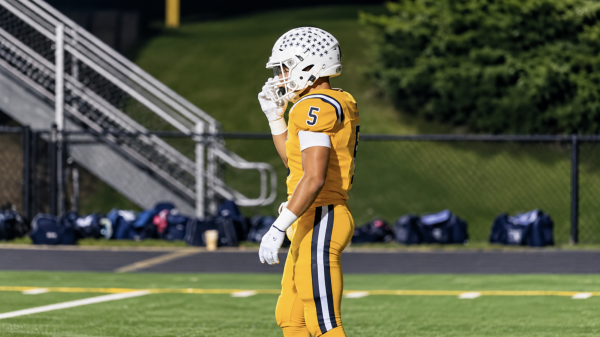

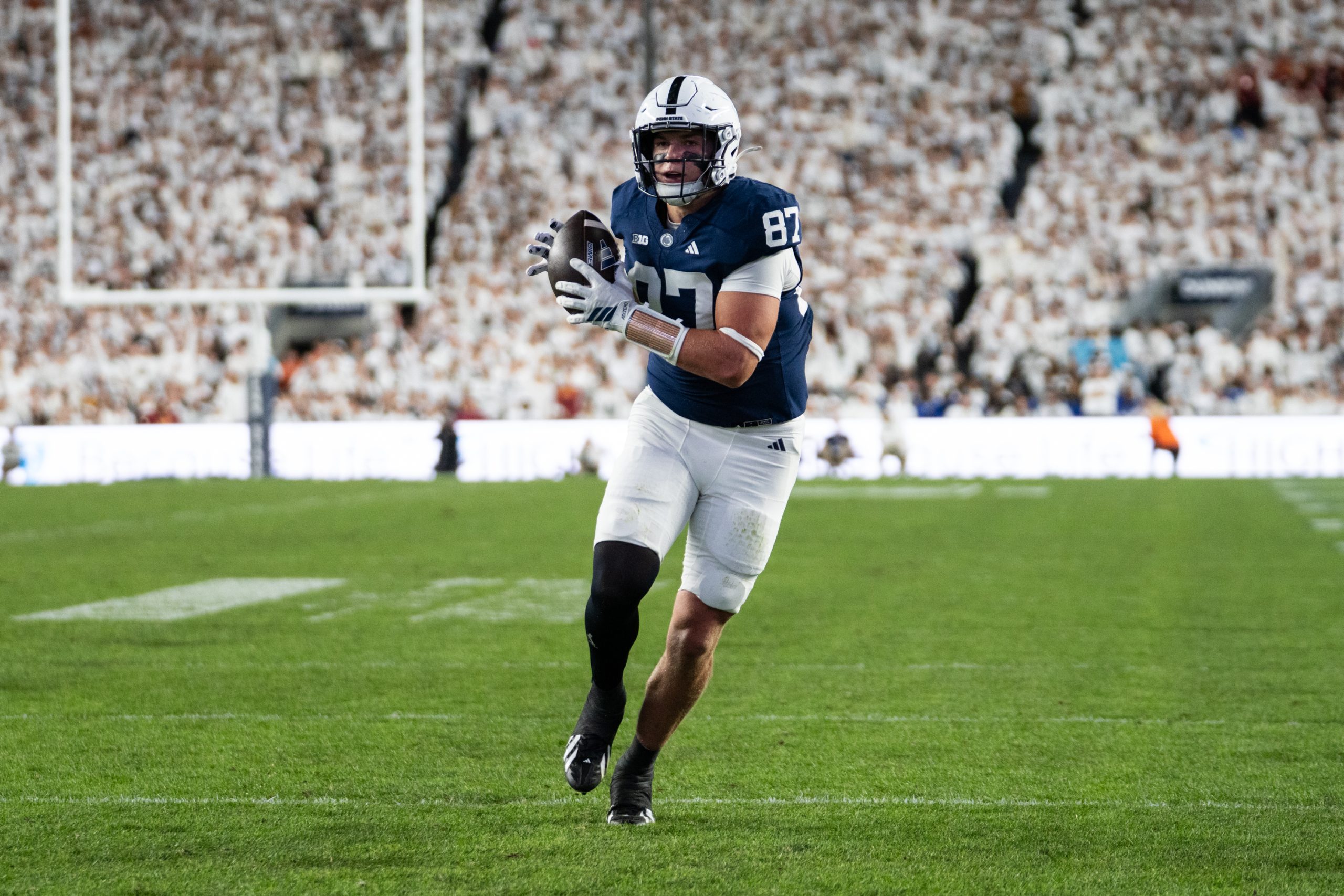
Penn State’s first touchdown drive against Purdue needed all three tight ends to get there.
Gabe Burkle helped move the offense away from its own goal line.
Ben Brahmer rescued the possession on a fake field goal.
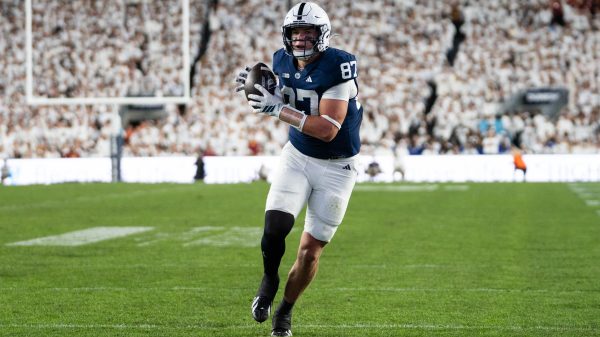
Andrew Rappleyea finished it in the end zone.
That sequence explained why this room mattered so much in Saturday’s 31-17 victory over Purdue for their first Big Ten win of 2026.
With the Nittany Lions top two wide receivers unavailable in Chase Sowell and Koby Howard, Penn State needed dependable receiving options without sacrificing the personnel to support its running game.
Burkle, Brahmer and Rappleyea gave the offense both.
“If I’m not in, Ben’s got me. If Ben’s out, then I’ve got him,” Rappleyea said.
The value of that arrangement showed up well beyond a shared position designation. These were three players accepting different assignments, with enough receiving ability across the group to make those assignments less predictable.
According to Pro Football Focus (PFF), Rappleyea played 65 offensive snaps, Brahmer 50 and Burkle 37.
Their combined workload reflected how heavily Penn State leaned on the position while adjusting to its depleted receiving corps.
The opening possession provided the clearest example.
Starting at Penn State’s 4, the Nittany Lions got breathing room when Burkle caught a 12-yard pass on second-and-6.
His only reception delivered an immediate first down and helped launch a 96-yard touchdown march.
Later, facing fourth-and-7 at Purdue’s 20, Penn State trusted Brahmer with the finish on Nathan Tiyce’s fake. Brahmer turned the holder’s pass into a 13-yard gain, taking the ball to the 7 and keeping the possession alive.
Two plays later, Rappleyea caught a four-yard touchdown pass from Rocco Becht.
Three tight ends, three consequential touches, seven points.
Rappleyea’s reliability became especially valuable after Purdue tied the game at 14.
 Add Nittany Sports Now as a preferred source in Google! Click here to add us.
On the ensuing touchdown drive, he converted third-and-8 with a 17-yard reception, then third-and-7 with a 12-yard catch. Carson Hansen eventually scored from a yard out, but Rappleyea twice prevented that possession from stalling.
His four receptions produced 45 yards and a touchdown. Brahmer added four catches for 58 yards, and Burkle’s reception brought the trio’s total to nine catches for 115 yards.
Those catches also complemented what Penn State wanted to accomplish on the ground.
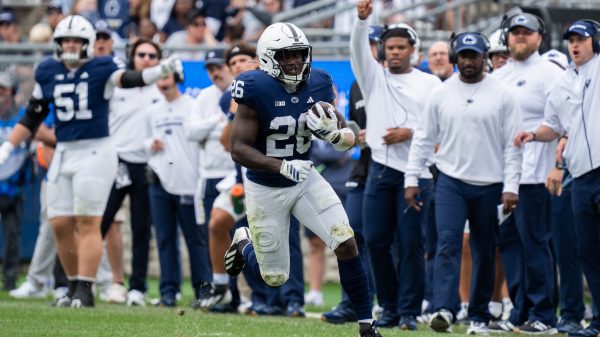
Cam Wallace rushed for 135 yards and Hansen added 96.
PFF charted Rappleyea with 38 run-blocking snaps, while Brahmer and Burkle each logged 27. Burkle blocked on 29 of his 37 offensive snaps, accepting a workload that offered little opportunity to collect receiving numbers.
“You need me to lead block and pull through the hole? I got you,” Rappleyea said.
That willingness to sacrifice their body to block when an offense needed to find a spark on the ground and remain credible targets when released into routes in the passing game was important.
Their contribution was the volume and flexibility they supplied within an offense that successfully leaned on its backs.
Brahmer then supplied the explosive catch that helped put Purdue away.
After a holding penalty had wiped a 26 yard run by Wallace in the fourth quarter, Becht found Brahmer down the middle for 33 yards. Wallace finished the drive with a two-yard touchdown, extending Penn State’s lead to 31-14.
Rappleyea’s description of Brahmer as a 6-foot-7 passing threat fit that moment.
His size and receiving ability gave Becht an answer when a penalty threatened to derail another scoring opportunity.
Burkle’s return from injury added another available contributor to that mix.
“Just having a room that can complement each other, and having no emotion to it, too,” Rappleyea said.
The mission for the group was to take a critical step forward in blocking consistency while preserving the trust that allowed Becht to turn toward this group in the game’s defining situations.
Penn State needed that cooperation against Purdue.
The tight ends sustained possessions, supplied blocking snaps and delivered when the offense needed a catch.
With two receivers missing, their willingness to share the work helped keep both halves of the offense functioning.