













Quarterback is the most important position in American sports.
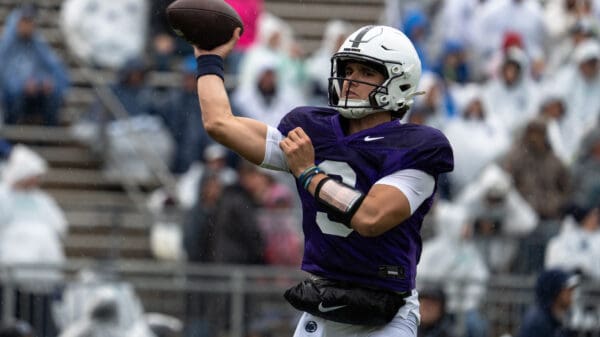
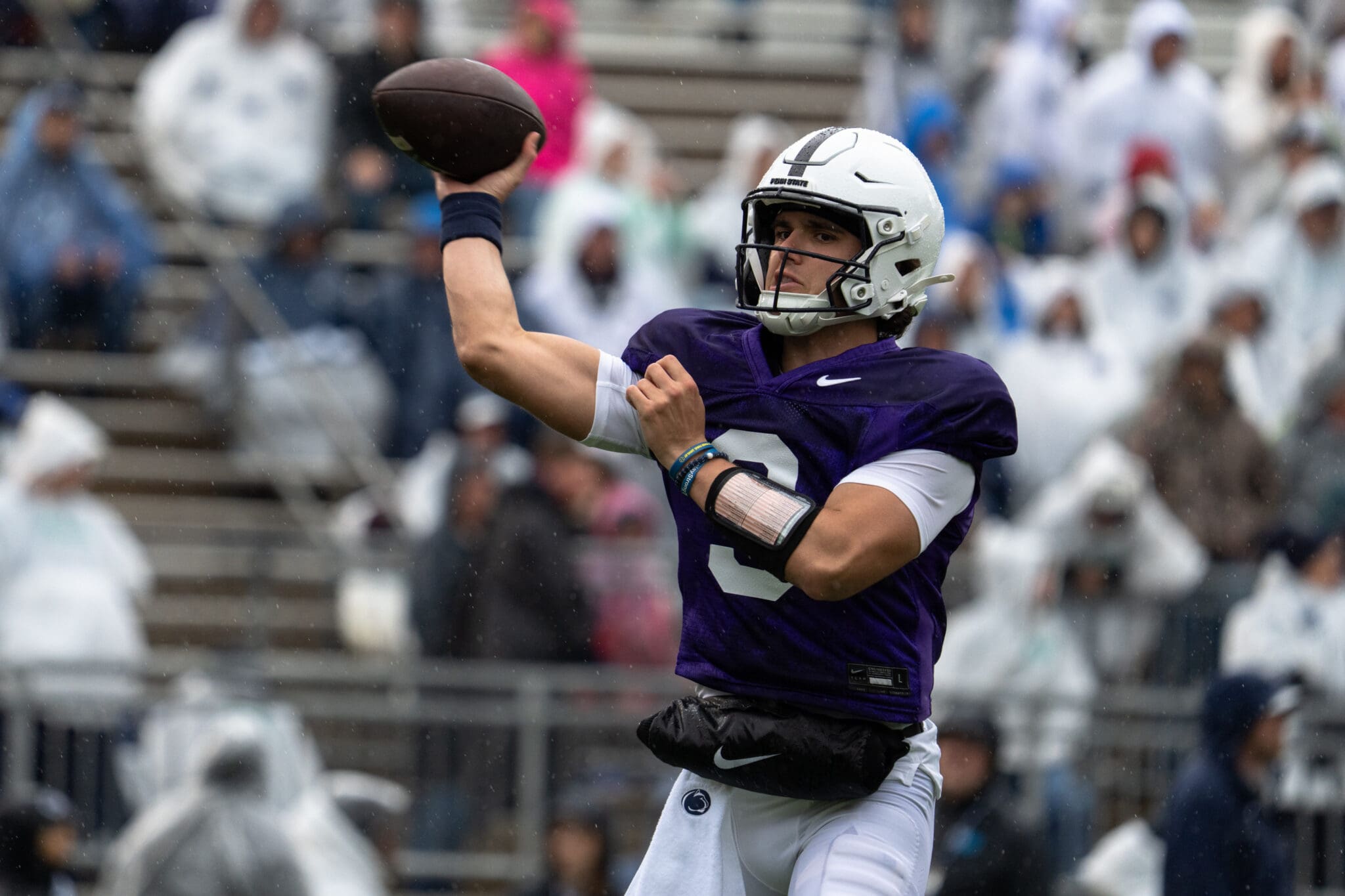
The fortunes of a college football program or an NFL franchise are often determined by how its quarterback performs. For Penn State, that reality has placed considerable attention on first-year head coach Matt Campbell’s decision to entrust the position to Rocco Becht.
The Athletic recently released the results of a survey ranking FBS quarterback rooms by tiers, placing Penn State near the top of Tier 3. That assessment is similar to the one offered by longtime college football analyst Phil Steele, who ranked the Nittany Lions’ quarterback room 33rd nationally in his preseason position-group index.
Campbell had to make a consequential decision shortly after arriving at Penn State. Because he took over much later in the coaching cycle than most new head coaches, he had limited time to evaluate the roster, build his staff and determine whether the Nittany Lions already had their answer at quarterback.
He had plenty of film on Ethan Grunkemeyer.
Grunkemeyer received a baptism by fire in his first three starts, facing three top-10 defenses in Iowa, Ohio State and Indiana. He struggled early, which was understandable considering the level of competition and his limited experience.
But as Grunkemeyer became more comfortable in the offense interim head coach Terry Smith wanted Andy Kotelnicki to employ, his play improved.
Over his final three starts, Grunkemeyer completed 76.1% of his passes and operated efficiently behind a veteran offensive line and a rushing attack led by Kaytron Allen and Nick Singleton.
When it came time for Campbell to commit to a quarterback, however, he apparently determined that Grunkemeyer, despite having multiple years of eligibility remaining, would not give Penn State a better chance to win in 2026 than Becht, who has only one season left.
From a roster-management perspective, Grunkemeyer likely wanted assurances about his future as well. He had more than six games of film documenting his growth and had shown enough improvement to believe he could compete for a starting job somewhere.
Campbell, meanwhile, is making a calculated bet.
With a favorable schedule and Becht’s familiarity with the offense Campbell and coordinator Taylor Mouser prefer to run, the wager is that a healthy Becht can help Penn State make an immediate splash.
There is also a longer-term element to the decision. Should Penn State’s younger quarterbacks fail to prove they are ready, the program could position itself as an attractive destination for another transfer quarterback next offseason.
College football has already shown what the right transfer can do.
Last season, Ole Miss rode Trinidad Chambliss to arguably the finest season in program history, reaching the 2026 College Football Playoff semifinal at the Fiesta Bowl before running into Miami. The Hurricanes also benefited from a transfer behind center in Carson Beck.
Becht has already demonstrated that he can lead a successful offense. At his best in 2024, he helped engineer the highest-scoring season in Iowa State history, with the Cyclones producing 435 points. He also guided the program to a school-record 11 victories.
The other side of Campbell’s wager, and the one many are watching cautiously, is Becht’s health.
Becht is recovering from offseason surgery to repair a torn labrum in his non-throwing left shoulder, along with a late-season AC joint sprain in his throwing shoulder. Since transferring to Penn State, his focus has been on conditioning and rebuilding his arm strength safely enough to enter the season fully healthy.
“I would say my spring went really good,” Becht said following Penn State’s final spring practice. “In the beginning, I wasn’t able to do a lot on the field, so I think building that chemistry in the film room and being a leader on and off the field for me was a huge step.
“I thought I had a good spring to develop in that way, develop in the offense, learn more of the protections, learn the run game, and I think I did a really good job of that.”
Becht has resisted the temptation to rush his recovery. His preference is to return fully healthy rather than carry lingering shoulder problems into the season.
 Add Nittany Sports Now as a preferred source in Google! Click here to add us.
Campbell understands exactly what Penn State is getting.
“His leadership and his humility and just his toughness and grit were huge pieces of why we had the success we did at Iowa State,” Campbell said. “Some of the greatest moments in the program’s history are under Rocco.”
Campbell’s decision to turn to Becht over Grunkemeyer represents a bet on experience, toughness and dependability.
Becht is not an overwhelming physical talent, but he has shown that he can operate an offense within the structure Campbell and Mouser want. When he maintains his pocket presence and uses his compact release, he has enough arm strength to attack tight windows and make throws outside the numbers.
The comparisons to last season’s Indiana national championship team will be prevalent. Fernando Mendoza was not highly sought after, but his ability to operate within the framework established by head coach Curt Cignetti and offensive coordinator Mike Shanahan allowed him to maximize his skills, win the Heisman Trophy and become the top selection in the 2026 NFL Draft.
Becht also provides more athletic value than his appearance might suggest. He scored 19 rushing touchdowns at Iowa State and has the strength to contribute in short-yardage situations.
The wager still comes with legitimate risk.
From a scouting perspective, Becht can become hesitant when his first read is covered, hold the ball too long under pressure and struggle to create consistently when a play breaks down. Those issues have led to coverage sacks and unnecessary punishment. His short-range accuracy has also been inconsistent, occasionally limiting yards after the catch.
Other circumstances may have contributed to those problems. Iowa State struggled with dropped passes, which could have disrupted Becht’s rhythm, and the quality of the offensive play-calling was frequently questionable.
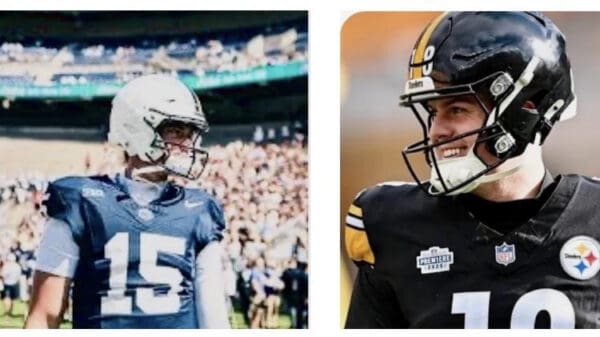
At his best, however, Becht resembles a slightly more athletic version of Brock Purdy. He plays with poise, throws with touch and is willing to move outside the pocket when the original play breaks down.
Campbell knows Becht’s strengths and limitations better than anyone. He has seen the quarterback’s toughness, leadership and inconsistency at close range, yet appears willing to bet that Becht’s best football remains ahead of him.
Penn State is counting on improved health, better support and Becht’s familiarity with Campbell’s system to bring out the most consistent version of the quarterback.
Choosing Becht over Grunkemeyer is not necessarily about pursuing the player with the highest long-term ceiling. It is about trusting a veteran whom Campbell already understands to give Penn State its best opportunity to win now.
Entering the 2026 season, Becht leads all returning FBS starters with 26 victories.
Questions about Penn State’s future at quarterback will remain. That is understandable considering the program has relied on only three primary starters over the past decade in Trace McSorley, Sean Clifford and Drew Allar.
College football coaches, however, are increasingly choosing to win big now rather than wait for tomorrow. That is not how Campbell will want to operate forever, and Penn State’s commitment from Hopewell Class of 2028 quarterback James Armstrong reflects an effort to build a more stable future at the position.
As of this writing and taking into account logic, Campbell made the correct decision, even if it becomes an uncomfortable one a year from now with uncertainty under center. When Pat Kraft was able to land Campbell, Kraft wanted immediate returns. For Campbell to produce those results Becht gives him a better chance to do that than a younger quarterback still learning how to win at this level.
For now, Campbell is betting that a strong first season with Becht can create momentum, give Penn State time to develop its younger quarterbacks and make the program more attractive to another transfer if one is needed.
Whether that gamble pays off could determine more than Penn State’s success in 2026. It could shape the foundational years of the Matt Campbell era.