










One of the defining features of Penn State’s landmark 2025–26 season has been the infusion of elite CHL talent that has elevated expectations far beyond simply reaching another Frozen Four. The Nittany Lions added high-end players capable of shifting the program’s ceiling and the early returns have justified the hype.
When you bring in a generational talent like Gavin McKenna, widely projected as the No. 1 overall pick in the 2026 NHL Draft in Buffalo, and a premier defenseman such as Jackson Smith, the Columbus Blue Jackets’ top selection in the 2025 NHL Draft, the dividends tend to arrive quickly.
But another addition is now beginning to pay off in equally meaningful ways.
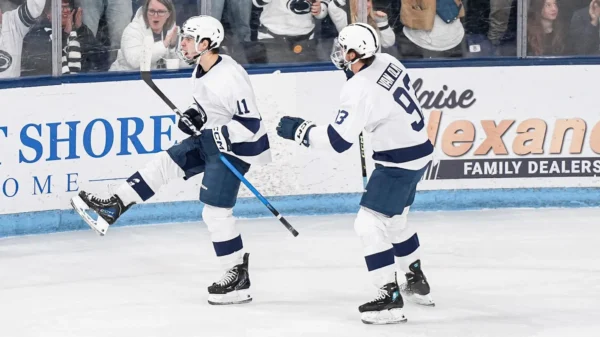
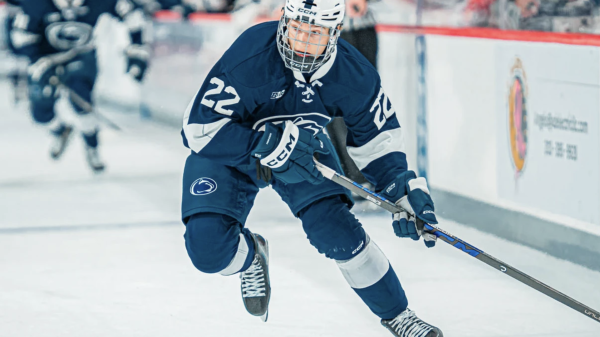
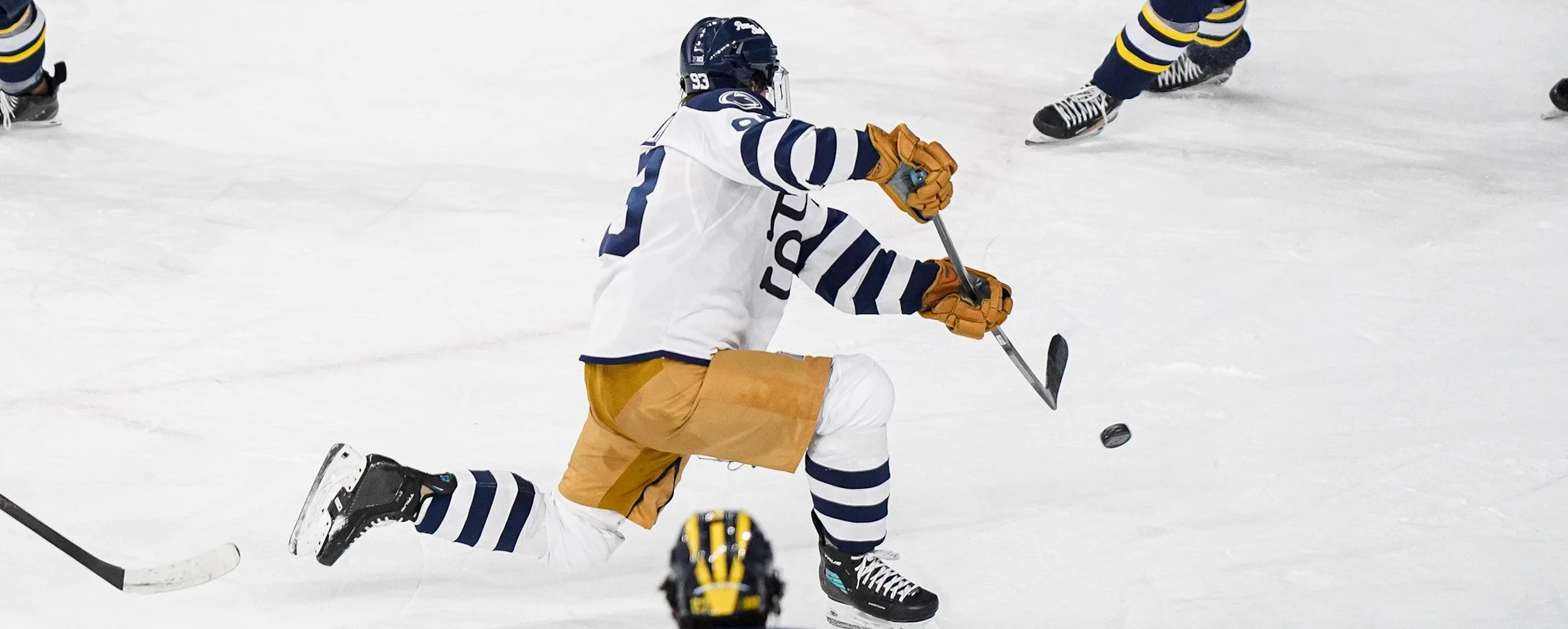
Calgary, Alberta native Shea Van Olm is starting to emerge as the physical force Penn State envisioned when it recruited him out of the Western Hockey League.
Van Olm built his reputation in junior hockey with the Spokane Chiefs, where he led the WHL with 49 goals and powered the Chiefs to a league championship series appearance against McKenna’s Medicine Hat Tigers. He arrived in Hockey Valley with a proven scoring résumé and the label of a prototypical modern power forward.
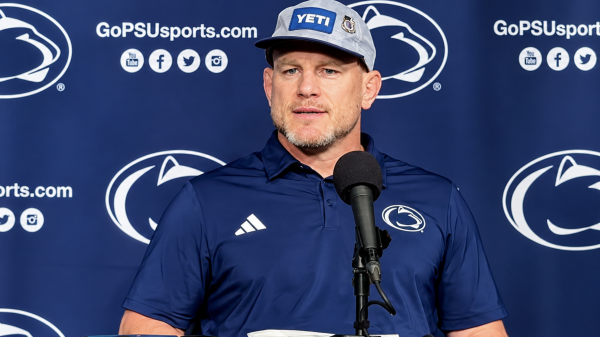
Yet transitioning from the CHL, particularly the rugged Western League, to NCAA hockey is not seamless. Penn State head coach Guy Gadowsky has repeatedly emphasized that reality.
“He was also a really, really tough kid. And so he sort of plays dual roles. He’s a goal scorer, but he’s also a power forward,” Gadowsky said. “And I don’t think the goal scoring was much of an issue. I think it was a matter of him finding a way to play the top power-forward game under NCAA rules. And he’s really focused on it. He’s really working at it. It’s not as easy as you would think.”
A power forward is a rare blend of a player who combines size, strength, physicality, and scoring touch.
The best power forwards produce offense while thriving in high-contact areas: along the boards, at the top of the crease, and in the trenches where games are decided.
History shows that even elite power forwards face adjustment periods when they elevate to higher levels.
Hockey Hall of Famer Brendan Shanahan serves as a classic example. Shanahan remains the only NHL player in history with over 600 career goals and more than 2,000 penalty minutes.
Early in his career, however, he struggled to define his identity.
“He came in very young, really wasn’t ready to play in the NHL, but he found a way to get in the lineup when he was put on a fourth line,” legendary executive Lou Lamoriello once said. “He decided, ‘Well, I’ll fight, and I’ll show them I belong here.’ We finally sat down with Brendan and said, ‘We didn’t draft you to be a fighter. We drafted you to be a power forward who can score.’”
While fighting is not permitted in NCAA hockey, the lesson resonates.
Power forwards must walk a fine line between playing physically and playing recklessly.
Van Olm experienced that learning curve firsthand.
 Add Nittany Sports Now as a preferred source in Google! Click here to add us.
Through the opening month of non-conference play, he managed just one goal and frequently found himself skating on the fourth line, searching for traction. The frustration of adjusting to NCAA officiating and tempo surfaced on January 23 against Wisconsin. Returning from an injury sustained in the January 4 matchup against RIT, Van Olm was on the penalty kill during an unusual sequence in which Penn State was assessed a penalty before the opening puck drop.
Later, he delivered a heavy hit on Wisconsin captain and defenseman Ben Dexheimer that resulted in a game misconduct. It marked a low point in what had been a challenging transition stretch.
Since then, however, Van Olm has turned a corner.
Beginning with the January 31 Outdoor Game at Beaver Stadium against top-ranked Michigan State, Van Olm has recorded four goals in five games while significantly cutting down on penalties, taking only two minor infractions during that span.
“If he can continue that going forward, we will be a much better team,” Gadowsky said.
The timing could not be more critical.
Penn State’s forward depth has been severely tested. Following captain Dane Dowiak’s injury, the Nittany Lions have been reduced to just nine healthy forwards. Until Braedon Ford and Charlie Cerrato return, role clarity and discipline are essential to weathering the stretch run.
That responsibility has fallen squarely on players like Van Olm.
“With the expanded role, he’s just a guy who kept working and working and wanting to help the team,” Gadowsky explained. “He knew he had to adjust his game. It’s a very fine line between playing the way he has to play to be effective as a power forward and staying out of the box. You’ve got to give him credit he’s working really hard.”
The growth is evident. Van Olm is winning board battles without crossing the line. He is screening goaltenders without drawing retaliation penalties. He is finishing checks, but finishing shifts.
And perhaps most importantly, he is scoring.
If Penn State intends to contend with the nation’s elite, including top-ranked Michigan State and Michigan, each boasting multidimensional power forwards in Porter Martone and Will Horcoff, the Nittany Lions need Van Olm to fully embrace and master this role.
McKenna may be the headline attraction. Smith may anchor the blue line. But championships are often decided by players who do the heavy lifting.
Shea Van Olm is beginning to look like Penn State’s ultimate power forward and just in time.