





















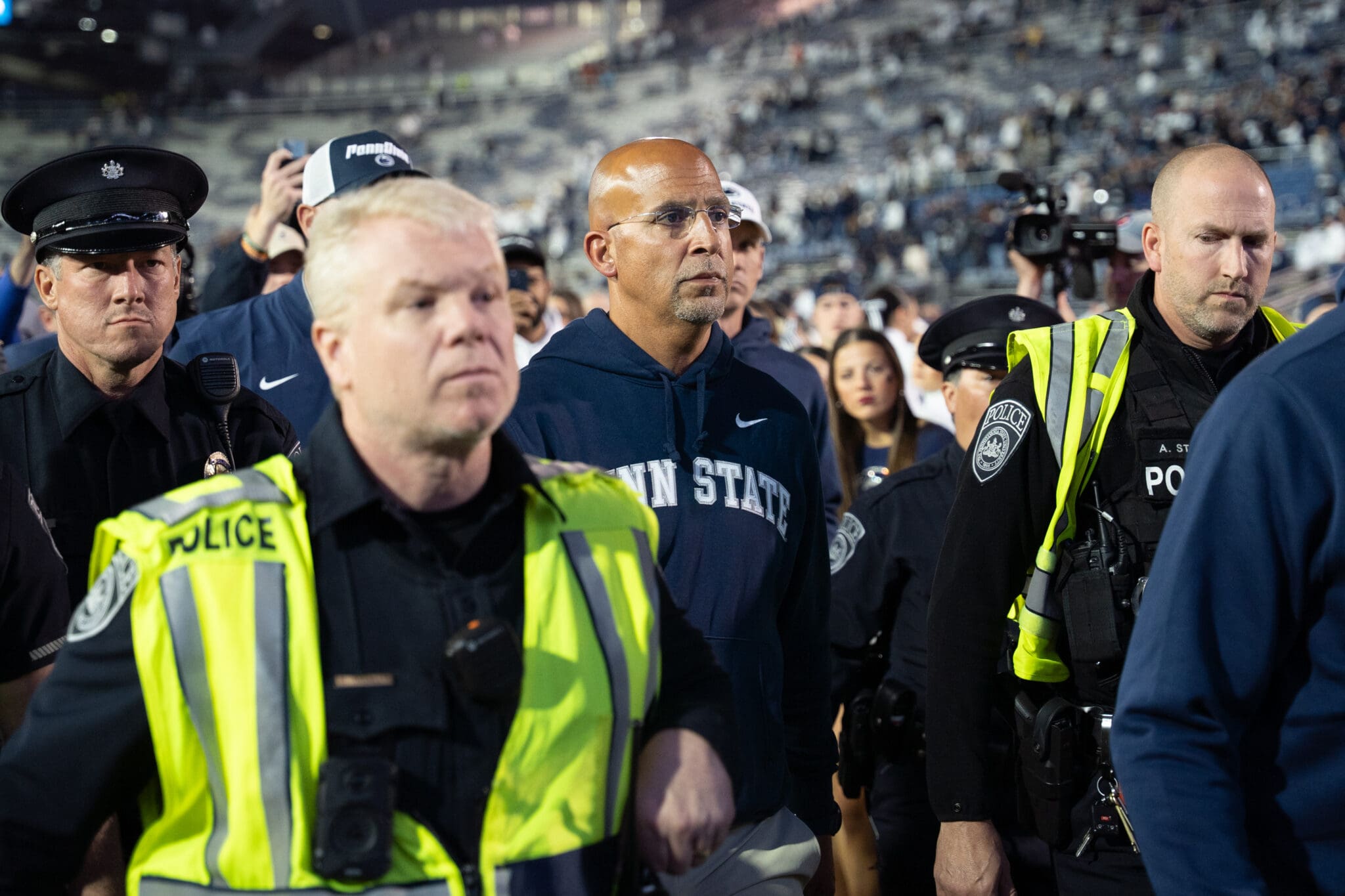
James Franklin did not sound like a coach still fighting to prove Penn State made the wrong decision.
He sounded like a coach who, perhaps unintentionally, explained why the decision had already become inevitable.
In a wide-ranging interview with Adam Breneman, Franklin was emotional, reflective, honest and, at times, still wounded by how his 12-year run at Penn State ended. He spoke with pride about what he built, frustration over how quickly it ended and appreciation for the players, staff and families he left behind. But beneath all of that was the central truth of big-time college football and Franklin said it himself.
“Ultimately, it’s about winning,” Franklin said. “If you don’t win, it don’t matter.”
That line is the whole column.
For years, Franklin’s defenders could rightly point to context.
He took over Penn State at one of the most difficult moments in modern college football history. The roster was damaged. The scholarship situation was abnormal. Franklin noted that when he arrived, most programs had 16 to 22 scholarship offensive linemen, while Penn State had roughly four.
Franklin built himself a hall of fame coaching resume for taking Vanderbilt to heights it hadn’t seen in a century and stabilizing a Penn State program, recruiting at a high level, winning the Big Ten, reaching New Year’s Six bowls and restoring the Nittany Lions into the national conversation.
But Franklin also admitted the statute of limitations on that argument had expired.
“After 12 years, again, nobody cares about what the program was like when you got there,” Franklin said.
That is the pivot point. That is the difference between appreciation and accountability.
Penn State fans can appreciate what Franklin did and still believe his time had run its course. Both things can be true. He rebuilt the floor of the program. He made Penn State stable again. He recruited well enough to make the Nittany Lions nationally relevant. But the job changed once the rebuild was complete. The standard was no longer recovery. The standard became championships.
And by Franklin’s own admission, Penn State did not take the final step.
“We won a bunch of big games, played in a bunch of New Year’s Six bowl games, won two playoff games, did a ton of really good stuff,” Franklin said. “But ultimately it’s about winning national championships, and we weren’t able to take that last step.”
That is not the fan base being unreasonable. That is Franklin defining the standard.
 Add Nittany Sports Now as a preferred source in Google! Click here to add us.
The interview also revealed something else: the final season was not merely a case of bad luck or outside negativity. Franklin acknowledged that he changed his own formula. He said Penn State became “aggressive and bold” and took on risks he normally would not have taken. He admitted the program talked about things differently, moved away from the strict 1-0 messaging and tried to do something different to “move the needle.”
That is understandable. Penn State was close. Franklin believed the program needed to stretch to reach the next level. But the most telling part was his conclusion.
“I think we took on too much risk in too many different areas,” Franklin said.
That matters because it cuts against the idea that his firing was simply an emotional overreaction. Franklin essentially described a program that recognized it was close, altered parts of its identity to chase the final step, and then lost control of the formula that had made it successful.
He specifically pointed to hires. Franklin said Penn State made “great hires on a resume,” but questioned whether they were the “right fit at the right time.” He said the program had a system for offense, defense and special teams, but “got away from that.”
That is a major admission. At a place like Penn State, a head coach is not only judged by recruiting rankings and bowl appearances. He is judged by staff construction, program identity, adaptability and whether the machine is still moving forward. If the head coach himself is saying the staff fit was wrong, the messaging changed and the risk became too much, then the case for change becomes stronger.
None of this means Franklin deserved to be treated without grace. He said he felt blindsided, claiming there was “no conversation at all” before he was told it was over 20 minutes before a team meeting. He said he had to call his wife and daughters before they found out on social media, then address the players for the final time.
That is brutal. After 12 years, Franklin had earned a more dignified ending than that. He had earned a conversation. He had earned respect for what he built.
But earning respect is different from earning more time.
The most revealing part of the interview might be that Franklin could not even watch Penn State afterward. He said he could watch college football, but not Penn State, because there were too many emotions involved. That is human. It also confirms how heavy the relationship had become.
By the end, Franklin’s Penn State tenure was no longer just a football arrangement. It was emotional, complicated, successful, frustrating and exhausted. The program needed a new voice. Franklin needed a reset. Virginia Tech now gets a motivated coach with a chip on his shoulder, and Penn State gets a chance to redefine its ceiling.
Franklin should be remembered as the coach who brought Penn State back.
But his own words show why he was no longer the coach to take it all the way.