














We’re all guilty of placing blame for a football loss on the most consequential play — the one that appears to decide the outcome. Typically, that happens because a team overcomes numerous obstacles to position itself to win, only to fail at the final hurdle.
Take last season’s Orange Bowl, a College Football Playoff Semifinal. Many point to Drew Allar’s interception to Notre Dame’s Christian Grey, but overlook the many missed opportunities before that moment — Allar’s failed connection with Nicholas Singleton in the flat that could have been his fourth touchdown, or Jaden Greathouse’s scores where two Penn State defenders whiffed, falling down or getting their ankles broken. There were plenty of missed throws and wasted chances that built up to that defining mistake.
You get the message.
Last night’s loss to Iowa was another case of Penn State falling victim to the “domino effect” — a chain reaction of small breakdowns that led to its ultimate collapse.
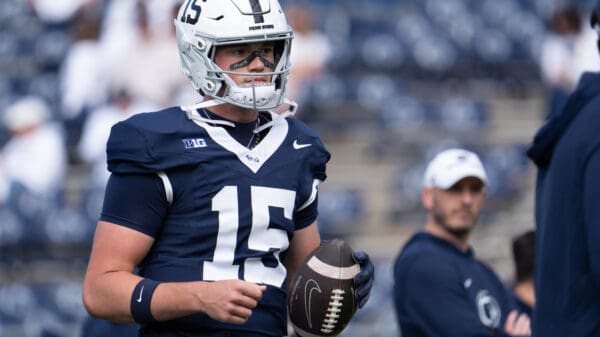
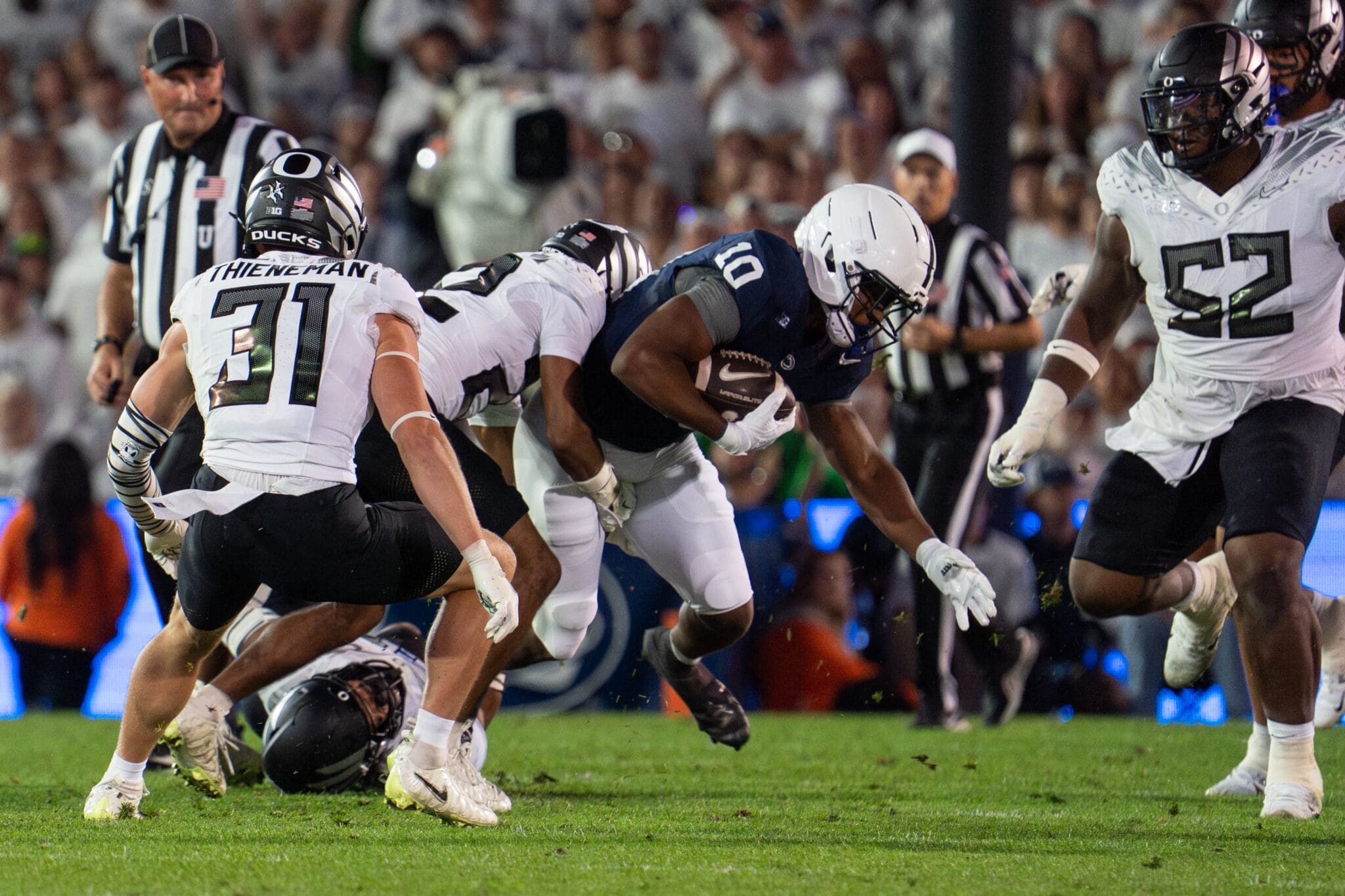
The first domino fell late in the first half, when quarterback Ethan Grunkemeyer’s pass ricocheted off tight end Luke Reynolds’ shoulder pads and into the hands of Iowa defensive back Xavier Nwankpa, setting up Mark Gronowski’s first rushing touchdown.

Ethan Grunkemeyer pass intended for Luke Reynods deflected off his shoulder pads for an interception for Iowa
Reynolds was involved again late in the third quarter. On a fourth-and-short, offensive coordinator Andy Kotelnicki dialed up a play similar to what he ran last season with Tyler Warren, giving Reynolds the carry. This time, he was stuffed for no gain — a puzzling decision to take the ball out of the hands of the team’s only true playmaker, Kaytron Allen.
Warren had about 20 extra pounds of muscle that helped him power through short-yardage situations a year ago. That physicality was sorely missed on that critical down, especially when the offensive line didn’t get the necessary push to aid Reynolds.
On Penn State’s final drive, the same pattern emerged. Singleton got the call on the penultimate play — again, taking the ball out of Allen’s hands.
It may seem I am pushing Allen here, but if you take away all of Allen’s efforts, the Penn State offense had 2.7 yards per play – breathtakingly low.
To put that in perspective: USC leads the nation at 7.9 yards per play. UMass is last at 3.9.
I didn’t mind using Singleton, but why not put him in space to leverage his speed for a potential explosive play?
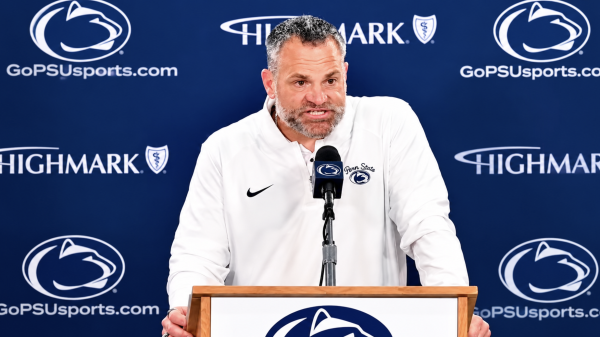
It was a night when the passing game never found traction, something interim head coach Terry Smith acknowledged afterward.
“On offense, we continue to not be able to throw the ball down the field, or even throw the ball in the intermediate zone. So we’ve gotta get that fixed,” Smith said.
That limitation was clear on a crucial fourth-quarter drive, when Grunkemeyer misfired to Trebor Pena on first-and-goal from the 10 that led to a Ryan Barker short field goal.
The offense managed to hand the defense a slim lead with under five minutes to play — setting the stage for the final, fatal domino.
 Add Nittany Sports Now as a preferred source in Google! Click here to add us.
On Iowa’s first play of the ensuing drive, Gronowski kept the ball on a read-option. Linebacker Dominic DeLuca attacked the gap to contain him but was sealed off by offensive lineman Trevor Lauck. As safety King Mack froze in hesitation, a lane opened up as wide as the Field of Dreams, and Gronowski burst through for a 67-yard gain that set up the decisive touchdown.

Iowa quarterback Marc Gronowoski rushes for 67 yards to defeat Penn State
Defensive coordinator Jim Knowles’ run defense has been nothing short of disastrous during Big Ten play.
Over the course of the current four-game losing streak, Penn State has surrendered 202.3 rushing yards per game – including allowing two quarterbacks rush for over 100-yards.
The inability to account for the quarterback sneak cost them twice down the stretch. Beside the Gronowski 67-yard run, on the game sealing third and six play, he was able to bootleg uncontested – a common theme over the last month.
Since 1947, only two Penn State defenses have been worse against the run over a full season: the 2001 team (206.2 yards per game) and the 2003 squad (209.1), which this group is beginning to resemble. That 2003 team finished 1–7 in Big Ten play and became the first in program history to lose six straight conference games — a fate this year’s team is dangerously close to repeating with Ohio State and Indiana ahead.
Each of this season’s four losses has come by the same pattern: a chain reaction of small mistakes that snowball into defeat.
It doesn’t help that the two coordinators once regarded as one of the nation’s best combinations have grossly mismanaged the roster and scheme, leaving the team underprepared and inconsistent.
Last year’s Nittany Lions were composed and resilient, rarely letting games spiral out of control. They recognized when the margin for error was thin — and made plays to win.
This year, from the top down, everyone seems to be searching for answers.
The reality?
The answer is right in front of them.