














With Gavin McKenna officially declaring for the 2026 NHL Draft, the hockey world begins looking backward as it tries to assess its future.
That is what happens with prodigies.
The comparisons start. The names surface. The measuring sticks come out.
But with McKenna, there is a different twist.
His story, a CHL prodigy making the jump into the NCAA ranks, is virtually unheard of. It also could prove to be trailblazing.
In the documentary The McKenna Project, McKenna said he did not want the easier route of playing another year at the junior level, where he easily could have averaged two or more points per game.
During the 2026 IIHF World Junior Championship with Team Canada, McKenna posted 14 points, four goals and 10 assists, in seven games. He was not being challenged the way he would be in the NCAA, where he would face players three or more years older than him, including some who were physically mature 23- or 24-year-olds.
That was the ultimate test for NHL scouts: how would the Whitehorse, Yukon, native transition?
Was there a struggle?
Absolutely.
But once McKenna acclimated to the speed of the NCAA game, it became almost unfair.
Following his dominant World Junior performance, McKenna closed the regular season with a blistering stretch from Jan. 9 through March 6. Over those 16 games, he erupted for 10 goals, 20 assists and 30 points, scoring at a 1.88 points-per-game pace.
That turned the second half of Penn State’s season into less of a freshman breakout and more of a prodigy confirmation.
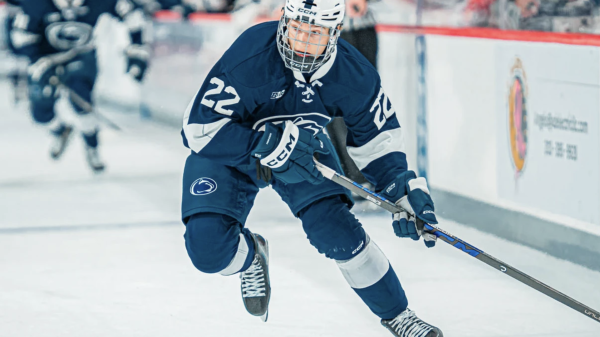
McKenna finished with 51 points, including 15 goals and 36 assists. He set Penn State freshman records for points and assists, broke the program’s single-season assist record, became the first Penn State player to win the Big Ten scoring title with 38 points in league play and was named a Hobey Baker Award finalist.
Comparing McKenna to previous prodigies always produces a few familiar names, past and present.
My measuring stick for hockey prodigies starts with Mario Lemieux, and passing Lemieux is highly unlikely.
Lemieux was recently named the top CHL player of the last 50 years, and what he did for Laval in the QMJHL during his final junior season may never be replicated: 133 goals and 282 points in 70 games, an average of more than four points per game.
Some may wonder what Lemieux would have done on McKenna’s path. My response is simple: Lemieux averaged nearly two points per game in his NHL career. There was nothing he could not do.
Sidney Crosby is next on my measuring stick.
From a playing-style perspective, Crosby and McKenna could not be more different.
McKenna is closer to the modern rush-creator archetype, while Crosby became the model for the franchise center whose offense was only one part of a complete 200-foot game.
The similarities come with the expectations.
Crosby was dubbed “The Next One” as a teenager. McKenna has been profiled on Canadian television since he was 12 years old.
In that regard, McKenna measures up well.
As shown in the documentary, McKenna is not the first elite athlete to deal with constant criticism through a device he carries with him everywhere. But it is still something to monitor.
 Add Nittany Sports Now as a preferred source in Google! Click here to add us.
McKenna used the phrase “pressure is privilege,” and that mindset should serve him well.
Boston University Hobey Baker Award winner and current San Jose Shark Macklin Celebrini might be a closer comparison.
Celebrini’s draft profile was built around pace, competitiveness, middle-lane drive, transition offense and a motor that impacted both sides of the puck. Celebrini was described by scouts as a highly competitive offensive catalyst who wanted to be involved in every play, while other scouting analysis emphasized his ability to drive play in different areas and his strong off-puck intelligence.
Much of the Celebrini comparison centers on offensive creation. He became the third-fastest teenager in NHL history to reach 90 points, behind only Crosby and Wayne Gretzky.
That type of offensive comparison is why some in western Canada have connected McKenna to Connor McDavid.
McDavid trails only Wayne Gretzky for the most scoring championships in NHL history.
But McDavid comparisons can get reckless quickly if they are not framed properly.
The relevant comparison is not pure speed. It is the way elite prospects force defenders to make choices before they are ready.
McKenna’s gift is how he processes the game steps ahead of everyone else. That anticipation allows for maximum creativity.
McKenna is a disruptor on and off the ice. His path was not traditional, but neither was the path taken by Vegas Golden Knights forward Jack Eichel or potentially his future Toronto teammate Auston Matthews.
Matthews disrupted the normal development track by going to Europe and playing professionally for the ZSC Lions in Zurich, Switzerland. Eichel gave college hockey a true one-and-done superstar at Boston University.
McKenna’s Penn State season belongs in that kind of conversation because his commitment was viewed as a major moment for the NCAA, the CHL/NIL landscape and Penn State hockey’s credibility. ESPN described his Penn State commitment as a game-changer after he produced 129 points in 56 WHL games with Medicine Hat.
McKenna did not pass through Penn State as a curiosity.
He became the measuring stick for what Penn State hockey can now attract, market and build around.
For Crosby (Rimouski), McDavid (Erie) and Matthews (Zurich), the program was merely the stage.
For McKenna, Penn State became part of the story.
His season did not just validate him. It validated the idea that Hockey Valley can be more than a competitive Big Ten program. It can be a place where the sport’s next great prospect spends one of the most important years of his development.
That is where McKenna belongs in the prodigy conversation.
Not as the next Crosby, the next McDavid, the next Matthews or the college version of Eichel.
He belongs there because the sport is already doing with him what it only does with a select few.
It is watching the present and talking about the future at the same time.
Penn State got to host that future for a season.
Now the question is no longer whether Gavin McKenna was special in Hockey Valley.
It is how long it takes the rest of hockey to find out just how special.