








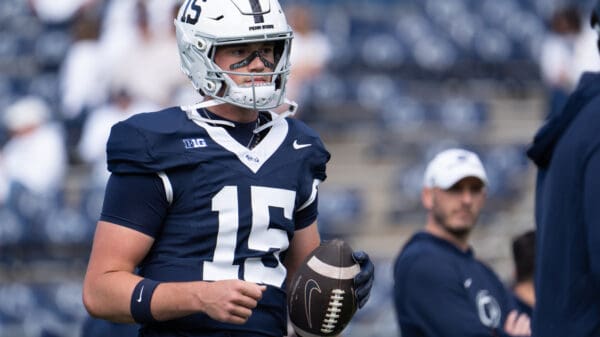



For all the criticism surrounding Penn State’s defense through seven games, one position group has quietly established itself among the best in college football.
While the Nittany Lions have struggled to stop the run and generate consistent pressure on opposing quarterbacks, their secondary has been remarkably effective at limiting production through the air.
The numbers tell a compelling story.
Penn State ranks fourth nationally and first in the Big Ten in passing defense, allowing just 141.3 yards per game. If that average holds, it would represent the program’s lowest passing yards allowed per game since 1980.
That’s an extraordinary accomplishment considering Penn State’s 3-4 record and winless start to Big Ten play.
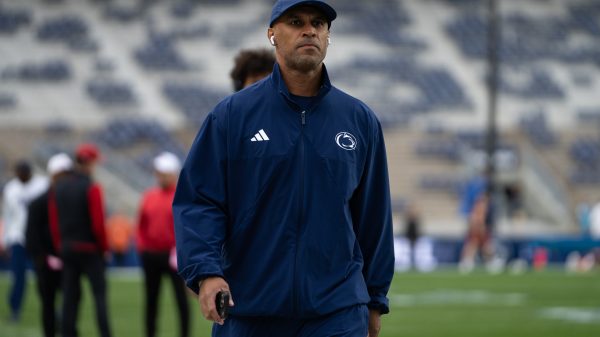
More importantly, it demonstrates that defensive coordinator D’Anton Lynn, assistants Terry Smith and Deon Broomfield has assembled a secondary capable of producing at an elite level despite the struggles elsewhere on his defense.
Led by Audavion Collins, Zion Tracy, Daryus Dixson, Jeremiah Cooper, Jamison Patton and Josiah Zayas, Penn State’s defensive backfield has become one of the few consistent bright spots in a frustrating season.
Audavion Collins Has Emerged as a Shutdown Corner
Perhaps no player better represents Penn State’s secondary success than Collins.
According to Pro Football Focus (PFF), Collins has allowed just four receptions on 14 targets across 150 coverage snaps, surrendering only 28 receiving yards.
Opposing quarterbacks have completed just 28.6% of their passes when targeting Collins, averaging seven yards per completion.
His 78.8 coverage grade reflects the consistency he’s demonstrated throughout the season.
Collins also has five pass breakups in PFF’s charting, while Penn State’s official statistics credit him with eight, ranking ninth nationally.
His performance earned him first-team midseason All-American recognition from Sports Illustrated.
For a defense that has struggled to create pressure up front, Collins’ ability to eliminate passing opportunities has been particularly valuable.
Quarterbacks aren’t finding much success challenging him, and his production has made him one of the nation’s most effective coverage defenders.
Zion Tracy’s Versatility Gives Lynn More Options
If Collins represents consistency, Tracy provides versatility.
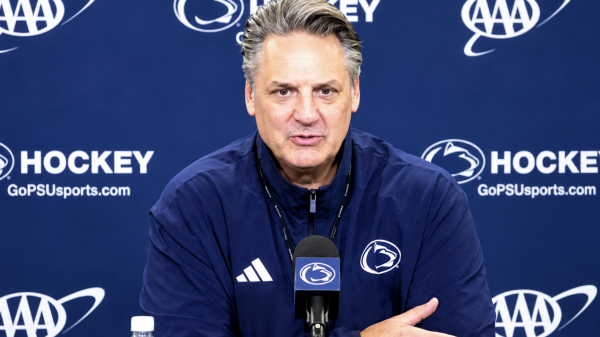
Lynn explained Tuesday why Penn State has increasingly utilized Tracy at safety, particularly against USC and Michigan.
“Zion’s a guy who can play boundary safety, he can play field safety, he can play in the slot, and he can play outside,” Lynn said. “He can kind of do it all.”
That versatility allows Penn State to adjust its defensive coverages without constantly changing personnel.
“When you put a guy like him at safety, it opens up some things that you can call that you probably couldn’t call if he wasn’t in the game,” Lynn explained.
Tracy has played 135 coverage snaps, allowing 11 receptions for 88 yards on 14 targets.
His 69.8 coverage grade doesn’t necessarily jump off the page, but his flexibility provides something statistics cannot completely measure.
Lynn emphasized that Tracy can handle difficult coverage responsibilities without additional help.
“Sometimes, they weren’t going to have any help, and he’s a guy that we trust in that position.”
Tracy also recorded an interception against Michigan, further demonstrating his value in the secondary.
Daryus Dixson and Jeremiah Cooper Provide Different Strengths
Dixson has quietly produced some of Penn State’s strongest coverage numbers.
Across 133 coverage snaps, he’s allowed six receptions on 15 targets for 91 yards.
His 40% completion rate allowed and 80.4 coverage grade are particularly impressive.
Dixson also has an interception and two pass breakups, giving Penn State another defensive back capable of disrupting passing opportunities.
 Add Nittany Sports Now as a preferred source in Google! Click here to add us.
Cooper’s season has been more complicated.
After missing spring practice and training camp with injuries, Cooper returned earlier than anticipated.
Lynn acknowledged that the workload eventually became a concern.
“He was hurt all spring. He was hurt all camp, and he came back earlier than we expected,” Lynn said.
Following the USC game, Penn State elected to manage Cooper’s workload and allow him additional recovery time around the bye week.
In 116 coverage snaps, Cooper has surrendered 10 receptions on 18 targets for 110 yards.
His 54.1 coverage grade indicates room for improvement, but his experience and availability remain important to Penn State’s secondary depth.
Jamison Patton and Josiah Zayas Complete the Picture
Patton has been particularly effective against the run, earning a 90.2 run-defense grade and an 80.5 tackling grade.
Those numbers are significant considering Penn State’s struggles with missed tackles and explosive rushing plays.
His coverage numbers have been less impressive, allowing seven receptions on eight targets for 118 yards.
Still, Patton’s physicality provides an important element to Penn State’s defensive backfield.
Zayas, meanwhile, has emerged as one of the team’s most promising young defenders.
The freshman has allowed 13 receptions on 25 targets for just 81 yards, earning an 81.3 coverage grade.
His 6.2 yards allowed per reception demonstrates his ability to limit damage when opposing receivers make catches.
Zayas also has two interceptions, including one returned for a touchdown, and a fumble recovery.
His production earned him midseason True Freshman All-American recognition from On3.
For a young defensive back, that combination of coverage efficiency and playmaking ability offers considerable promise.
A Foundation Penn State Can Build Around
Penn State’s secondary success becomes even more impressive when considering the defense’s overall struggles.
The Nittany Lions rank 105th nationally against the run, allowing 172.3 yards per game.
Their inability to consistently stop opposing rushing attacks has contributed to four consecutive conference losses.
There’s also an important distinction between limiting passing yardage and possessing a completely dominant pass defense. Opponents’ willingness to run against Penn State undoubtedly influences passing opportunities.
Nevertheless, the individual coverage statistics demonstrate that Penn State’s defensive backs have largely performed their responsibilities at a high level.
Lynn’s recruiting philosophy suggests this success isn’t accidental.
“We’re trying to recruit more just DBs,” Lynn said. “Not guys who are corner-only, not guys who are safety-only. Guys who are DBs.”
That approach emphasizes versatility, athleticism and the ability to handle multiple defensive responsibilities.
For Penn State, the results are already becoming evident.
The Nittany Lions might not have the defensive identity they envisioned entering the season, but their secondary has provided something worth recognizing.