

















For much of the 2026 season, Penn State’s inability to consistently stop the run has been one of the most troubling developments under first-year head coach Matt Campbell.
Saturday’s 31-17 victory over Purdue offered something the Nittany Lions desperately needed: evidence that their defensive problems might be correctable.
Penn State held Purdue to just 33 yards on 15 carries, an average of 2.2 yards per attempt. It was a dramatic turnaround for a defense that entered the contest ranked last in the Big Ten in rushing defense, allowing 172.3 yards per game.
Campbell credited the improvement to adjustments made during the team’s bye week, particularly correcting fundamental mistakes and improving execution on first down.
“Twofold, we were able to do a better job on first down, which I thought really helped us,” Campbell said. “I think those things were big, and as we evaluated ourselves, how can we continue to be better on first and ten or repeat situations.”
Those corrections were reflected throughout Saturday’s performance.
Purdue managed just nine first downs, including one rushing first down, while finishing with 175 yards of total offense.
The Boilermakers converted only two of 11 third-down opportunities and possessed the football for just 16 minutes and 33 seconds.
For a Penn State defense that had repeatedly struggled to get opponents off the field, those numbers represented a substantial improvement.
Correcting a Troubling Trend
The performance becomes more significant when examining Penn State’s recent defensive struggles.
Northwestern’s 413 rushing yards on 55 attempts exposed major deficiencies in the Nittany Lions’ run fits, tackling and ability to control the line of scrimmage.
Michigan followed with 211 rushing yards and three rushing touchdowns, averaging six yards per attempt.
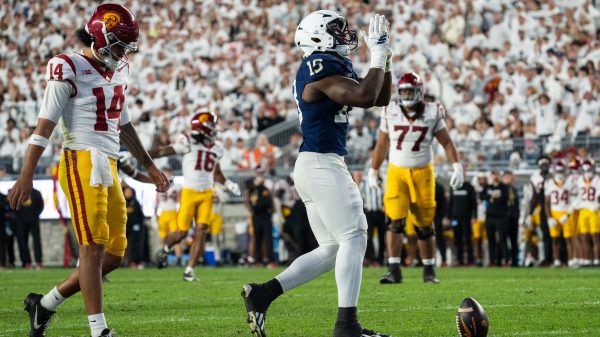
Even USC, which attacked Penn State primarily through the air, generated 129 rushing yards and four yards per carry.
Campbell indicated the coaching staff spent considerable time addressing those shortcomings during the two weeks between games.
“Then I think the third piece of it, those are things we really went to work on in the last two weeks: man running the ball and stopping the run, and what are we doing and not doing, both schematically and fundamentally, can help us,” Campbell said.
 Add Nittany Sports Now as a preferred source in Google! Click here to add us.
“I give a lot of credit to our coaches. I think they did a great job with the game plan, but I think they also did a great job fundamentally correcting some areas that we were just a hair off on over the last couple of weeks.”
Improvement or Opponent-Driven Success?
While the statistics were encouraging, Saturday’s performance requires some perspective.
Purdue entered the game ranked 15th in the Big Ten in rushing offense, averaging 128.4 yards per game.
The Boilermakers were hardly the most imposing rushing opponent Penn State has encountered.
Campbell also acknowledged that playing with a lead contributed to the defensive success.
“Getting a lead, playing with the lead, helps that opportunity as well,” Campbell said.
Penn State controlled possession for more than 43 minutes, limiting Purdue’s offensive opportunities and forcing the Boilermakers to operate under unfavorable circumstances.
Penn State’s defense also generated just one sack, demonstrating that improved run defense did not necessarily translate into consistent quarterback pressure.
Still, holding any Big Ten opponent to 33 rushing yards represents meaningful progress for a defense that had struggled so significantly.
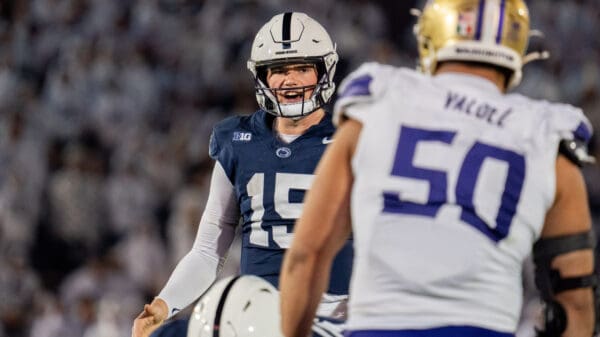
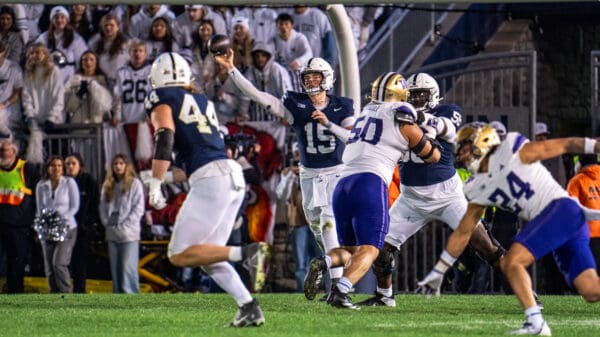
The next challenge comes Saturday against Washington, where Penn State must demonstrate that its improvements are sustainable.
One encouraging afternoon cannot erase the defensive breakdowns that contributed to four consecutive losses.
But Campbell believes the Nittany Lions have established a foundation for improvement.
“We took a step in the right direction,” Campbell said.
For Penn State, the challenge now is proving that step wasn’t an isolated one.