







Penn State is the reigning dynasty in college wrestling, and after winning 13 national championships in the last 15 years, it is hard for many to envision the end of its rule.
Penn State’s 2026 Team Didn’t Just Make History, It Became the Standard
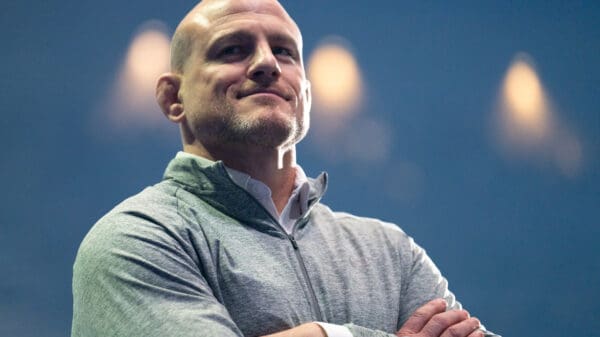
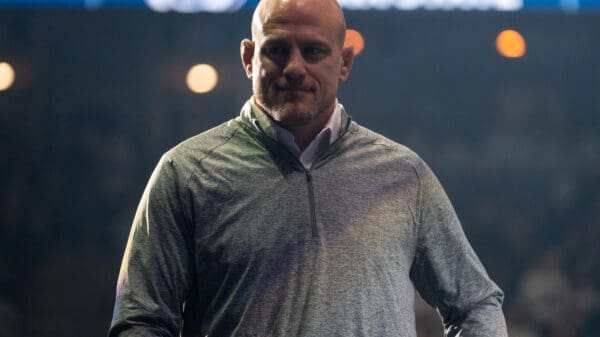
The Nittany Lions have become the sport’s modern empire under Cael Sanderson, a program so dominant that even historic achievements can begin to feel routine.
This year’s NCAA Championships only added to that sense.
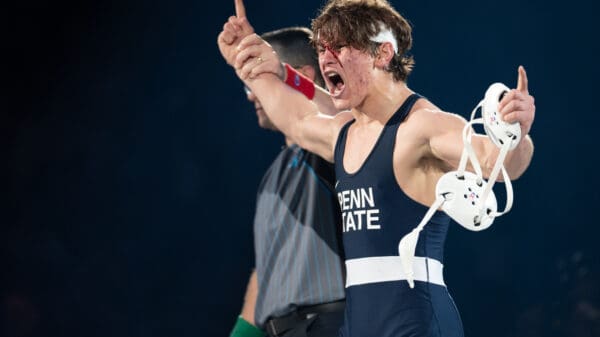
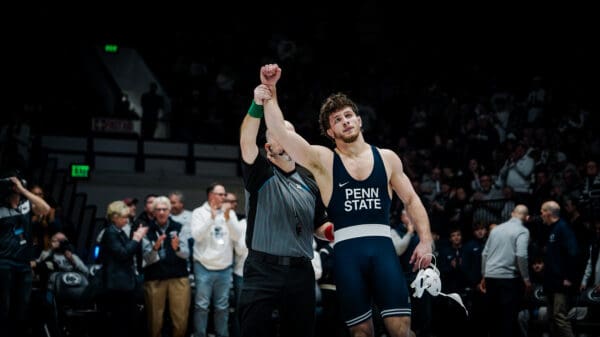
Penn State entered the tournament with seven No. 1 seeds, produced eight All-Americans, crowned four national champions and set a new NCAA Wrestling Championships scoring record with 181.5 points.
It was, by any reasonable measure, one of the greatest team performances the sport has ever seen.
And yet, history suggests that even the mightiest runs eventually meet a worthy challenger.
Consider the sport’s most famous streak before Penn State’s rise: Dan Gable’s Iowa Hawkeyes, who won nine consecutive NCAA team titles from 1978 through 1986.
That run ended with one of the most revered teams wrestling has ever produced.
The 1986 Hawkeyes are still spoken about with a kind of awe usually reserved for legends. They scored 158 points at the NCAA Championships, shattering the tournament scoring record at the time and delivering one of the defining performances in the history of the sport.
That team didn’t merely win: it overwhelmed the field.
Iowa’s 1986 lineup gave opponents almost no relief. The Hawkeyes were stacked across the board and collected advancement points, bonus points and placement points from nearly every corner of the bracket. That legendary lineup looked like this:
126: Brad Penrith — 1st
134: Greg Randall — 2nd
142: Kevin Dresser — 1st
150: Jim Heffernan — 1st
158: Royce Alger — 6th
167: Marty Kistler — 1st
177: Rico Chiapparelli — 4th
190: Duane Goldman — 1st
Although that Iowa squad was anchored more by dominance in the lighter and middle weights, and Penn State under Sanderson has often bludgeoned the field through its upper-weight strength, the common thread is lineup depth.
Great dynasties don’t simply rely on stars. They bury opponents under wave after wave of scoring threats.
That’s been the formula for Penn State. It was the formula for Iowa then, and it’s the reason conversations about all-time teams so often link the two programs.
But dynasties, no matter how imposing, always live with the same underlying truth: eventually, someone comes for them.
In 1987, at Cole Field House in College Park, Maryland, Iowa State that snapped Iowa’s historic streak. One of wrestling’s great blue bloods was ready at the right moment and ended the sport’s most iconic run.
Fast forward to today, and while this year may have been Penn State’s masterpiece under Sanderson, there is a real storm brewing in Stillwater, Oklahoma.
 Add Nittany Sports Now as a preferred source in Google! Click here to add us.
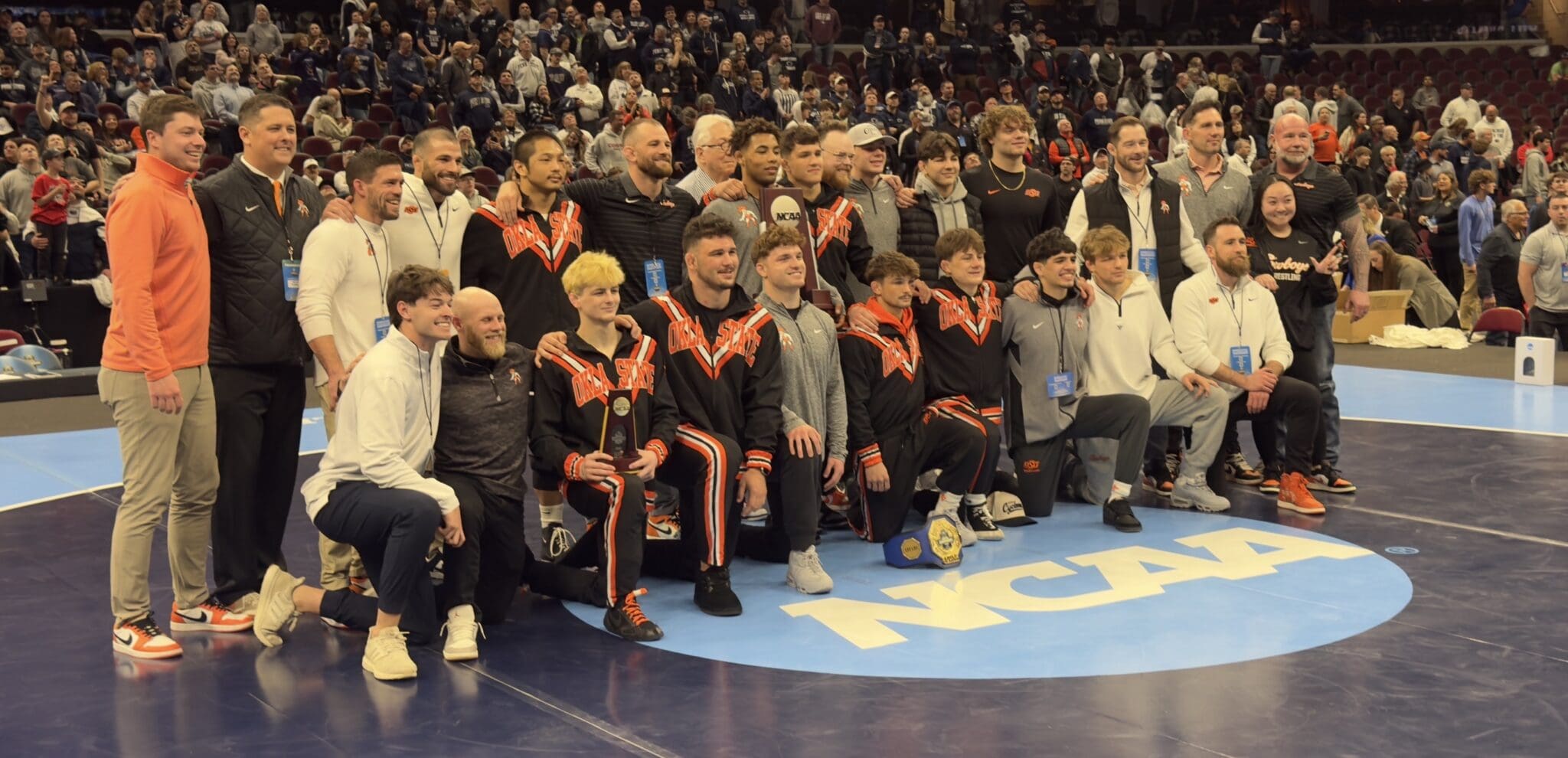
David Taylor, one of Penn State’s legends, is now building Oklahoma State into something formidable. The Cowboys didn’t win the team title this year, but they showed something that mattered nearly as much: belief. Not borrowed belief, not fake bravado in defeat, but the conviction of a program that sees itself as a legitimate national title threat.
That belief starts with the Cowboys’ youth, talent and finals success.
At 157 pounds, Landon Robideau made the most of his opportunity against Penn State freshman PJ Duke in the semifinals, then went on to win a national championship over Nebraska’s Antrell Taylor. He was one of several Oklahoma State wrestlers who carried themselves like a group that expects to matter in March for years to come.
Sitting in the press room, it was impossible not to notice the confidence from Robideau and his teammates, including Jax Forrest, Sergio Vega and Cody Merrill.
Even as Penn State was turning the team race into a mathematical formality, the Cowboys were talking like a team focused not on moral victories, but on the future.
“Yeah, I mean, I think this is the start of something special,” Robideau said. “Obviously, last year, we did really good at this tournament, but we didn’t get what we wanted. We got second, 2nd or 3rd place. And this year, we’re just, we’re looking to go and win this tournament. I know a lot of people think it’s unrealistic, but I think from you seeing how Jax Forrest, how Sergio Vega is, how I wrestle, we all believe we came in this tournament and all our team believes we can win this tournament and that’s what we’re kind of focused on.”
Oklahoma State didn’t win this year, but that quote sounds like the voice of a team preparing to contend for one next year.
The Cowboys went 3-for-4 in national championship bouts.
Forrest beat Ohio State’s Ben Davino at 133. Vega defeated Ohio State’s Jesse Mendez in overtime at 141, a result that ended Mendez’s Hodge Trophy hopes. Robideau won at 157. The one they didn’t get came at 197, where Penn State and Oklahoma State met head-to-head in one of the night’s most revealing finals.
Josh Barr won his first national championship for Penn State, but Cody Merrill made him work for every inch. Barr ultimately prevailed, yet Merrill gave him one of his toughest tests of the tournament. That matters, especially because both wrestlers figure to improve.
That’s part of what makes Oklahoma State such a compelling challenger.
The Cowboys aren’t building around nostalgia.
They’re building around wrestlers who are already championship-caliber and still ascending.
Penn State fans understandably talk about what the team returns and how next season could be historic. That may well prove true. But it is worth remembering that dominant programs often believe their rule will continue uninterrupted, right up until a real challenger arrives.
Didn’t Iowa feel much the same way heading into 1987?
That’s not to predict Penn State’s fall. It is simply to acknowledge that dynasties are tested most seriously not by the teams they blow out, but by the contenders who begin to see themselves as equals.
And for the sport, that is a good thing.
Wrestling is better when the national title is not treated as a fait accompli.
It’s better when multiple superpowers bring elite wrestlers, distinct styles and genuine championship ambition into the same building.
Penn State’s greatness has elevated the sport, but real competition can sharpen it even more.
If Oklahoma State becomes the challenger it appears capable of becoming, Penn State will only get better in response. That is what the best rivalries do. They force the champion to evolve. They force the contender to harden. They create seasons where greatness is not assumed but earned again.
For now, this is still Penn State’s kingdom. The Nittany Lions own the trophies, the record books and the aura of inevitability.
But Oklahoma State is no longer just chasing relevance. It is building toward supremacy.
And if that challenge fully arrives, college wrestling will be better for it.
Because when the sport’s superpowers are both operating at their apex, everybody wins.