









Injuries are an unavoidable part of hockey, and managing them often becomes a strategic chess match for head coaches trying to disguise the voids left behind.
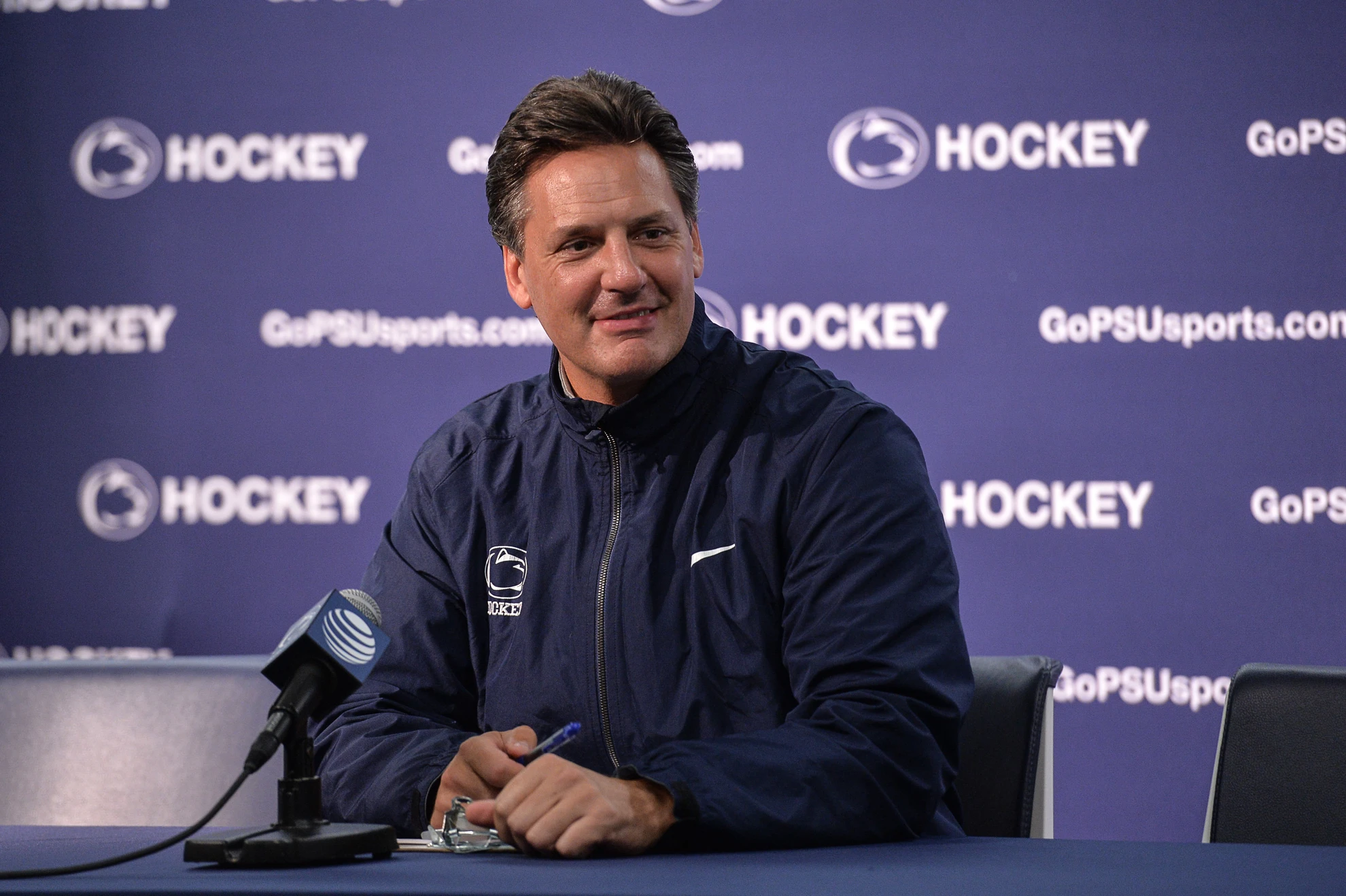
For head coach Guy Gadowsky, that challenge has intensified during a season filled with heightened expectations. Now down two of their top centers and multiple top-six forwards, Penn State find themselves navigating one of the most difficult stretches of the 2025–26 campaign.
The biggest blow came when team captain Dane Dowiak announced prior to Gadowsky’s weekly media availability that he suffered an upper-body injury that will sideline him for the remainder of the season.
Dowiak’s absence leaves a significant hole at the top of the lineup, both in production and leadership, forcing the coaching staff to reshuffle combinations as Penn State pushes toward the postseason.
Gadowsky’s player availability at center has been tumultuous ever since Charlie Cerrato went down with an injury on Jan. 9 against Minnesota.
At the time, Cerrato led Penn State in assists (18) and points (24) while serving as the team’s most reliable faceoff specialist, winning 59.7% of his draws.
Initially considered day-to-day, his recovery has proven unpredictable, with progress followed by setbacks that have delayed a firm return timeline. There is hope he could return for the Big Ten Tournament, but nothing is guaranteed.
“This week he’s been great, but it’s been up and down a lot,” Gadowsky said of Cerrato’s status, underscoring the uncertainty surrounding the team’s depth at center.
Losing Dowiak compounded the problem. The captain was not only Penn State’s most consistent two-way forward but also led the team with a plus-16 rating.
His dominance in the faceoff circle and ability to match up against opposing top lines made him indispensable.
“(It’s) a tough one for us,” Gadowsky said. “He’s still our captain. He’s still going to be a huge part of the team. We didn’t need to lose another centerman. He was our top guy in draws. But he brings great value as a captain and a leader.”
With Dowiak sidelined, Gadowsky has turned to Calgary Flames prospect Luke Misa as a potential solution to center the line featuring dynamic forwards Gavin McKenna and Aiden Fink.
The move places significant responsibility on Misa, who must adapt his game to complement two of the program’s most offensively gifted players.
“Smart players like to play with really smart players,” Gadowsky said. “Luke may have to adjust his game a little bit.”
Early returns have been encouraging.
Misa delivered one of his strongest performances of the season against Michigan, his first full game centering McKenna and Fink.
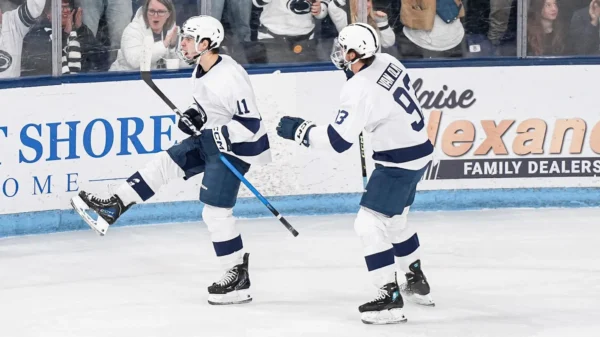
He won 12 of 24 faceoffs and recorded his third career multi-point game, including a redirection goal off a McKenna shot past Wolverines goaltender Jack Ivankovic.
His ability to stabilize the line could prove critical as Penn State seeks scoring consistency amid the injuries.
 Add Nittany Sports Now as a preferred source in Google! Click here to add us.
Another key figure emerging during this stretch is Reese Laubach.
With Cerrato sidelined and Dowiak unavailable, Laubach’s role has expanded dramatically. He has centered a line with JJ Wiebusch and Matt DiMarsico while providing the physical edge and versatility the coaching staff values.
“We are extremely proud of Reese,” Gadowsky said. “He does whatever the team asks in whatever role is asked. He’s a really tough kid. He’s worked extremely hard on walking that fine line between being a warrior and staying out of the box.”
Laubach’s production has matched his increased responsibility.
Fresh off earning Big Ten Third Star of the Week honors after a three-goal performance, he has compiled 10 points over his last 10 games while anchoring his line.
His emergence has helped stabilize the middle six and provided secondary scoring that Penn State desperately needs.
The shortage of forwards has forced Gadowsky to experiment in unconventional ways.
Defensemen Nick Fascia and Casey Aman have seen time at forward, and at one point the coaching staff deployed a line consisting of four defensemen and a single forward, something that is a rare sight at the collegiate level.
Even with the improvisation, Gadowsky insists the team’s identity will not change.
“We change personnel because we have to, but we don’t want to change our stripes,” he said. “To change your stripes takes months. We’re not changing this team. We have our stripes, and that’s how we play.”
That identity has been built on relentless forechecking, physical play, and pace that has carried Penn State to a No. 6 USCHO national ranking and No. 5 in the NPI, remains the foundation of the program’s success. Altering that approach midseason could create confusion and undermine the habits developed over months of preparation.
Still, the margin for error is shrinking.
With uncertainty surrounding Cerrato’s return and the roster already stretched thin, any additional injuries could jeopardize Penn State’s pursuit of a return to the Frozen Four.
For now, the Nittany Lions are relying on resilience, adaptability, and a next-man-up mentality.
If players like Misa and Laubach continue to rise to the occasion, Penn State may not only survive this stretch but emerge stronger when the postseason arrives.
Injuries may be inevitable, but how a team responds often defines its season. For Gadowsky and Penn State, the challenge is clear: preserve the identity that made them contenders while finding just enough answers to keep their championship hopes alive.