










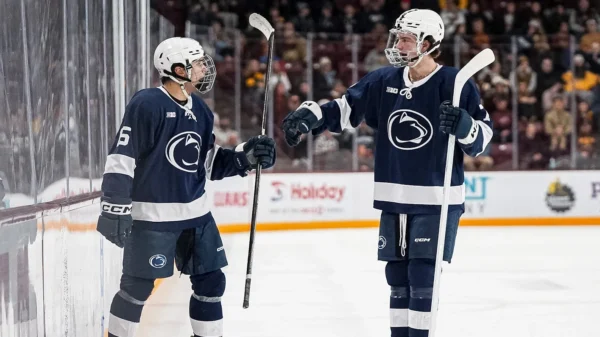
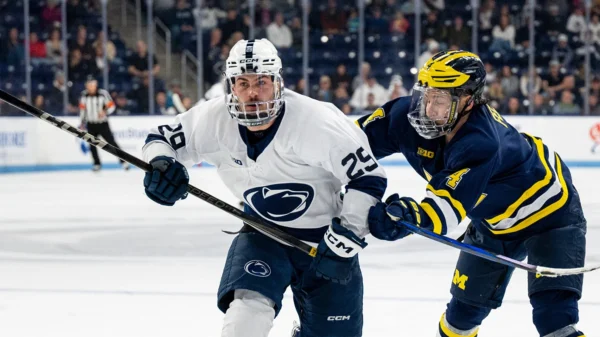





As Penn State returns to action this week ranked No. 5 in the latest NPI and prepares to visit No. 2 Michigan at Yost Ice Arena, both programs find themselves in urgent need of points.
With the Big Ten Tournament looming and NCAA Tournament seeding very much in play, this weekend carries weight well beyond a typical February series.
A potential No. 1 seed, and the favorable path that comes with it, could hinge on the outcome.
Beyond the standings, however, there is a deeper and more uncomfortable subplot connecting these two teams. Penn State and Michigan share a dubious distinction: both sit at the very top of the nation in penalty minutes.
Penn State leads the country with 535 penalty minutes, followed closely by Michigan at 492.
No. 1 Michigan State ranks third at 484.
In nearly 20 years of publicly available College Hockey News data, there has never been a season where three top-five teams in the NPI also finished top three nationally in penalty minutes.
Whether this represents a new era of college hockey, fueled by the increased physicality brought by CHL imports blending with American development systems, or simply an anomaly remains to be seen.
What history clearly shows, however, is that teams that lead the nation in penalty minutes almost never win men’s ice hockey national championships.
Postseason hockey ruthlessly exposes anything that provides opponents with free advantages, and few things are more dangerous than giving elite teams repeated power-play opportunities.
Since the 2011–12 season, when Guy Gadowsky took over the Penn State program, only two teams that led the nation in penalty minutes have even reached the national championship game: Quinnipiac in 2012–13 and Boston University last season.
Neither won the title.
Over that same span, national champions finished with an average national ranking of 27.7 in penalty minutes. Denver’s 2022 championship team is the lone exception ranking in the Top 10, finishing seventh nationally, and even that team paired physical play with elite discipline in critical moments.
The margin for error narrows dramatically in March and April.
That reality was front and center following last Friday’s emotional unraveling against Michigan State, just hours before Penn State’s historic outdoor game at Beaver Stadium.
Senior defenseman Jarod Crespo was candid when asked about the fine line between emotion and discipline.
“It’s something we really have to figure out,” Crespo said. “Tonight hurt us. They had, what, two or three power-play goals? There’s a time and a place to stand up for a teammate, and we’re all on board with that. But we have to stay out of the situations that put us down a man.”
As the calendar inches closer to postseason play, the way games are officiated changes dramatically.
The regular-season version of “let them play” hockey largely disappears in conference tournaments and the NCAA Tournament. Officials tighten standards, emphasizing stick infractions, obstruction, and retaliation.
The same borderline behavior that may slide in January often results in penalties in April.
Teams built on edge and intimidation can suddenly lose their margin.
 Add Nittany Sports Now as a preferred source in Google! Click here to add us.
In tournament hockey, games are typically one-goal affairs, where a single special-teams breakdown can flip an entire season.
When a team consistently takes more penalties than its opponent, it is not just risking goals against, it is disrupting its own rhythm.
High-penalty teams spend extended stretches killing penalties instead of rolling lines at five-on-five. Top players log heavy shorthanded minutes, benches shorten late in games, and offensive timing suffers. Championship teams need flow. Survival mode rarely wins titles.
The contrast was evident during Penn State’s outdoor showdown with Michigan State.
When the Nittany Lions stayed composed and avoided unnecessary penalties, they went stride for stride with the Spartans. In two losses where Penn State took three minor penalties or fewer, both games were even through regulation and ultimately decided in overtime.
By contrast, in the two losses where Penn State lost its composure, accumulating 79 penalty minutes, the Nittany Lions were outscored 11–3.
Following Michigan State’s 5–4 overtime win at Beaver Stadium, Gadowsky pushed back on the idea that previous penalty trends automatically dictate future outcomes.
“Every hockey game takes on a personality of its own,” Gadowsky said. “You can’t just say these two teams are going to play one way every time. We’re both tough, big, gritty teams, and we don’t mind playing that way. I was actually a little surprised it wasn’t more physical, but we had just played less than 18 hours earlier, and that played a role.”
Gadowsky’s perspective is fair. Context matters. Matchups matter. Fatigue matters. Still, expectations around this Penn State roster are immense, and the talent level is unmistakable.
Frozen Four–caliber opponents are loaded with NHL-level skill. When games become chaotic due to penalties, those teams turn broken structure into goals. Discipline keeps games predictable.
Chaos favors talent and Penn State has plenty of it.
But even elite skill cannot consistently overcome repeated trips to the penalty kill.
When championships are won, teams typically average at least one additional power play per game or post a positive penalty differential of three or better.
Despite leading the nation in total penalties, Penn State currently owns a positive penalty differential of +2.23 and averages nearly one more power play per game than its opponents.
That nuance matters.
It suggests Penn State is not merely undisciplined, but rather involved in emotionally charged games where both teams are being penalized.
Still, perception becomes reality in March.
As games tighten and whistles get quicker, Penn State must prove it can operate within stricter confines without losing its edge. When this team plays disciplined hockey, it looks like one of the best teams in the country. When emotion takes over, the margins disappear quickly.
The final month of the season will determine whether Penn State is prepared for tournament hockey.
Their preseason aspirations of Big Ten titles, a No. 1 seed, a Frozen Four run, will ultimately be realized or lost based on how they carry themselves when everything is on the line.