
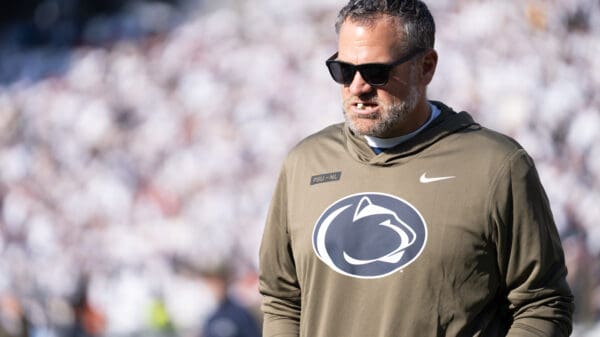
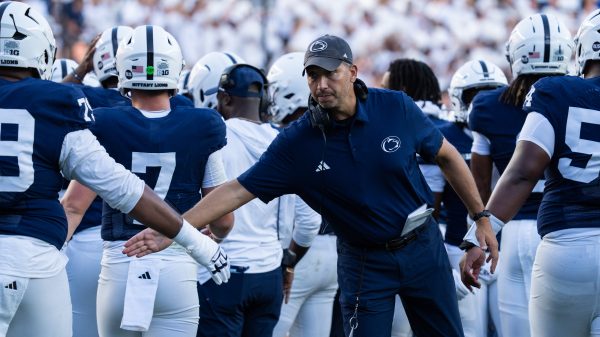








As Matt Campbell’s new staff begins to take shape, one consistent theme has emerged: familiarity.
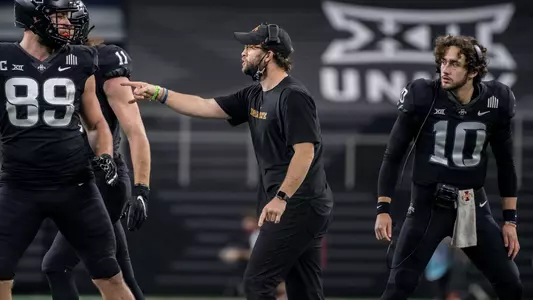
Campbell’s decision to bring Taylor Mouser with him from Iowa State as offensive coordinator reflects a belief in continuity, shared philosophy, and proven results.
Penn State Makes Offensive Coordinator Pick, Adds Two Assistants
Mouser is not simply a familiar face; he is a long-time disciple of Campbell whose offensive fingerprints are now firmly embedded in the most successful stretch in Cyclones history.
Mouser’s relationship with Campbell dates back to 2015, when he was on Campbell’s staff as a graduate assistant at Toledo. When Campbell left for Iowa State, Mouser followed, gradually climbing the ranks. That loyalty was rewarded last season, when Campbell promoted Mouser and handed him the keys to the offense.
The result was historic. Iowa State posted a program record 11-win season, while producing the highest-scoring offense in school history.
Iowa State finished the year with a program-record 435 points, a benchmark that illustrates both efficiency and balance.
Mouser’s offense ran the ball 51.8% of the time, reinforcing Campbell’s long-held belief that physicality and ball control are foundational to success.
That run rate closely mirrors the blueprint Campbell has favored throughout his career.
The only time Iowa State leaned more heavily on the ground game during Campbell’s tenure came when the Cyclones featured quarterback Brock Purdy and All-American running back Breece Hall.
During the 2020 season, Iowa State ran the ball 56.9% of the time. Hall led the nation in rushing attempts (279) and rushing yards (1,572) while pacing the Big 12 in rushing touchdowns (20), and the Cyclones rode that identity to a 9-3 record and a Fiesta Bowl win over Oregon – the program’s first New Year’s Six bowl victory.
Campbell’s offenses have been at their best when they avoid tipping the scales too far in either direction.
When Iowa State drifted toward a more pass-heavy approach, the results were mixed.
In 2021, the Cyclones passed the ball 52.5% of the time and regressed from a New Year’s Six champion to a 7–6 team.
Even in subsequent seasons riddled with injuries, Iowa State remained committed to the run, rushing the ball over 50% of the time, underscoring Campbell’s resistance to abandoning his core principles.
Throughout Campbell’s era, Iowa State has typically employed a two-back rotation outside of the Hall years.
That approach aligns closely with what Penn State leaned on during its recent run to bowl eligibility: a run-first offense that asked the passing game to be efficient rather than overwhelming.
Mouser’s background suggests that approach will continue, but with key refinements.
 Add Nittany Sports Now as a preferred source in Google! Click here to add us.
One of the most notable evolutions in Mouser’s play-calling has come in high-leverage moments.
Earlier in Campbell’s tenure, there were instances where Iowa State appeared overly conservative late in games, choosing to protect leads rather than close opponents out.
Over the past two seasons under Mouser, that tendency has shifted. In moments of consequence, Mouser has shown a greater willingness to attack.
That evolution was on full display in Iowa State’s Pop-Tarts Bowl victory over Miami. In a 42–41 shootout, Mouser empowered quarterback Rocco Becht to push the ball to the perimeter late, attacking coverage rather than bleeding the clock. The approach paid off, sealing one of the Cyclones greatest post-season victories.
Mouser’s use of play action has been another defining feature. Roughly 29% of Iowa State’s dropbacks incorporated play action, a point of emphasis that helped Becht improve significantly as a passer. Becht raised his completion percentage from 52% in 2024 to 60% in 2025, a jump that reflects both schematic growth and quarterback development.
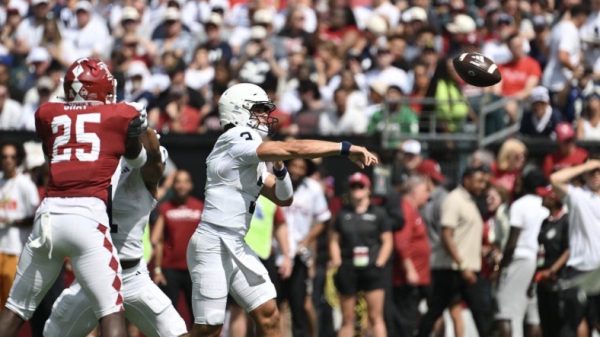
For context, Penn State leaned heavily on play action last season as well. Drew Allar completed 70.6% of his passes on play-action attempts before regressing to 65% overall. After Allar’s season-ending injury in October, Penn State leaned even more heavily on play action with Ethan Grunkemeyer, using it on 36.6% of his dropbacks. Grunkemeyer completed 65% of his passes, matching Allar’s overall efficiency despite limited experience. Notably, Grunkemeyer was even more effective on straight dropbacks, completing more than 70% of those throws.
Where Mouser’s offense is expected to differ most significantly is in its verticality. One of the primary criticisms of former offensive coordinator Andy Kotelnicki was his reliance on passes behind the line of scrimmage. This season, 18% of Allar’s pass attempts targeted receivers behind the line. For Grunkemeyer, that figure ballooned to 37.9%. While some of that was by design, particularly given injuries to Allar and Jaxon Smolik, it often limited the offense’s ability to stress defenses downfield.
Mouser’s passing game challenges defenses more aggressively. Nearly 45% of his throws are short passes within 10 yards of the line of scrimmage, compared to just 31% under Kotelnicki. While still efficient and controlled, those concepts force defenders to cover more ground and open up opportunities vertically.
Tight ends will continue to play a central role.
Although many lamented Penn State’s loss of tight ends coach Ty Howle to Virginia Tech, Mouser’s track record should ease concerns.
Penn State Assistant Leaving For OC Role With Virginia Tech, James Franklin
Mouser was named FootballScoop’s Tight Ends Coach of the Year after junior Benjamin Brahmer emerged as Iowa State’s leading receiver. Brahmer finished with 37 receptions for 446 yards and a team-high six touchdowns, earning Second Team All-Big 12 honors. He already ranks sixth in school history in receptions by a tight end and fifth in receiving yards, with a clear path to finishing his career as one of the best pass-catching tight ends in Cyclones history.
That philosophy should resonate in State College, where Penn State boasts a loaded tight end room featuring Luke Reynolds, Andrew Rappleyea and Andrew Olesh. Under Mouser, tight ends aren’t accessories, they are focal points.
When Iowa State has dynamic wide receivers, Mouser is unafraid to feature them prominently.
Last season, Jaylin Noel and Jayden Higgins each surpassed 100 targets and 1,100 receiving yards. In the James Franklin era at Penn State, only Chris Godwin in 2015 and Jahan Dotson in 2021 are the only wide receivers to reach both benchmarks in the same season. Penn State has never had two receivers accomplish that feat in the same season.
If history is any indication, Mouser’s arrival could finally usher in a more aggressive perimeter passing attack in State College, one that complements a physical run game rather than being constrained by it.