



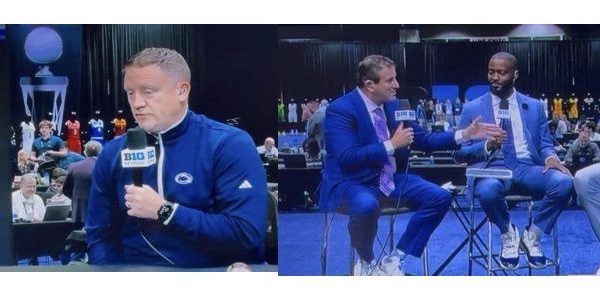








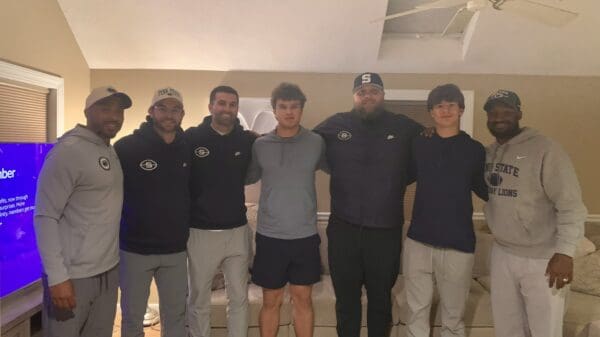



One of the most admirable traits of Penn State men’s hockey coach Guy Gadowsky is the humility he continues to show more than a decade into his tenure in Happy Valley.
“I didn’t build the program — I was just along for the ride,” Gadowsky said this week when describing Penn State’s passionate fan base, The Roar Zone.
It’s a humble statement from the man who has been the backbone of the Nittany Lions’ rise. When Gadowsky left Princeton to take over what was then a club powerhouse, he was betting on potential — not stability.
Between 1994 and 2007, Penn State’s club program either won or finished runner-up in the ACHA Division I national championship. That legacy of success, combined with institutional commitment, convinced Gadowsky to take the leap and help transition Penn State into a Division I program and eventual Big Ten member.
Since then, he’s built a team that reflects his energy and discipline. There have been signature moments — the 2017 Big Ten Tournament Championship, the 2020 regular-season title (cut short by COVID-19), and last season’s first-ever Frozen Four appearance.
While championships aren’t won in November, they often reveal who will contend for them in March. And this weekend’s series at Munn Ice Arena in East Lansing against top-ranked Michigan State could serve as a tone-setter for Penn State’s season and perhaps the program itself.
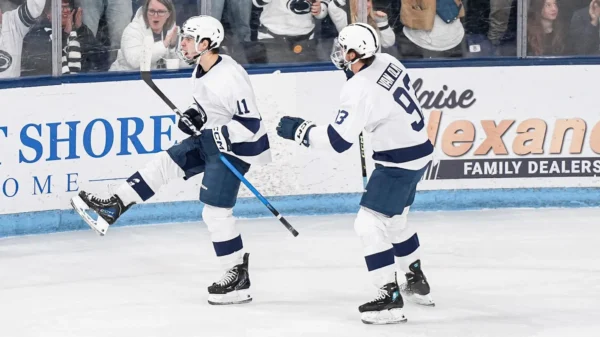
Gadowsky didn’t downplay last weekend’s sweep at No. 19 Ohio State, a result that lifted No. 3 Penn State to its best start in years.
“To win any game in the Big Ten is difficult,” Gadowsky said. “To win on the road — to sweep on the road — that’s very hard to do. So this is something to feel really good about.”
He’d feel even better if his young Nittany Lions could earn another sweep — though that will be an enormous challenge.
The Challenge: Michigan State’s Defensive Machine
Michigan State, ranked No. 1 despite playing four fewer games so far, has quickly established itself as one of the nation’s most physical, disciplined teams. Their relentless forecheck and structured back pressure have made life miserable for opposing offenses.
“If you’re trying to make long first passes, [Michigan State] does a really good job checking,” Gadowsky said.
The Spartans’ defensive numbers back that up. They rank ninth nationally in goals allowed per game (1.83), a figure buoyed by an early-season sweep over then-No. 1 Boston.
Anchoring that defensive effort is sophomore goaltender Trey Augustine, whom Gadowsky called “the best goaltender in the nation right now.” The reigning Big Ten Goaltender of the Year has already recorded two shutouts and boasts an elite .924 save percentage.
 Add Nittany Sports Now as a preferred source in Google! Click here to add us.
Spotlight Matchup: McKenna vs. Martone
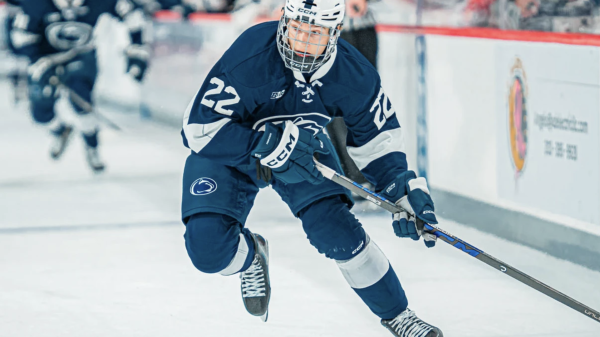
Beyond the team stakes, this series will showcase two of college hockey’s brightest young stars — Penn State’s Gavin McKenna and Michigan State’s Porter Martone — both projected to be top picks in the 2026 NHL Draft.
“I’m excited,” McKenna said this week. “He’s a great player. I’ve played with him in past tournaments, and the plays he makes are pretty special. We’ve got to make sure we’re watching him.”
McKenna, just 17, has lived up to his billing as a generational offensive talent. In 10 games, he’s produced 13 points (3 goals, 10 assists) — good for 1.30 points per game — and earned an 18.4 CHIP rating from College Hockey News.
CHIP, akin to baseball’s WAR metric, quantifies total individual value; anything over 10 is considered elite and often correlates with Hobey Baker-level performance. McKenna’s 18.4 mark not only leads all freshmen nationally but also underscores his impact across all situations.
Martone, two years older at 19, presents a different kind of challenge. Standing 6’3”, 207 pounds, the former OHL standout plays a power game built on strength, reach, and vision. Comparisons to Mikko Rantanen and Corey Perry feel apt — a blend of finesse and physicality with a net-front presence that demands attention.
Through six games, Martone leads the Spartans with nine points (3 goals, 6 assists) and adds a physical edge with hits and penalty minutes. Before arriving in East Lansing, he dominated the OHL with 98 points (37 goals, 61 assists) in 57 games for the Brampton Steelheads.
For McKenna, the matchup is both personal and developmental — a chance to measure his skill and compete level against a more mature, NHL-ready body. For scouts, it’s a preview of a potential NHL rivalry that could span a decade.
A Midseason Measuring Stick
Penn State’s immediate goal isn’t necessarily to reach No. 1 in the USCHO rankings — a spot the program hasn’t held since January 2017, when it was 16-2-1 and one of college hockey’s great stories. But Gadowsky’s group understands that weekends like this shape how legitimate contenders are perceived.
November will test every aspect of the Lions’ makeup. After facing the nation’s top-ranked team on the road, Penn State returns home next weekend to host No. 2 Michigan in what could be another top-five showdown at Pegula Ice Arena.
It’s a stretch that could define the program’s trajectory — not just for this season but for how far Penn State can climb nationally.
“We’ve always believed in building for consistency, not one-year spikes,” Gadowsky said earlier this month. “You want to be part of those conversations every single year.”
Whether Penn State leaves East Lansing with a split or a sweep, this series will say plenty about where the Nittany Lions truly stand — and whether the program Gadowsky “didn’t build” but certainly defined is ready to take the next step toward national dominance.