











For nearly a decade under James Franklin, Penn State’s defensive calling card was simple: attack the quarterback and dominate the line of scrimmage.
No matter the coordinator, the results were consistent — relentless pressure, disruption, and an identity rooted in physical, suffocating football.
That defining edge is gone.
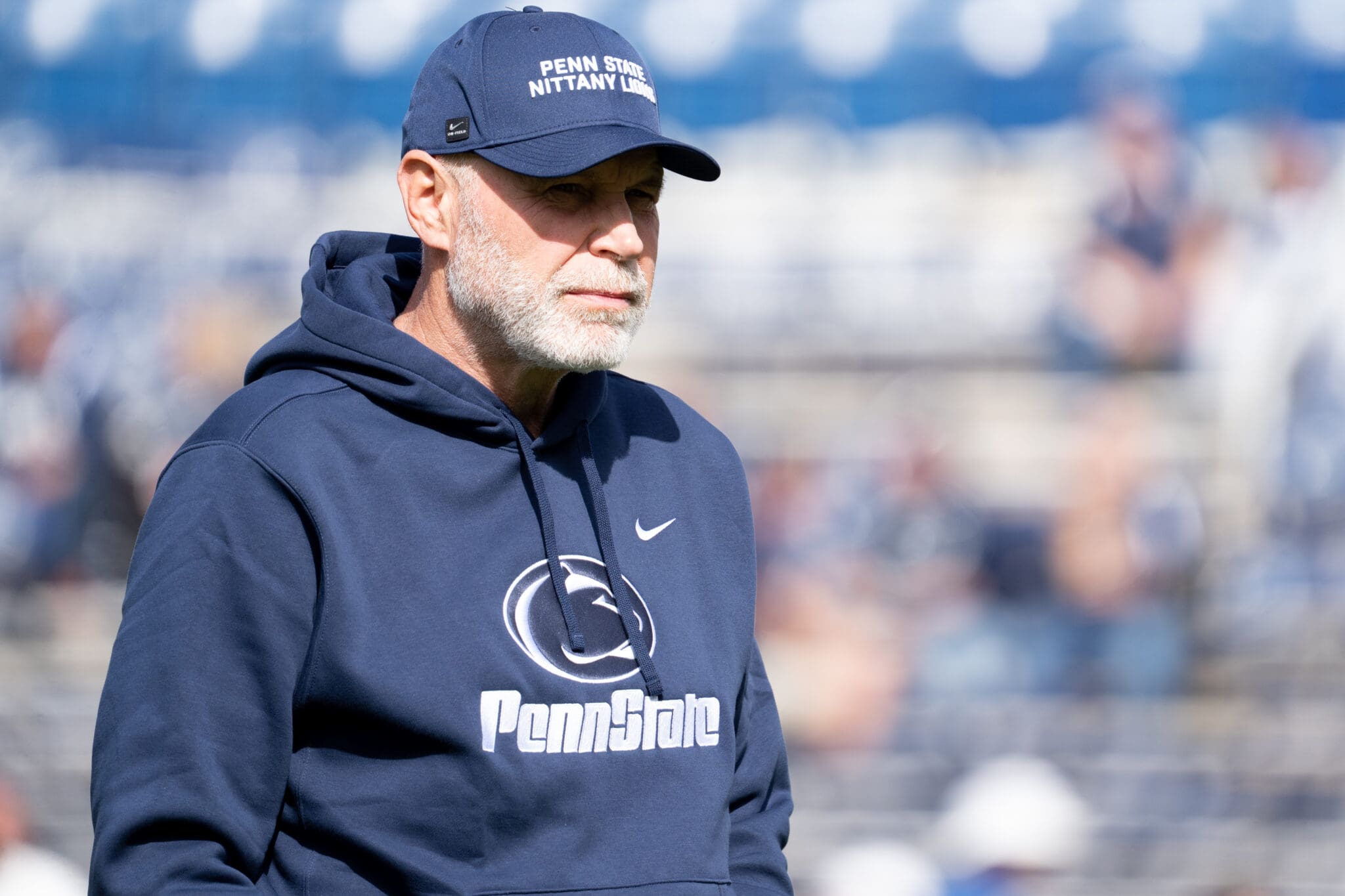
When Penn State hired Jim Knowles to replace Tom Allen, it appeared to be a home run.
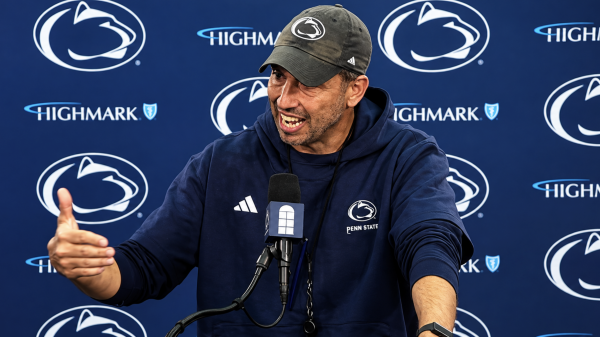
Knowles arrived fresh off a national championship run with Ohio State and brought a résumé that included a Broyles Award–level season at Oklahoma State in 2021. Franklin touted it as a philosophical “blending” — Knowles’ complex, cerebral system meeting the aggression that had long defined Penn State’s defense.
That blend has instead become a watered-down mess.
“There are some technique changes up front, in terms of how they’ll play blocks,” Franklin said before the season. “There’s some changes with the linebackers. With Manny (Diaz), we were gapped out — linebackers had a gap responsibility. This defense requires them to play more of a traditional linebacker, read things out a little bit more.”
The problem is that Penn State’s defense was never built to read. It was built to attack.
Knowles’ approach has neutralized what made Franklin’s defenses so effective. The Nittany Lions are thinking instead of reacting — and the results are ugly.
Through six games, PFF grades Penn State’s pass rush at 82.0, good for 20th nationally.
By most standards, that’s fine.
By Penn State standards, it’s disastrous.
From 2022 to 2024, Penn State averaged a top-seven national ranking in pass rush, including a No. 1 finish in 2023 with a 91.5 grade.
The decline isn’t cosmetic — it’s structural.
Under Diaz and Allen, Penn State maximized the EDGE position, turning raw athleticism into calculated chaos. Chop Robinson was unleashed on the quarterback on 54.7% of his snaps between 2022 and 2023. He wasn’t dropping into coverage or reading plays — he was ending them.
In 2023, Abdul Carter earned a 90.3 pass-rush grade as a linebacker despite blitzing on only 19% of his snaps. The impact was so obvious that Franklin and Allen permanently moved him to EDGE, a decision that unleashed a monster.
Carter’s 2024 campaign was the blueprint: 66 total pressures, 47.7% pressure rate, 23.5 tackles for loss, 12 sacks, and a 92.4 PFF pass-rush grade — all tops among Power Four defenders. Penn State’s defense was a nightmare because its best athletes were turned loose.
Now? That ferocity is gone.
Dani Dennis-Sutton’s usage under three coordinators is a case study in how Penn State’s defensive identity has been diluted.
As a true freshman under Diaz, Dennis-Sutton was deployed as a pure pass rusher, attacking on 53.8% of his snaps and earning an 83.8 grade.
Under Allen, his workload tripled, but his pressure rate held steady.
This season, under Knowles, that has cratered.
Dennis-Sutton has rushed the passer on just 46% of snaps — the first time in his career he’s dipped below 50% and a 16.5-point drop from his high. That’s not evolution — it’s regression.
 Add Nittany Sports Now as a preferred source in Google! Click here to add us.
The statistical collapse extends beyond one player. Between 2022 and 2024, Penn State averaged 3.48 sacks per game, including a national-best 4.23 in 2023. In 2025? Just two sacks per game, a 53.8% drop from last year.
It gets worse the deeper you dig.
Under Diaz and Allen, Penn State averaged 3.71 QB hits, 13.57 hurries, and 7.95 tackles for loss per game. Under Knowles, those numbers have fallen to 3.00 hits, 12.33 hurries, and 6.83 tackles for loss.
That might seem like incremental slippage until you isolate Penn State’s three-game losing streak, when those numbers nosedive into embarrassment: 1.33 QB hits, 11.66 hurries, and four tackles for loss per game.
That’s nearly a 50% decline in hits and tackles for loss from the program’s three-year average — and a 14% decline in hurries. For a team once defined by quarterback pressure, this is a complete identity collapse.
It’s not hyperbole to call it what it is: a failure of coaching.
Knowles hasn’t “blended” philosophies; he’s stripped away what worked. His system has neutered Penn State’s natural aggression and forced players to think their way through situations that used to be instinctive. The result is hesitation — and hesitation gets punished.
Even Knowles admitted in the spring that the process of merging schemes was ongoing:
“I think we’ve made a lot of progress in a short time, blending new concepts with some of the old concepts that they did,” Knowles said. “Obviously, they were very good here on defense. So we’re using what we can and trying to keep things in similar terms for the players.”
But six games in, that “progress” looks like deterioration.
In Penn State’s three losses, opposing quarterbacks have completed 70.7% of their passes, averaged just under 200 yards per game, thrown six touchdowns, and forced zero interceptions.
Those numbers aren’t just the byproduct of a defense in transition — they’re the product of a defense that’s lost its soul.
Franklin’s teams have always been defined by defensive violence. The pass rush wasn’t an accessory; it was the engine. The 2023 unit made life miserable for opponents — collapsing pockets, forcing errant throws, and dictating tempo.
This 2025 defense is the polar opposite — reactive, restrained, and visibly unsure of itself. The front seven, once a terror, now plays on its heels. The energy that used to radiate from every snap has been replaced with confusion and resignation.
Knowles was hired to elevate a defense that didn’t need fixing. Instead, he’s broken it.
Penn State has gone from leading the nation in sacks to struggling to average two per game. The line that once controlled every trench battle now gets pushed around. For a coach whose reputation was built on defensive genius, Knowles has looked painfully ordinary.
Franklin wanted a fusion of philosophies. What he got was a watered-down version of both — a defense that lacks the chaos of Diaz’s units and the efficiency of Knowles’ best work.
In the process, Penn State’s most consistent strength has become its most glaring weakness.
The numbers, the tape, and the losses all tell the same story: Penn State isn’t just failing to get to the quarterback — it’s failing to know who it is.
And in the Big Ten, that’s not just a tactical issue. It’s a cultural one.
As the Franklin era has ended, Penn State’s defense isn’t feared. It’s figured out.