





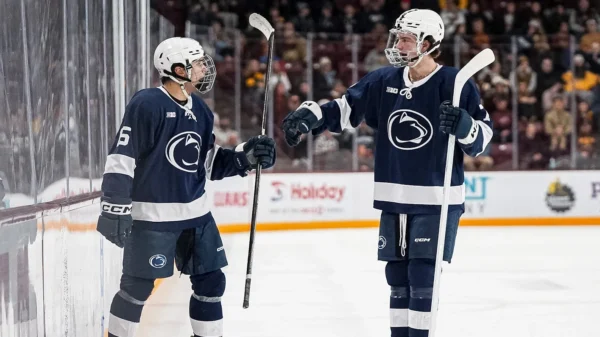

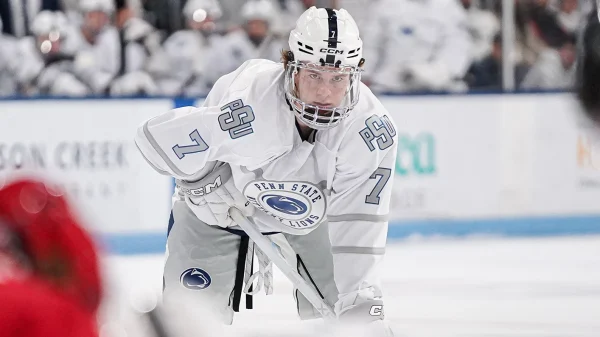





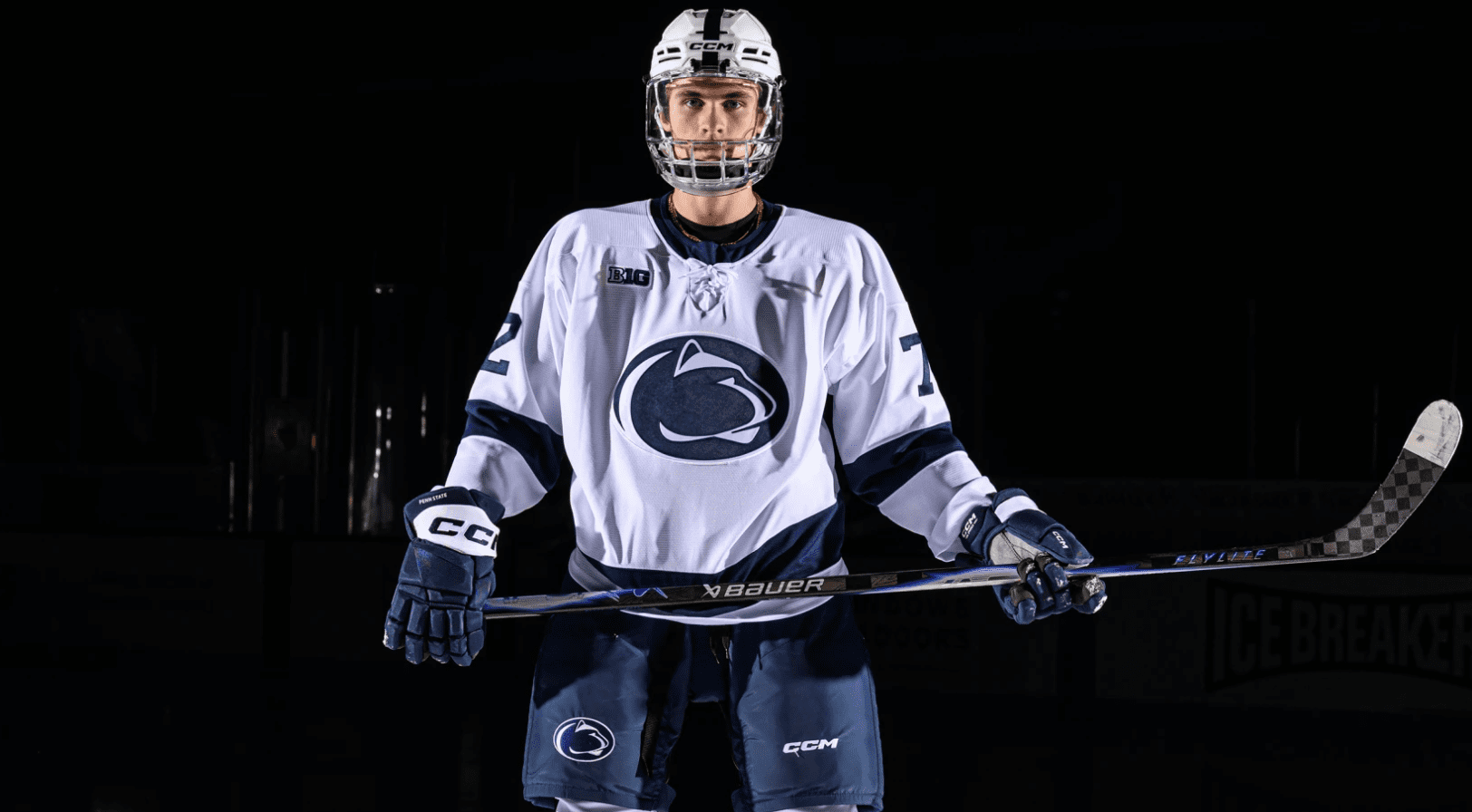
Gavin McKenna entered Penn State hockey as one of the most highly regarded freshmen in college hockey — a generational talent on the wing combining elite hockey IQ, advanced processing speed, and relentless competitiveness.
After an historic WHL season with Medicine Hat — where he led the league with 129 points in 56 games, posted a 54-game point streak, and earned the CHL’s David Branch Player of the Year — McKenna has quickly adjusted to the NCAA level.
Through eight games, he’s posted 10 points (three goals, seven assists), including four points in Penn State’s sweep of Stonehill, signaling that his game is beginning to heat up as the competition level rises.
Below is an assessment of McKenna’s performance through the first quarter of his freshman season.
Hockey IQ / Vision – 9/10
McKenna’s processing ability and read of the ice are already elite. He consistently anticipates defensive coverage and offensive movement two or three steps ahead of his linemates, forcing them to elevate their own awareness.
His ability to manipulate defenders and create passing lanes shows shades of Sidney Crosby’s spatial intelligence. The next step will be exploiting micro-gaps and punishing defensive overplays more efficiently.
His hockey sense projects comfortably into the NHL’s top tier.
Skating – 8.5/10
McKenna’s first-step acceleration is strong but not yet explosive. His top-end speed in open ice is impressive, though he still appears to be building lower-body strength, which limits his drive through contact and quickness in tight spaces.
Edge work and balance are improving — his stride is efficient and upright, and as his strength develops, he’ll add another gear and better puck protection.
Puck Skills – 9.5/10
McKenna’s puck skills border on elite-to-generational. His hands are soft, precise, and adaptable at speed. His wrist shot is world-class — compact release, effortless power, and pinpoint accuracy from multiple angles.
His vision and touch on passes are surgical, and as chemistry builds with linemates Shea Van Olm and Aiden Fink, expect even more dynamic creation in transition.
Once fully adjusted to NCAA pace and physicality, McKenna’s puck skills will dominate late in games and on the power play.
 Add Nittany Sports Now as a preferred source in Google! Click here to add us.
Physical Tools – 7/10
At 17, McKenna is still physically maturing. He competes against players up to five years older, and while he’s handled the challenge admirably, he’s not yet an NHL-ready frame.
Improving lower-body strength and core stability will help him win more board battles, extend offensive zone time, and maintain puck control under pressure.
The foundation is there — as he fills out, his overall impact will expand significantly.
Compete Level / Motor – 10/10
McKenna’s motor is relentless. His practice habits, in-game intensity, and off-ice competitiveness set the standard in the locker room. Teammates and coaches consistently highlight his preparation and focus.
He plays every shift with intent and purpose. As his strength develops, expect that compete level to translate into a more physical presence — especially on loose pucks and defensive recoveries.
Defensive Play – 8/10
McKenna shows strong awareness and stick positioning in all three zones. He supports defensemen effectively and tracks the puck with intelligence and discipline.
Penn State’s aggressive penalty-kill scheme allows him to use his anticipation to disrupt passing lanes and transition quickly.
To project as a complete NHL two-way winger, he’ll need to build consistency on the backcheck and more assertiveness defending net-front battles.
Leadership / Intangibles – 10/10
McKenna exhibits maturity well beyond his age — emotionally composed, hyper-prepared, and team-driven. His daily habits and accountability model professional standards.
He demands excellence from himself and teammates without ego, a hallmark of players who wear letters at the next level.