

























As more jobs open during this year’s coaching carousel, there’s a natural tendency to compare each vacancy to Penn State — or even suggest that some may be better.
In truth, only a handful of programs, if their job opened, could top Penn State’s.
You’ll hear claims that Florida, for instance, offers more.
Sure, each program has its advantages.
But taken as a whole, none surpass Penn State.
Penn State’s prestige and history remain defining advantages. The program’s legacy ensures that when Penn State calls, any coach — no matter how high-profile — will either answer or call back.
Still, the modern era of college football has leveled the playing field. NIL, revenue sharing and the transfer portal have reduced traditional program advantages. The best coaches now separate themselves through schematic excellence, not inherited talent gaps or emotional momentum.
There is no longer a birthright that guarantees elite teams will always defeat lesser ones.
So why does Penn State stand alone among current or likely openings? Here are five reasons why the job is truly incomparable.
1. A Naturally Fertile Recruiting Footprint
Even if Florida State opens, Florida will always rank among the most talent-rich states, rivaling California and Texas.
But Penn State’s natural recruiting footprint — spanning the DMV (D.C., Maryland, Virginia), Pennsylvania, and New England — considerably narrows the gap.
James Franklin made major inroads in locking down Pennsylvania, though not completely. He excelled in Maryland, a pipeline the next coach must continue to exploit. The same factors that draw Maryland players north also resonate with New Jersey recruits — many of whom simply want to get out of state.
Franklin never fully solved the New Jersey riddle, a gap that lingered throughout his tenure.
By the end of his run, however, Franklin transformed Penn State into a national recruiting presence, landing top talent from California, Texas, and Florida.
If Penn State can consistently secure the best players from Pennsylvania, Maryland, and New Jersey, it can compete head-to-head with the top programs from Georgia, Alabama, and Florida.
2. Heavy Investment in Facilities

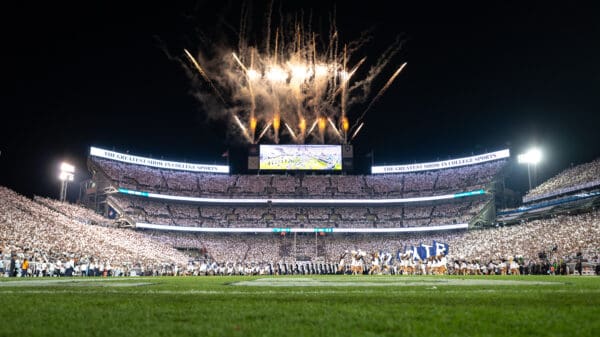
Photo by Penn State Athletics: The New-Looked Beaver Stadium
One of Franklin’s lasting contributions was his relentless push for facility upgrades — investments that his successor will inherit.
Penn State has committed roughly $700 million to revitalize Beaver Stadium and surrounding football facilities.
Phase I already earned Penn State a spot in 247Sports’ Top 30 facilities nationally. When renovations finish in 2027, the program’s infrastructure could rival any in the country.
The Lasch Building and locker room are also slated for another $50 million in enhancements — their second major upgrade since 2016.
These amenities are critical in attracting elite athletes who increasingly evaluate programs based on resources and player experience.
3. Financial Power and a Willingness to Spend to Win

First year defensive coordinator Jim Knowles during pregame warmups ahead of the annual Blue White game. (Photo by Matt Lynch, Nittany Sports Now
Penn State’s ability — and willingness — to spend aggressively sets it apart.
The $3 million investment to bring in defensive coordinator Jim Knowles drew some criticism, but it also underscored a shift in philosophy.
 Add Nittany Sports Now as a preferred source in Google! Click here to add us.
Historically cautious, Penn State showed newfound boldness and alignment between Franklin, athletic director Pat Kraft, and university president Neeli Bendapudi.
That alignment funded efforts to retain the senior class, secure impact transfers, and upgrade staff and infrastructure.
Kraft has emphasized that the next head coach must blend traditional development with modern adaptability — especially in maximizing the transfer portal.
According to CNBC’s 2024 college program financial valuations, Penn State ranked 11th nationally with $202 million in athletic revenue, ahead of Florida (No. 14, $189 million), Auburn (No. 20, $195 million), and Florida State (No. 24, $170 million).
Penn State was one of only 13 programs to surpass $200 million in annual revenue, ranking fifth in the Big Ten behind Ohio State, Michigan, USC, and Nebraska.
Fundraising, fan loyalty, and donor engagement remain among the strongest in the country. When Penn State leadership presents a compelling vision, financial support follows — fast.
4. The Big Ten’s Financial and Competitive Edge

INDIANAPOLIS, IN – JULY 23: The Amos Alonzo Stagg Big Ten Championship trophy sits on display during the 2024 Big Ten Media Days on July 23, 2024 at Lucas Oil Stadium in Indianapolis, IN. (Photo by James Black/Icon Sportswire)
Money drives much of modern college football, and the Big Ten’s media rights deal gives Penn State a distinct advantage.
The conference currently distributes about $60–65 million per full-share member annually — a figure expected to climb toward $100 million in the coming years. Only SEC programs can compare.
Beyond that, the Big Ten continues exploring innovative revenue streams, including potential venture funding models that could funnel nine-figure payouts to member schools.
Commissioner Tony Petitti’s proactive stance in securing four College Football Playoff berths for the conference ensures maximum exposure and opportunity.
In today’s razor-thin competitive landscape, consistent access to the playoff is everything.
Florida may enjoy similar stability within the SEC, but outside those two conferences, no program enjoys such a secure championship pathway.
5. Built-In Stability
Regardless of whether one agrees with Franklin’s dismissal, it’s clear he was given every opportunity to meet the program’s goals.
It took more than 20 losses to Top 10 opponents before Penn State fans reached their breaking point. The next coach may not receive identical patience — but will still find an environment more stable than most.
Since 2011, Florida has cycled through four head coaches. If Auburn or Florida State make changes, they’ll also be on their fourth in roughly the same span.
Penn State, meanwhile, will only be on its fourth head coach since Joe Paterno, and five of its last seven have lasted at least a decade — a streak dating back to 1918.
That kind of continuity is rare and deeply valued by coaches and their staff.
Penn State’s 2026 schedule sets up real nicely for a new coach to transition in and can make a great initial impression that will extend an already robust good will.
Final Thoughts
Ultimately, every job must feel right for the candidate. Personal fit matters — some may prefer UCLA or Virginia Tech for individual reasons.
But when coaches evaluate the total package, Penn State consistently grades as a Top 5 job nationally.
The alignment between administration, resources, facilities, tradition, and recruiting reach makes the Penn State opening the premier opportunity of this cycle — and unrivaled.