
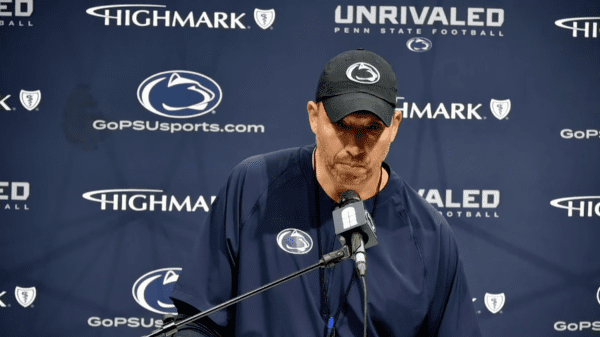




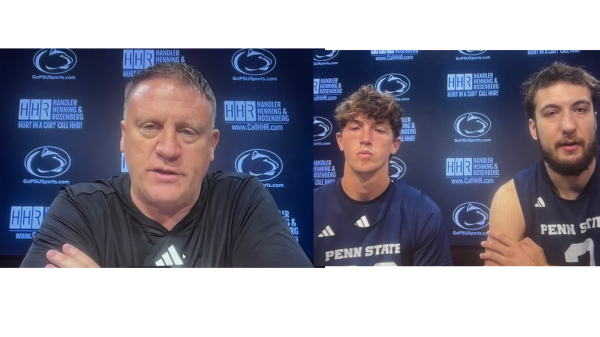






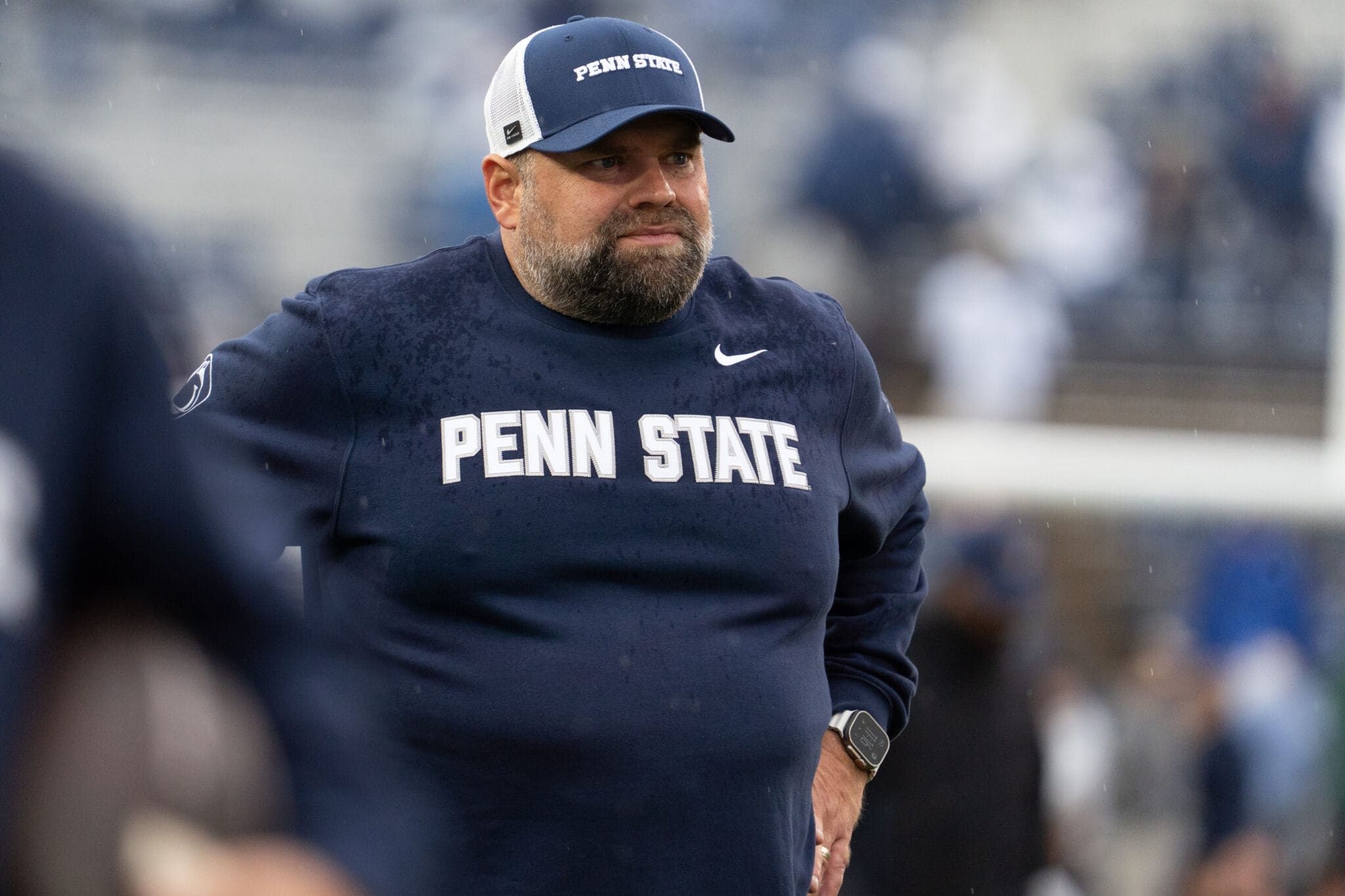
Penn State has come up short in all four Big Ten contests this season, and interim head coach Terry Smith is searching for answers—particularly in the passing game.
“On offense, we continue to not be able to throw the ball down the field, or even throw the ball in the intermediate zone. So we’ve gotta get that fixed,” Smith said.
Understanding the offense’s regression from last year’s College Football Playoff Semifinal team is complex, but three key factors stand out.
1. Failure to Implement a High-Volume Passing Attack With New Wide Receivers
When Penn State brought in Trebor Pena, Kyron Hudson and Devonte Ross through the transfer portal, it appeared that offensive coordinator Andy Kotelnicki was set to modernize the passing game—spreading the ball creatively among his new targets rather than funneling it almost exclusively to a single player, like it did with tight end Tyler Warren last year.
That evolution never materialized, and the numbers tell the story.
Last season, Warren totaled 693 yards after the catch (YAC) in 16 games. The much-maligned receiver corps of Harrison Wallace III, Liam Clifford and Omari Evans combined for just 401 YAC.
This season, the new trio—plus Tyseer Denmark—has managed only 290 YAC through seven games. That lack of production shows a continued failure to generate high-percentage completions in space.
Pena’s usage drop-off has been especially glaring. At Syracuse last year, he led the ACC in receptions (84) and ranked among the nation’s top short-yardage receivers, helping quarterback Kyle McCord lead the country in passing yards. Pena alone had 475 YAC, more than all Penn State wideouts combined in 2024.
This fall, Pena has been targeted only 12 times (8 catches) compared to 55 short-area targets the previous season. Ross has seen a similar regression—just 10 short-range targets after drawing 53 at Troy last year, when he posted 481 YAC.
Through seven games, Penn State receivers have been targeted 102 times, on pace for 174 over 12 games—barely exceeding last season’s 171 despite a higher total of offensive snaps.
The bottom line: Kotelnicki has underutilized his transfer additions and failed to establish the quick, space-driven attack that would help both the passing game and quarterback Drew Allar find rhythm.
2. Nick Singleton’s Inability to Break Away
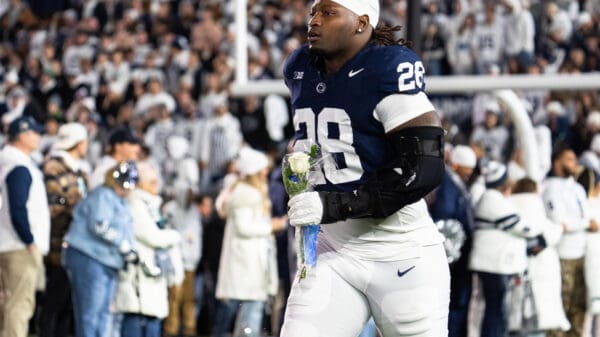
Photo by Matt Lynch, Nittany Sports Now
Early in the season, it appeared Kotelnicki planned to feature Singleton as RB1, using Kaytron Allen as a change-of-pace bruiser once defenses wore down—a strategy designed under former head coach James Franklin and running backs coach Stan Drayton.
That formula has backfired.
Singleton’s struggles stem from his hesitancy in reading blocks and inability to find open lanes that allow him to unleash his elite speed. In football terms, his “home run” rate has disappeared.
Last year, Kotelnicki seemingly rediscovered Singleton’s spark: he matched his freshman total with 18 breakaway runs of 15+ yards, amassing 448 breakaway yards and a 40.5% breakaway rate, —a mark considered “great” at the college level (45% is elite).
 Add Nittany Sports Now as a preferred source in Google! Click here to add us.
This season, Singleton has produced just one breakaway run for 16 yards and a BAR of 5.8%.
While execution issues fall partly on Singleton, Kotelnicki deserves blame for failing to scheme him into space—via swing passes, outside zones, or screen concepts that leverage his acceleration.
The penultimate play against Iowa exemplified the problem. With Allen emerging as the only consistent offensive weapon, Singleton got the call and faltered. In that key moment, Kotelnicki neither played to his hot hand nor designed a contingency to free Singleton. The play calling, player usage, and situational awareness all broke down.
3. Abandonment of the Intermediate and Deep Passing Game With Allar
It may sound counterintuitive, but Allar entered 2025 viewed by NFL scouts as a potential Day 1 pick—a prototype quarterback capable of dominating the intermediate and deep zones.
Last season, Allar completed 56% (65-of-116) of such throws—between the numbers or to the right boundary—for 17 touchdowns, 5 interceptions, and an NFL passer rating of 109.2, just shy of elite.
For comparison, Tampa Bay’s Baker Mayfield, currently having an MVP-level NFL season, completes 51.8% of his passes and has a 98.8 rating in those same zones.
Many expected Kotelnicki to expand that success with more vertical looks and complementary short throws to build rhythm.
Instead, both have regressed.
Through six games this season, Allar was 17-of-32 (53.1%) for four touchdowns and a 99.2 rating on those same routes.
The offensive line isn’t to blame. According to Pro Football Focus, Allar has actually been kept clean on 76.9% of dropbacks, up from 68.8% last year. Pressure has dropped from 31.2% to 23.1%.
That means the issue lies in play design. Kotelnicki’s horizontal emphasis—favoring perimeter screens and quick outs over vertical progression—has effectively shrunk the field for Allar. His targets in hot zones are down nearly 29%, and his confidence in pushing the ball deep appeared diminished prior to his season-ending injury against Northwestern.
By abandoning the very structure that showcased Allar’s arm strength and field vision, Kotelnicki had handcuffed his quarterback and contributed directly to Penn State’s offensive stagnation.
Final Thoughts
The regression of Penn State’s offense under Kotelnicki is not the product of one flaw but a combination of mismanagement, misusage, and missed opportunities. The inability to leverage transfer receivers, reignite Singleton’s explosiveness, and maintain Allar’s vertical edge has produced a once-dynamic unit that now struggles to obtain mediocrity.