











When Penn State loses, it seems all hell breaks loose.
It seems everyone wants to fire James Franklin, replace the quarterback, and much consternation is pointed towards the coordinator whose side of the ball failed the team.
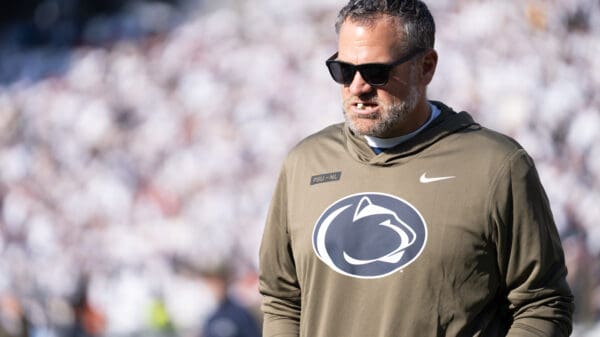
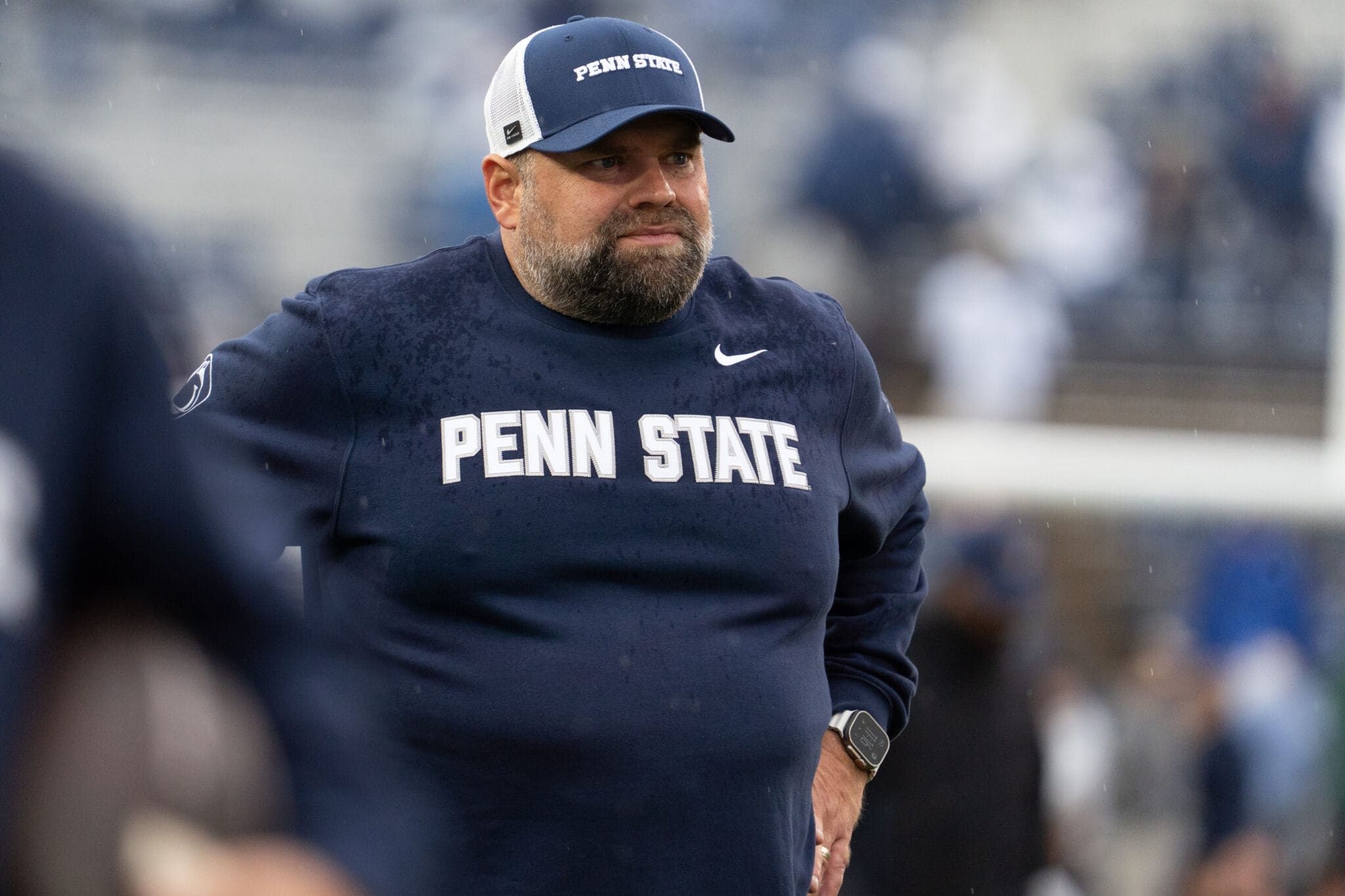
After the latest loss, many are blaming second-year offensive coordinator Andy Kotelnicki.
If you believe Kotelnicki is the problem, I feel you’re missing sight.
“I don’t think we were executing the way we’re capable of executing,” Franklin said following Penn State’s 30-24 loss to Oregon. “Obviously, we got to do whatever we got to do to manufacture yards. We got to make some plays. It’s all of it. Those things come at a premium when you’re playing really good teams. The margin of error is small.”
When you begin to unpack the errors the offense committed, Kotelnicki has some fault, but not to the degree of being the problem.
The offensive line had a terrible game.
Center Nick Dawkins committed the only infractions Penn State had on the night with two false start penalties.
That’s completely unacceptable.
I can understand if Penn State was on the road, having miscommunications on the snap cadence due to crowd noise, but they were at home where the fans were quiet— at least when Penn State was on offense.
Oregon was aplomb to the adverse conditions and never seemed rattled by the 111,015 fans that attempted to shake them.
What didn’t help Kotelnicki was how off schedule the offense got.
On eight first down plays in the first half, Penn State netted eight total yards, averaging one yard per play.
Penn State’s offense is predicated on first down success, having averaged this season nearly eight yards per first down play.
Not matching that against Oregon put the offense behind schedule.
Typically, you hear about players pressing, but coaches do as well.
There’s a fine line coordinators have to walk, and Kotelnicki seemed to have pressed at times to try to create that explosive play giving his offense some momentum to build on.
Looking even deeper, on those eight plays Penn State either had no gains or had negative outcomes. That screams poor execution, something Franklin alluded to postgame.
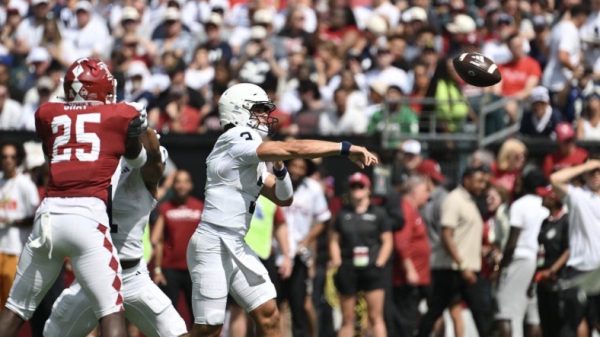
The poor execution of the offensive line impacted the passing game, where Drew Allar had another 50% passing day against a Top 10 foe.
Peering under the hood, you’ll find out Allar was pressured 72% of the time on dropbacks. I don’t expect that number to be zero considering how elite Oregon’s defensive front is, but constant pressure forces quarterbacks to try to process faster and that’s when mistakes happen.
Going even further, Allar was 13 of 14 when targeting wide receivers Devonte Ross, Trebor Pena, running backs Nick Singleton, Kaytron Allen, and tight end Khalil Dinkins.
 Add Nittany Sports Now as a preferred source in Google! Click here to add us.
The bad was when Allar was targeting wide receiver Kyron Hudson and tight end Luke Reynolds, who entered Oregon week as two of the Top 3 leading receivers, completing a single pass on 10 attempts.
That isn’t going to get it done.
Going back to Franklin’s postgame comment on execution, on the final interception, Kotelnicki dialed up one of Penn State’s bread and butter plays to Reynolds, who is seen as the heir apparent to Tyler Warren.
Allar simply didn’t execute on his throw and Oregon’s Dillon Thieneman made an amazing play on the ball to end the game.
How can you blame Kotelnicki for going to a play that has been a consistent staple in this offense?
“We have run that play to the boundary, a similar variation of that, for probably the last 12 years,” Franklin said during his Monday press conference.
“Most people run that play to the boundary. We’ve had a lot of the success with it. They did a really good job of coaching it and covering it, especially when it complemented the run we had been running all game…I mentioned earlier, I think you’ve got to give them credit. You got to throw the ball away or take a check down or run to give us a chance to play another down.”
What I’ve seen in the first four games is Franklin and Kotelnicki trying to find the plays that the players can execute with the maximum efficiency.
Stealing a line from Hall of Fame San Francisco 49ers head coach Bill Walsh from his book, “Finding the Winning Edge:”
“I directed our focus less to the prize of victory than to the process of improving—obsessing, perhaps, about the quality of our execution… I knew if I did that, winning would take care of itself”
Franklin and Kotelnicki are trying to get their veteran group executing to the standard they know they have the ability to achieve.
Think of it like this. New defensive coordinator Jim Knowles has the reputation of having a complex scheme.
For the first three games, Penn State allowed only 17 points.
In the defense’s first true test of the season, it only allowed 17 points in regulation.
The defense tired in overtime after losing the time of possession battle, but more importantly, it were on the field for 78 plays, in comparison Allar’s interception was Penn State’s 60th play.
I would give Knowles and his defense an A+ grade for what they accomplished in regulation.
Kotelnicki’s in its second season. The playbook didn’t radically change all of a sudden. The players aren’t executing at where they need to be and that is what cost them the Oregon game, not Kotelnicki.