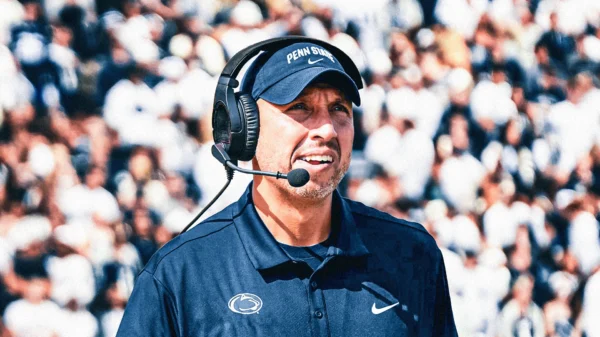











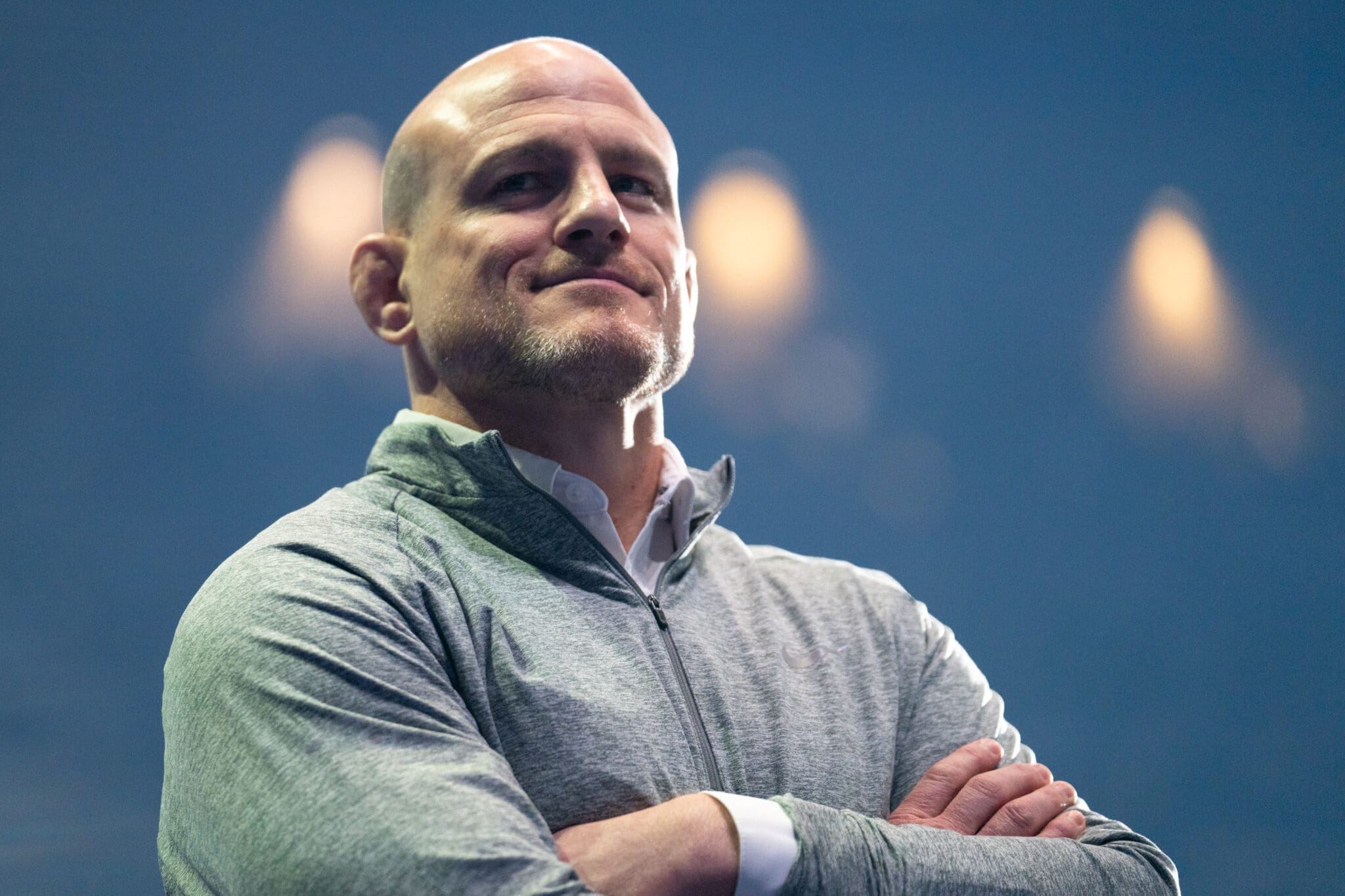
For many, April 17 carries special meaning. Seventeen years ago, Penn State introduced the greatest coach in school history.
At a place like Penn State, that is not a claim to throw around lightly.
This is a university that has seen icons walk its sidelines, dugouts and benches. It is a school where coaching greatness is not some abstract idea but part of the institutional identity.
Joe Paterno built one of the sport’s most recognizable brands.
Russ Rose turned Penn State women’s volleyball into a national power.
Guy Gadowsky elevated hockey
Emik Kaidanov is the most decorated fencing coach with 12 national championships.
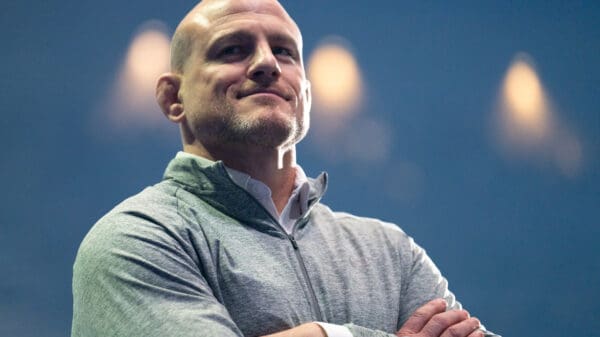
Yet the longer Cael Sanderson stays in State College, the harder it becomes to deny what is now staring everyone in the face.
Cael Sanderson has a real argument to be Penn State’s greatest coach in any sport.
Yes, even above Paterno.
That does not have to be read as an insult to Paterno. It is an acknowledgment of what Sanderson has built, how completely he has built it and how unmatched the dominance has become.
Paterno’s case will always begin with scale. Football is bigger. Beaver Stadium is bigger. The spotlight is bigger. He won national championships, built a brand with national reach and made Penn State football relevant for generations.
If the question is who is the most important coach in Penn State history, Paterno probably still holds that title.
No one else shaped the public image of Penn State athletics the way he did.
But importance is not exactly the same thing as greatness.
Greatness, at its purest level, comes down to this: How thoroughly did you own your sport? How high did you raise the standard? How long did you stay there? And did your program become the measuring stick for the entire nation?
On those terms, Sanderson’s resume is almost overwhelming.
Penn State wrestling under Sanderson is not merely successful. It is dynastic in a way that feels almost untouchable. National titles are no longer shocking. They are expected. Big Ten titles are no longer special occasions. They are checkpoints. Individual champions keep coming. All-Americans keep piling up. Team trophies are chased with the same calm inevitability that other programs reserve for qualifying wrestlers to nationals.
That is what separates Sanderson from almost everyone else. He has taken a sport built on brutal parity at the top that historically rotated between Oklahoma State, Oklahoma, Iowa, Iowa State and made Penn State feel inevitable.
That is an extraordinary achievement in wrestling because wrestling dynasties are hard to sustain. The sport is too physical, too year-round, too dependent on development and too vulnerable to roster disruption. One injury can swing a title race. One missed recruit can alter a weight class for years. One bad NCAA weekend can undo months of dominance.
 Add Nittany Sports Now as a preferred source in Google! Click here to add us.
And yet Sanderson has made the chaos feel organized in Penn State’s favor.
He has done it through recruiting, development, culture and vision. He does not just bring in stars. He makes them better. He does not just win with one golden generation and fade. He reloads. He does not just collect talent. He builds wrestlers who peak when it matters most. Year after year, Penn State looks like the deepest, calmest and most dangerous team in the country because Sanderson has created an environment where excellence is the baseline.
That is coaching greatness in its highest form.
The argument against Sanderson usually starts with one obvious point: football is king. Paterno won in a larger, harder, more visible arena. That is fair. Football is more complicated organizationally, more punishing politically and more demanding publicly than wrestling will ever be. Winning big in football comes with more variables and more pressure.
But that does not automatically end the discussion.
Because if the question is not which coach handled the bigger stage, but which coach reached the highest level relative to his sport, Sanderson’s case gets stronger and stronger. Paterno had incredible highs, but Penn State football under him was not permanently inevitable. It was elite, but not untouchable. There were valleys mixed in with the peaks. There were long stretches without national-title contention. There were seasons where Penn State was very good without being the unquestioned standard of the sport.
Sanderson’s Penn State has been the standard.
That matters.
When people discuss the greatest college coaches ever in their respective sports, they talk about those who changed the equation. John Wooden did that. Dan Gable did that. Nick Saban did that. Sanderson belongs in that type of conversation because his Penn State program has not just won championships, it has changed what the championship standard looks like.
There is also something to be said for the modern era. Sanderson is building this in a time of constant motion. Recruiting attention is national. The transfer portal exists. NIL is part of the landscape. Media scrutiny is unending. Expectations are no longer rising; they are permanently sky-high. And still, the machine does not crack.
If anything, it gets stronger.
That is where the comparison to Paterno becomes less uncomfortable and more necessary. Penn State fans revere Paterno because he symbolized excellence, consistency and identity. Sanderson now embodies many of those same things, only with even less slippage in results. His program has become the cleanest expression of what Penn State fans want from a powerhouse: development, discipline, star power, big-stage performance and banners.
A lot of Penn State fans may still hesitate to put anyone above Paterno because the emotional weight of football will always be greater. That is understandable. Paterno is not just a coach in Penn State history. He is a pillar of it.
But sports arguments are not won on sentiment alone.
If the discussion is about who has been the best coach, who has produced the most dominant program, who has most completely conquered his sport while representing Penn State, then Sanderson deserves the top spot. He may not be the most important coach in school history. Paterno probably remains that.
But greatest?
Cael Sanderson has earned that conversation, and by now, he may have won it.