









In the 1980s, the then-Washington Redskins’ offensive line became known as “The Hogs.”
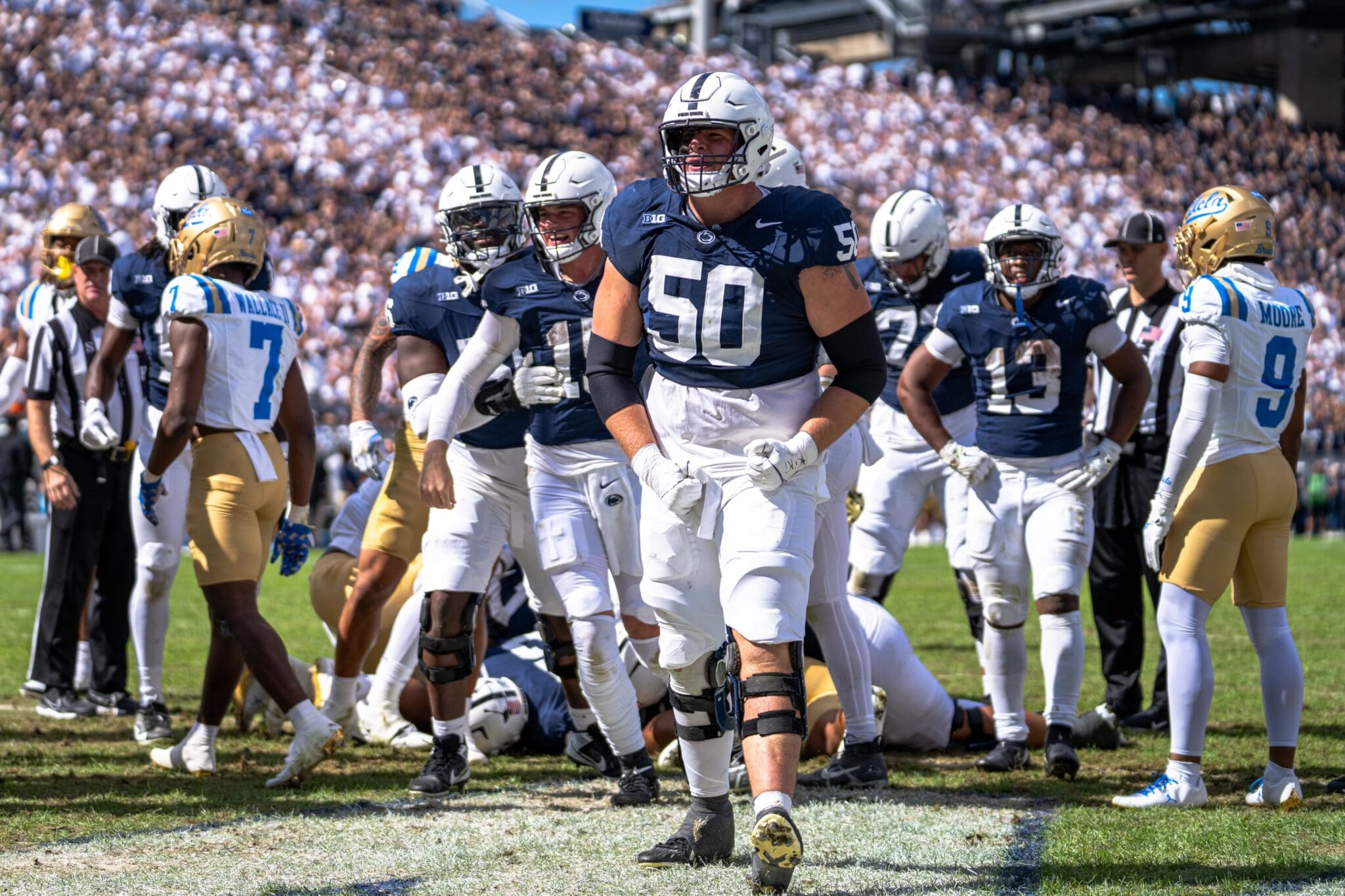
At Penn State, the boys on the line are known as “the dogs.”
That’s because of Ryan Clanton.
On the surface, Clanton had a glamorous college career.
He played at Oregon for three seasons under Chip Kelly, and in his last year, he was a captain on a team that won the Fiesta Bowl. But there was little glamour in what Clanton had to do to get to major college football.
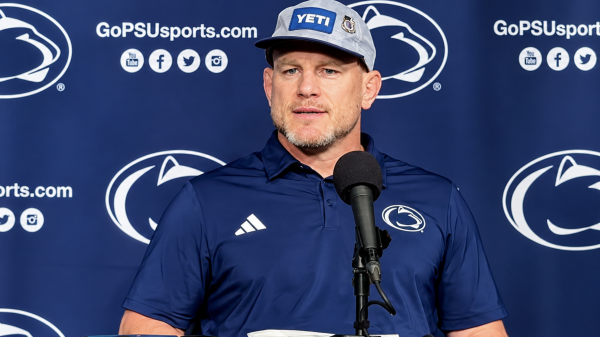
As Clanton explained to reporters after Penn State’s practice Thursday morning in the Lasch Building, a lack of recruiting interest led him to City College in San Francisco.
Off the field, he lived in a garage.
On the field, he became an JUCO All-American.
This is how Clanton’s “dog mentality” was born.
After Clanton’s career ended, he transitioned into coaching, where he honed his skills for four years at Ventura College, a community college in California.
“You hear people all the time, like even in football, they always talk about being a dog,” Clanton said, while wearing a t-shirt that said “dogs,” accompanied by the sketch of an angry dog’s eyes. “Well, for us, it’s a non-negotiable. You have to have that mentality if you don’t have it, better find it.”
The Penn State offensive line has produced several “dogs” over the past five years.
One of them, left tackle Olu Fashanu, went in the first round of the Draft two years ago, and another, left guard Vega Ioane, is going to go in the first round in less than a month.
So the current group has a standard to uphold, and fortunately for Penn State, the offensive line has dogs coming back (Cooper Cousins, Anthony Donkoh), dogs coming in (Brock Riker, Trevor Buhr) and talent that haven’t had much of a chance to bite yet (Malachi Goodman, Garrett Sexton)
Cousins and Donkoh are two of the leaders of the line.
 Add Nittany Sports Now as a preferred source in Google! Click here to add us.
Donkoh, who is out for spring practice with an injury, is slated to enter his third year as a starter and fourth overall with Penn State.
Cousins is entering Year 3, and spoke with reporters about what it means to be a dog.
“Just coming to work every single day with a lunch pail and just grinding,” Cousins said, “grinding with your group, moving people off the ball, getting your head in the block and just moving people 15 – 20 yards off the ball, throwing them on the ground. Talking a little crap a little bit, but really just doing your job efficiently and just being a good human being on social, too. So that’s part of the dog mentality for me: Who’s the best dog?”
During his interview, Cousins broke down some of the dogs of the o-line.
He described Riker, who was a freshman All-American at Texas State last season, as somebody who is “going to run through your face.”
He described Buhr– who coach Matt Campbell feels was one of the Big 12’s best offensive linemen at Iowa State– as “super violent.”
Clanton gave a painful example of Goodman– a former five-star recruit entering his second season– being a dog.
“He punched me in the chest, and I felt it,” Clanton said. You know what I mean?”
“He put his hand through my heart today, like I probably bleed,” he said.
Despite the pain– or maybe because of it– Clanton is a big fan of Goodman.
“But he can glide,” Clanton said, “he’s long, He’s aggressive and he’s smart, and he does a good job of retaining information and then putting it out there on the field, you know? And he plays confident.”
Confidence is a big part of being a dog, as is, well, the ability to destroy people.
“You got to be violent,” Clanton said. “You’ve got to want to be violent. You’ve got to want to run through somebody’s face. That’s a big part about playing O-line. At some places, you’re a human shield, just standing in front of the quarterback or in front of the running back, or you could be the hammer.”