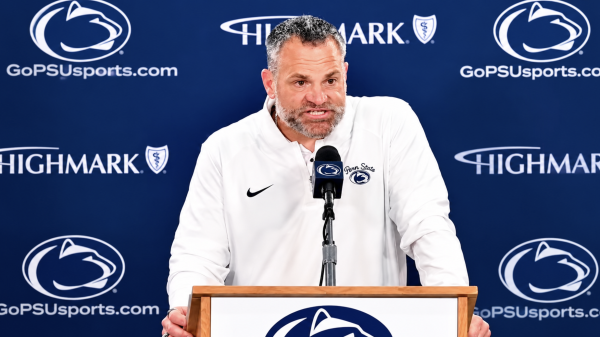


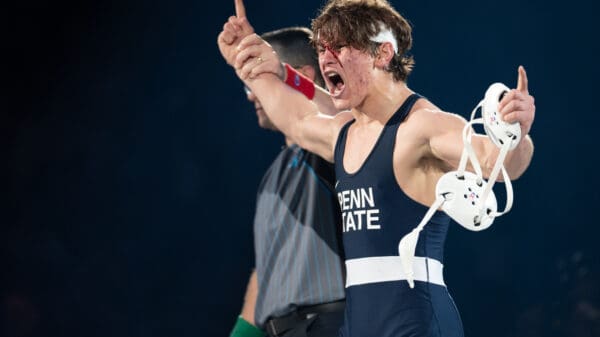
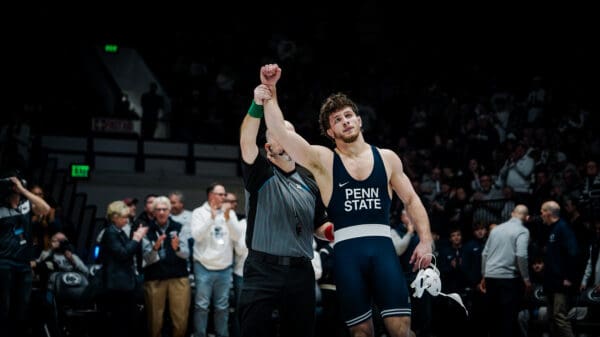
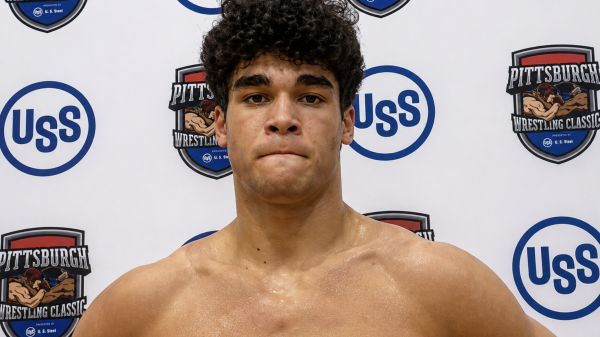











By winning the Dan Hodge Trophy, Penn State wrestling star Mitchell Mesenbrink did more than add another accolade to Penn State wrestling’s overflowing trophy case: He placed himself alongside some of the most dominant wrestlers not only in school history, but in the history of the sport.
Penn State Wrestling Star Mitchell Mesenbrink Wins Hodge Trophy
With the award, Mesenbrink becomes the latest Penn State wrestler to claim college wrestling’s top individual honor, joining Kerry McCoy (1997), David Taylor (2012, 2014), Zain Retherford (2017, 2018), Bo Nickal (2019), and Aaron Brooks (2024) in one of the most exclusive clubs in the program.
Mesenbrink brings Penn State’s total to eight Hodge Trophies won, the most of any program in the country.
What makes Mesenbrink’s rise so compelling is that his path to the award feels both familiar and unique.
Familiar, because Penn State has built the standard for this sort of dominance.
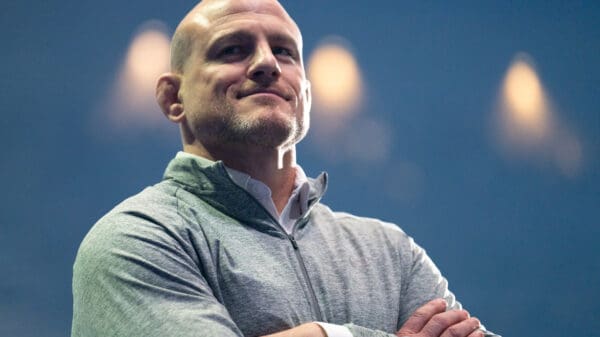
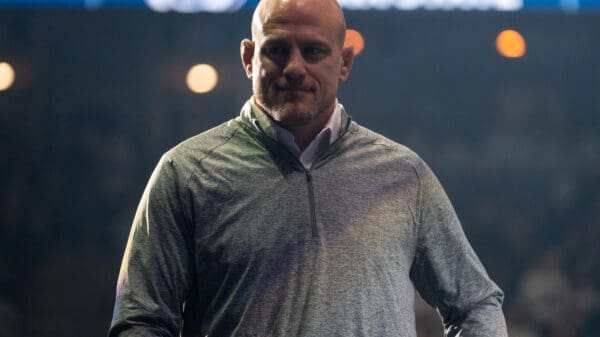
Under Cael Sanderson, the Nittany Lions have turned greatness into routine, producing wrestlers who don’t merely win, but overwhelm.
Unique, because Mesenbrink’s style stands apart even in a room full of legends.
He’s not a methodical grinder. He’s not a cautious tactician. Mesenbrink wrestles with a pace that suffocates opponents and a mentality that never seems content with simply securing a win. Every exchange feels like an attack. Every opening turns into points. Every match becomes a test of whether his opponent can survive the avalanche.
Few understand how they are positioned on the mat and has the ability to execute what is necessary to be in the proper position and control momentum.
Mesenbrink is one of the few.
That is what made him a Hodge Trophy winner.
Mesenbrink was in the Hodge conversation during his 2024-25 redshirt sophomore campaign where he went 27-0, won the NCAA title, a second Big Ten title and the NCAA’s season-long Technical Falls Award (18 tech falls).
Mesenbrink finished third in Hodge Trophy voting behind Oklahoma State’s Wyatt Hendrickson and former teammate Carter Starocci – who became the first NCAA Division I wrestler to win five individual NCAA National Championships.
Who Else?: Penn State Wrestling Star Carter Starocci Named Most Outstanding Wrestler
The Hodge Trophy was created by WIN Magazine’s Mike Chapman.
Chapman’s goal in creating the award was to motivate wrestlers to be dominant.
Mesenbrink’s motivation was on full display throughout the 2025-26 season, where he had an 100% bonus rate all the way up until the NCAA Quarterfinal. His eight pins were second on the team to PJ Duke (10), and Mesenbrink again finished 27-0.
His opus came in the 165 final for the national championship against a familiar foe.
It felt fait accompli that Iowa’s Michael Caliendo would be Mesenbrink’s last victim of the season, but Mesenbrink’s dominance getting the 20-4 technical fall just after Ohio State’s Jesse Mendez fell to Oklahoma State’s Sergio Vega, emphasized just how dominant Mesenbrink was.
When you compare Mesenbrink to Penn State’s other Hodge winners, the most natural stylistic parallel is Taylor.
 Add Nittany Sports Now as a preferred source in Google! Click here to add us.
Taylor won at 165 pounds and built his case on pace, offense, and relentless scoring pressure. Taylor’s Hodge seasons came with a reputation for making elite wrestlers look helpless. Mesenbrink has brought that same feeling to the mat. He breaks resistance with tempo, chains attacks together, and turns close matches into lopsided ones with startling speed.
He is less pin-driven than Retherford or Nickal, who often felt like they were hunting a finish from the opening whistle. He’s not the heavyweight force McCoy was, he doesn’t have the four-time NCAA champion aura that surrounded Brooks by the end of his career.
But Mesenbrink’s brand of domination belongs in the same conversation because it’s unmistakable. When he’s on the mat, the match bends to him.
That’s the essence of a Hodge winner.
For Penn State, the award is another reminder of the program’s unmatched place in modern wrestling. The Nittany Lions are no longer just producing national champions. They’re producing all-time seasons with regularity. Mesenbrink’s victory reinforces what the rest of the sport already knows: the standard in college wrestling still runs through State College.
This is what separates a champion from a figure woven into program history. Plenty of wrestlers win NCAA titles. Far fewer become the best wrestler in the nation for a season. That is what the Hodge Trophy signifies. It is not just excellence. It is supremacy.
Mesenbrink, who is majoring in psychology, may have been suppressing his true emotions when speaking about the Hodge Trophy during the NCAA Wrestling Championships.
“I like wrestling because, for the most part, I can keep pretty much everybody else’s opinion out of it,” Mesenbrink said. “That’s how I wrestle too, so the refs don’t have to go, ‘Oh, is it takedown or not?’ I am going to make sure it’s there.
“The Hodge is such an opinionated thing, such a futile kind of thing at the end of the day that people vote on. I’m not going to put my hope or well being into something that people are going to vote and think about.
“It’s a cool thing, but … even when they crown the Hodge trophy, then they’re going to be talking about who’s going to get it the next time. It’s just like we’re talking about things that come and go, collect dust. Ben has one at [the Askren Wrestling Academy] back in Wisconsin, and all the arms are snapped off it because all the kids that come to AWA play with it. I think that’s a good representation of what trophies do. They just sit, wear, and collect dust.”
Whether it matters to him or not, Mesenbrink now has that validation.
In a Penn State era filled with icons, he’s carved out his own place. Not by imitating the legends before him, but by overwhelming the sport in a style that is unmistakably his.
That is what makes this Hodge Trophy meaningful.
It’s not simply that Mesenbrink won it.
It’s that he earned it in a way that made it feel inevitable.