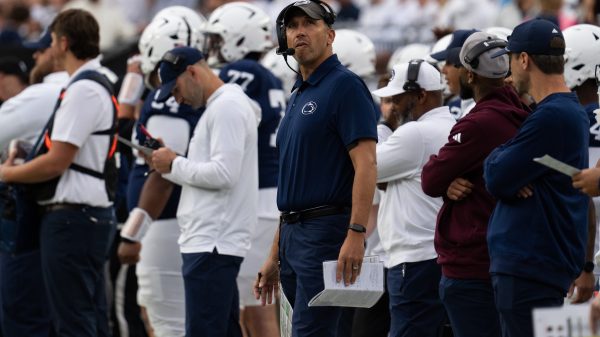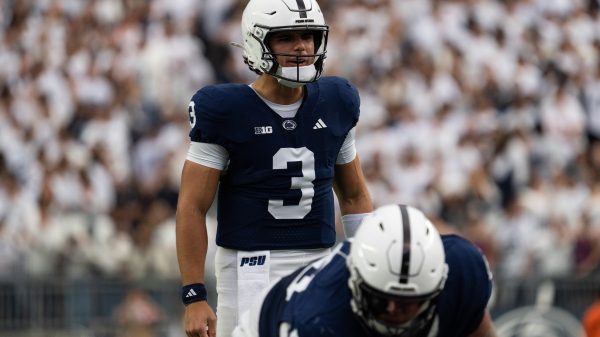


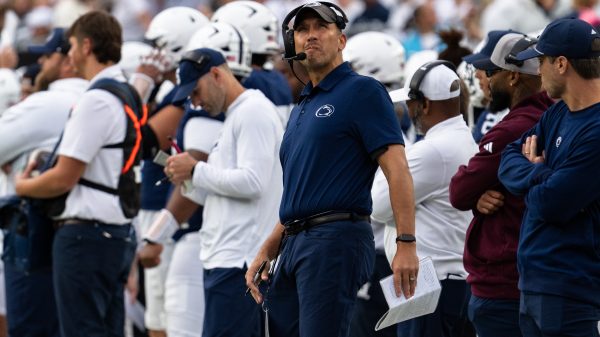










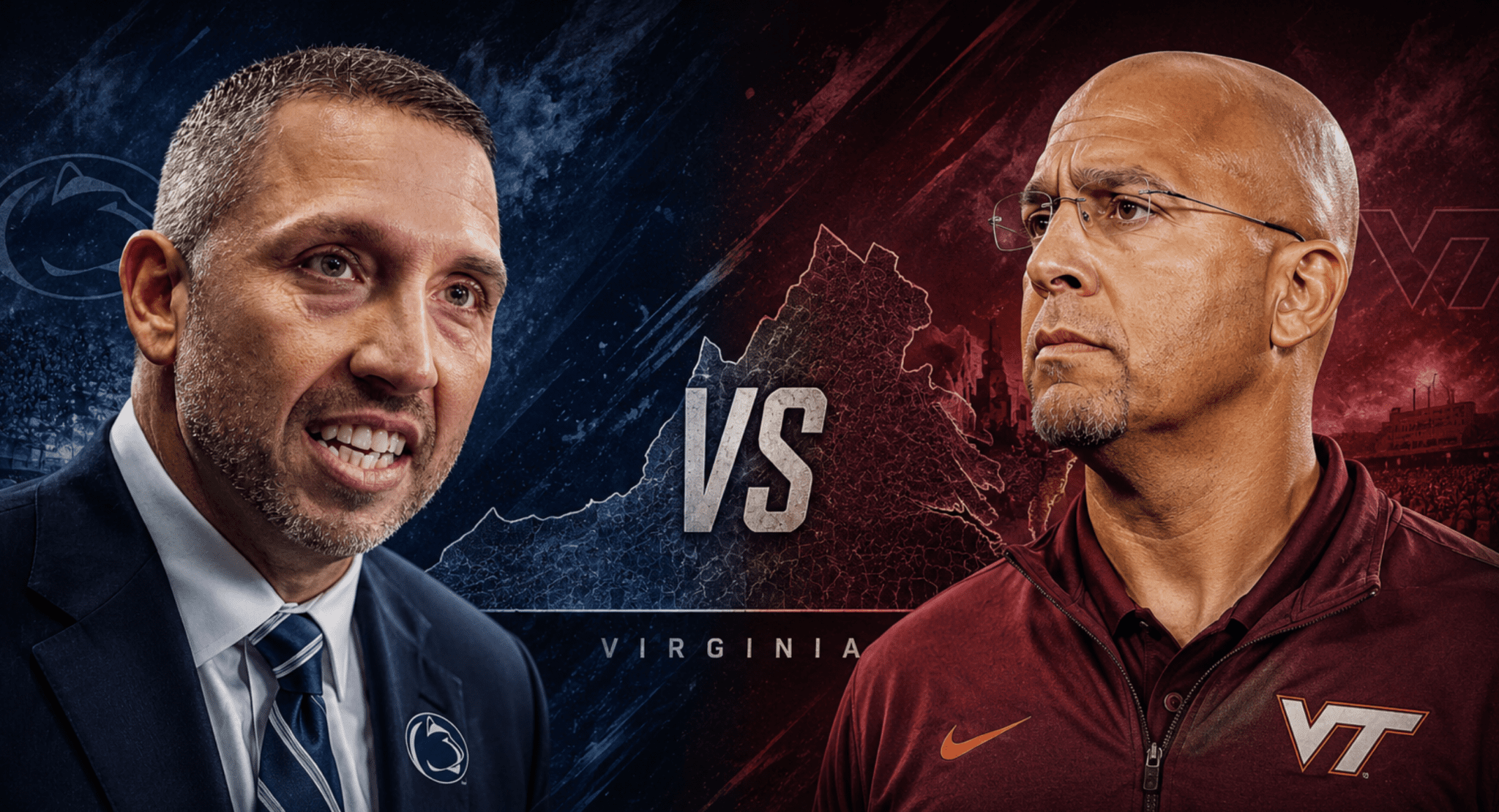
Matt Campbell has made it clear that Penn State’s recruiting vision has to stretch beyond Pennsylvania.
The Nittany Lions have to win within the six-to-eight hour radius that has historically given the program its best foundation.
Pennsylvania is the home base.
New Jersey is the revival project.
Maryland and DC comprise two-thirds of the DMV are non-negotiable.
The final piece of the DMV, Virginia may be the most complicated piece of the map.
Because now James Franklin is there.
That is what makes Virginia different from the other states Penn State has to prioritize under Campbell. This is not just about whether the Nittany Lions can recruit another Mid-Atlantic state. It is about whether Campbell can recruit the same regional map Franklin once understood better than almost anyone in the Big Ten.
Franklin knows Penn State’s pitch. He knows the recruiting territory. He knows the schools, the relationships, the staff expectations, the fan base, the NIL pressure points and the way Penn State has historically tried to build its roster.
Now he is selling against Penn State from Blacksburg.
That does not mean Virginia suddenly becomes a must-dominate state for Penn State. It is not Pennsylvania. It is not New Jersey. It is not Maryland.
But Virginia is not a state Penn State can ignore.
The state gives Penn State access to Tidewater, Richmond, Northern Virginia and the private-school talent that connects naturally to the greater Washington, D.C. orbit. It produces the kind of players Penn State has to keep finding if Campbell is going to build a roster capable of holding up in the expanded Big Ten: offensive linemen, edge rushers, defensive backs, wide receivers and occasional national-level skill talent.
Penn State does not need five or more Virginia signees every class.
But it does need to be selective and dangerous there.
The Old Dominion has given the Nittany Lions legends such as Michael Robinson, Tyler Warren, Deon Butler, and Kaytron Allen who set Penn State’s rushing record last year over another Virginia native Evan Royster.
The Nittany Lions have to be able to go into Virginia and win the right battles. They have to be able to identify the players who fit their development model, build early relationships and beat out the schools that naturally recruit that region. Sometimes that will mean Virginia Tech. Sometimes it will mean Virginia. Sometimes it will mean Clemson, Georgia, Tennessee, North Carolina, South Carolina or another SEC program trying to pull talent north.
That is why Virginia is different.
It is inside Penn State’s recruiting radius, but it is also sitting in the middle of a crowded fight.
Tyler Calvaruso of 247Sports, who recently appeared on a recent episode of NSN’s “Joe and the Fatman,” sees that challenge clearly.
“I think going into Virginia in general is not easy because one, when the programs in Virginia are good, you know, UVA is coming off a really good season,” Calvaruso said. “I think James Franklin has a pretty good chance to get that thing turned around in Blacksburg. So, that’s going to impact things, but the brand will definitely help Penn State still going to the DMV, going to Virginia, and get guys.”
That is the balance.
Penn State still carries weight.
The logo matters. The Big Ten platform matters. The College Football Playoff expectations matter. The history of sending players to the NFL matters. Penn State is still Penn State, and that gives Campbell’s staff advantages that many programs do not have.
But Virginia is not empty space on the map.
Franklin did not take over a program without resources, history or identity. Virginia Tech’s best teams were built on in-state recruiting, player development and defensive toughness. When the Hokies were at their peak under Frank Beamer and Bud Foster, Virginia high school football mattered deeply to the program’s identity.
Foster explained that point when looking back at one of Virginia Tech’s strongest recruiting stretches.
“I think all of our guys except for one was from the state of Virginia, if I’m not mistaken,” Foster said recently on his podcast Beyond The Pail. “That makes a statement about Virginia recruiting, the state of Virginia recruiting. I’m talking high school recruiting.”
That is the version of Virginia Tech Franklin is trying to re-create.
Foster’s larger point was that when Virginia Tech and Virginia were both good, the top players in the state often stayed home. The rivalries were real. The players knew each other. The best high school talent in Virginia flowed through Blacksburg and Charlottesville.
“The top 25 is dominated by Tech and UVA,” Foster said of that era.
That is the danger for Penn State.
If Franklin makes Virginia Tech relevant again and starts keeping more in-state players home, Virginia becomes harder for Penn State. If he also starts pushing back into the DMV, Penn State’s map gets tighter.
That is where this column fits into the broader recruiting picture for Campbell.
If Penn State protects Pennsylvania, revives New Jersey, prioritizes Maryland and competes in Virginia, Campbell has the outline of a playoff-level recruiting footprint.
If Virginia Tech starts winning Virginia and bleeding into Maryland, the southern edge of Penn State’s recruiting radius becomes far more difficult.
For Campbell, Virginia is a test of expansion.
 Add Nittany Sports Now as a preferred source in Google! Click here to add us.
For Franklin, it is a test of survival and validation.
That is the tension.
Franklin has to prove he can rebuild Virginia Tech by owning its state, modernizing its operation and making the Hokies feel nationally relevant again. Campbell has to prove Penn State’s regional reach did not leave with Franklin.
Those two goals now run directly into each other.
The 2027 cycle already shows why Virginia matters.
Penn State is heavily involved with Carter Jones, a four-star offensive lineman from Poquoson, Virginia. Jones has had Penn State in the mix with Clemson, Tennessee and Georgia, giving the Nittany Lions a direct test case for what recruiting Virginia will look like under Campbell.
Jones also recently posted on X that he had “a great time” with Penn State after Ryan Clanton and Taylor Mouser came to see him.
That matters because it shows Penn State is not treating Virginia as an occasional courtesy stop. It is actively recruiting one of the state’s top players at a premium position.
Calvaruso sees why Jones is such an important target.
“They’re right in it with Carter Jones, man, the four-star offensive lineman from Virginia, and they got a pretty good chance to get that one done,” Calvaruso said. “He’s really been their top guy out of Virginia throughout the cycle.”
Jones is the type of player Penn State has to win for if it wants Virginia to remain a real part of the map.
He is not just a name on a board. He represents the exact kind of recruitment that will define Campbell’s reach. Penn State is not going to sign every top player in Virginia. But when there is a high-level lineman who fits the program’s identity and sits inside the region, the Nittany Lions have to be a serious factor.
Calvaruso said Jones brings the kind of profile Penn State should want.
“Really tough kid, you know, versatile, athletic, moves well, side-to-side agility is what it needs to be for a high-level offensive line prospect,” Calvaruso said. “He projects as an interior at the next level, but he can play tackle as well. And that just physicality up front, the violence that he plays with, I think that’s something that makes him a really good fit at Penn State.”
That phrase matters.
A really good fit at Penn State.
That is what Virginia can offer Campbell. Not volume. Not dominance. Fit.
The right offensive lineman. The right edge rusher. The right defensive back. The right receiver. The right athlete from Northern Virginia, Richmond or Tidewater who fits what Penn State is trying to become.
That is why Maryland and Virginia are connected in this discussion.
Former Penn State offensive lineman Landon Tengwall, who was Rivals’ No. 4 player in Maryland for the Class of 2021 out of Good Counsel, called the DMV a must-win area for Campbell.
“The DMV is one of the most underrated recruiting hotbeds in all of America,” Tengwall said. “If you go back and look at the Penn State rosters over the last 10 years, you will see that a large number of the stars/contributors on those teams came from the DMV. I think Matt Campbell must find a way to recruit well in the DMV region. Non-negotiable.”
That does not stop at the Maryland border.
Northern Virginia is part of that same recruiting conversation. The schools, trainers, relationships and recruiting traffic overlap. If Penn State is going to prioritize the DMV, it cannot pretend Virginia is separate from the equation.
Virginia should not be judged the same way as Pennsylvania, New Jersey or Maryland.
Penn State does not need to own the state.
But with Franklin now at Virginia Tech, Campbell cannot afford to let Blacksburg become the program that controls the southern edge of Penn State’s recruiting radius.
That is the real stakes.
The first three parts of this recruiting map answer where Penn State has to recruit.
Pennsylvania has to be protected.
New Jersey has to be revived.
Maryland has to be prioritized.
Virginia answers a different question.
Who is now standing in the way?
For Campbell, that answer is familiar.
And that is what makes Virginia so complicated.