















As No. 5 Penn State (USCHO/NPI) inches closer to postseason play, the pressure continues to mount on a team carrying enormous expectations. After last season’s surprise Frozen Four run and the arrival of generational prospect Gavin McKenna, anything short of sustained success has drawn scrutiny.
Following a seven-game winning streak, the Nittany Lions hit a four-game winless stretch that put the program under a microscope. Injuries mounted, performances dipped, and many observers began suggesting changes particularly to a longstanding element of head coach Guy Gadowsky’s approach: his goalie rotation.
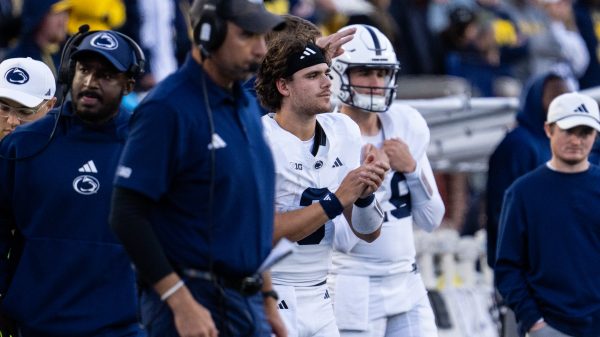
“We change personnel because we have to, but we don’t want to change our stripes, because to change your stripes takes months,” Gadowsky said recently. “You don’t just come in and say, ‘Hey, for this team, we play like this now.’ We have our stripes, and that’s how we play.”
One of those defining “stripes” throughout the 2025–26 season has been Penn State’s strict two-goalie system.
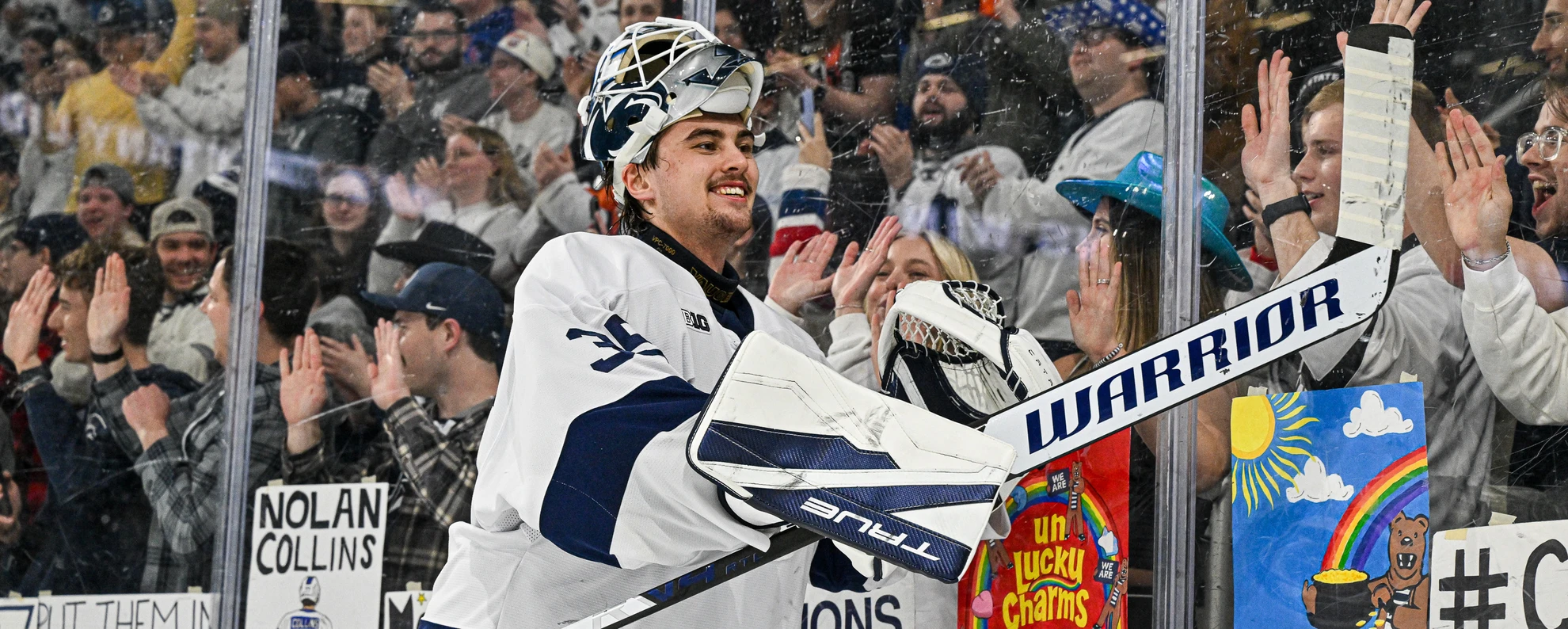
Freshman sensation Josh Fleming has started the opening game of nearly every series and has dazzled. His performance has earned him national attention, including consideration for the Hobey Baker Award and the Mike Richter Award, given to the NCAA’s top goaltender. Fleming is currently tied atop the Big Ten in save percentage (.932) with Michigan State standout Trey Augustine.
Game 2 of each series has belonged to Kevin Reidler, a transfer from Omaha and a native of Gävle, Sweden. Reidler’s season has been more uneven, and recently he has endured a rough stretch.
Over his last five starts, he allowed 18 goals and surrendered three or more goals in four of those games, numbers that naturally prompted calls for a change.
Given those statistics, many questioned why Gadowsky would not simply ride the hotter hand.
Instead of asking what was wrong with the rotation, I asked a better question following Penn State’s dramatic 5–4 overtime comeback win over Ohio State: Why did Gadowsky stick with Reidler after his team fell behind 4–1?
“What I can tell you is that kid’s a fighter,” Gadowsky said afterward. “He’s an absolute fighter. We’ve played very poorly in front of him at the start of many games and left him out to dry, and he just gets tougher and tougher as it goes.”
His assessment proved accurate. After Ohio State’s Max Montes scored a short-handed goal that gave the Buckeyes a three-goal lead, Reidler stopped the final 14 shots he faced, allowing Penn State to mount its comeback.
Defenseman Jarod Crespo supported his coach’s evaluation, pointing to breakdowns in front of both goaltenders rather than failures in the crease.
“I think this weekend we weren’t as good as we usually are at finding sticks in front of the net and clearing guys out,” Crespo said. “There was a lot of traffic that Kevin and Fleming both had to see through. As a goalie, that’s a really hard thing to do. That’s our job as defensemen is to clear space and let them see the puck.”
Statistically, Fleming holds the advantage in traditional categories. He leads in save percentage (.932 to .906), goals-against average (2.29 to 3.11), and shutouts (2–0). Reidler, however, has played more minutes (965 to 837), faced more shots (531 to 469), and recorded more wins (11 to 9).
Advanced metrics tell a more nuanced story of one that helps explain Gadowsky’s continued confidence in the rotation.
 Add Nittany Sports Now as a preferred source in Google! Click here to add us.
Expected save percentage (xSV%), which adjusts for shot quality, shows almost no separation between the two goaltenders (.903 for Fleming, .901 for Reidler). On the penalty kill, where Penn State has been heavily tested, their performances are also nearly identical (.897 for Fleming, .894 for Reidler).
Perhaps most importantly, both rank among the Big Ten’s top four in save percentage on high-danger scoring chances. Fleming sits second at .881, while Reidler ranks fourth at .852 behind Michigan’s Jack Ivankovic and Michigan State’s Augustine.
While analytics support the decision, Gadowsky insists his evaluation goes beyond numbers.
“I judge goaltenders by what kind of teammates they are, their work ethic, what they’re committed to, their save percentage, their wins, and their goals against,” he said.
In other words, trust and consistency matter as much as statistics.
The benefits of the rotation become even clearer when considering postseason hockey. Tournament play compresses schedules and amplifies fatigue. Teams relying on a single goaltender often face diminishing returns as the grind intensifies. Penn State, by contrast, has two battle-tested options who remain fresh and game-ready.
That depth could prove decisive. A rested goaltender seeing the puck clearly behind a defense committed to cleaning up rebounds and traffic is a powerful advantage when margins tighten in March.
The rotation also preserves team chemistry. Players understand their roles, preparation remains consistent, and neither goaltender faces the pressure of carrying the load alone.
Rather than creating uncertainty, the system fosters resilience, a trait that defined last year’s postseason run.
Ultimately, Gadowsky’s refusal to abandon his “stripes” reflects a broader philosophy: success built over months cannot be reshaped overnight without consequences. The rotation is not stubbornness for its own sake; it is a calculated strategy grounded in trust, data, and experience.
As Penn State pushes toward the playoffs, skepticism will persist whenever results waver.
But the evidence suggests the Nittany Lions possess one of the conference’s most valuable assets: two capable goaltenders prepared for the moment.
In a sport where a single hot performance can define a tournament, maintaining that dual threat may be the difference between another deep run and an early exit.
For Penn State, the goalie rotation isn’t a problem to fix. It’s a strength to protect and a stripe worth keeping.