












Winning a football game is an extraordinarily difficult thing to do. There’s a reason schools pay a king’s ransom to any coach who can consistently deliver victories.
Just look at Oxford, Mississippi, where ESPN is camped out waiting for Lane Kiffin’s next move—whether he’ll stay at Ole Miss or bolt for LSU.
Penn State is navigating a similar landscape. Like LSU, Florida and Auburn, Penn State is searching for the right leader to restore the program to national prominence.
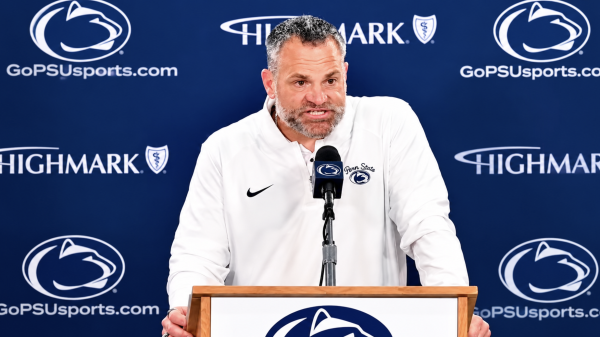
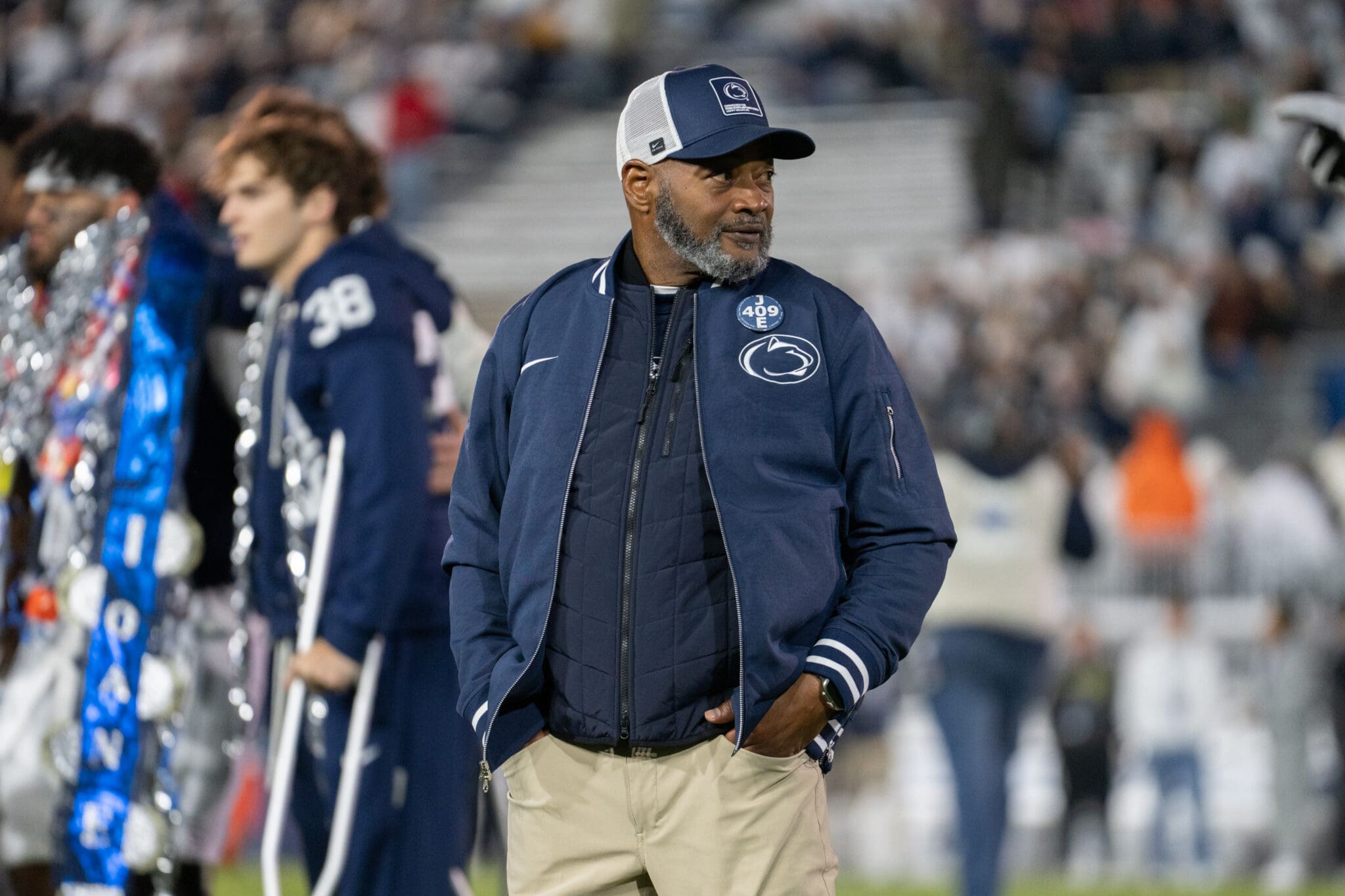
For the past six games, Terry Smith has been that leader, thrown directly into a baptism by fire.
It was fitting that Penn State’s 40–36 win over Rutgers mirrored the turbulent journey Smith has been on. The game was chaotic, stressful, and unpredictable—much like Smith’s stretch as interim head coach.
“It was a hard-fought victory. Definitely not a pretty victory, but it counts all the same,” Smith said afterward.
Winning ugly is always better than losing beautifully. Case in point: the Indiana game.
Penn State led Indiana 24–20 with under four minutes remaining and the ball.
The first objective was to drain the Hoosiers’ timeouts, which Penn State accomplished.
The second objective was finishing the game on their terms, which Penn State didn’t accomplish.
It was the one that lingered in Smith’s mind. It influenced almost every key decision he made against Rutgers.
“I was thinking about the Indiana game and what I would do differently,” Smith said. “It’s all learned from experience. I’m a ton better coach than I was the night of Iowa, a ton better than Indiana. We shouldn’t have given Indiana the ball back, and I said we’re not gonna do that tonight.”
The second half against Rutgers was a pure seesaw of momentum swings.
Legendary coaches like Nick Saban, Urban Meyer and Pete Carroll often describe momentum as the defining difference between the college and pro games. In college football, emotion fuels sudden, seismic shifts.
The best coaches know not just how to seize momentum, but how to protect it.
Smith learned that lesson painfully against Indiana, where conservative playcalling kept the door open and cost Penn State what could have been a signature victory—one that might have strengthened his case to become the permanent head coach.
After linebacker Amare Campbell’s scoop-and-score put Penn State ahead late against Rutgers, the Scarlet Knights still wouldn’t go away.
 Add Nittany Sports Now as a preferred source in Google! Click here to add us.
The Nittany Lions’ defense had been gashed all night by quarterback Athan Kaliakmanis, running back Antwan Raymond, and wide receiver KJ Duff.
If Smith was having Indiana flashbacks, they hit hard when Kaliakmanis fired a 42-yard strike to Duff on Rutgers’ final drive.
Much like Omar Cooper Jr.’s game-winning touchdown that lifted No. 2 Indiana earlier in the season, Duff’s grab put Smith in a familiar position: needing one stop.
After an eight-yard completion to Kenny Fletcher Jr., Penn State finally delivered. Three straight defensive plays stuffed Rutgers and prevented the Scarlet Knights from picking up the three yards they needed for a first down. Penn State had survived the drive and, momentarily, regained momentum.
But momentum is fragile, and Penn State nearly squandered it. A blindside block by wide receiver Trebor Pena created a first-and-23, backing the Penn State into a corner. It looked like Smith might have to send his exhausted defense back onto the field. Instead, Rutgers gifted Penn State a lifeline with a defensive holding penalty that turned third-and-26 into a first down.
Then came the first attempt at the knockout blow: a 50-yard burst by Kaytron Allen that flipped the field. Penn State drove into scoring position, but the offense began to stall.
With a chance to extend the lead to seven with a field goal, Smith instead remembered the lesson from Indiana: ending the game on their terms was worth more than three points.
“One of the things we learned tonight was how to end the game on our terms,” he said.
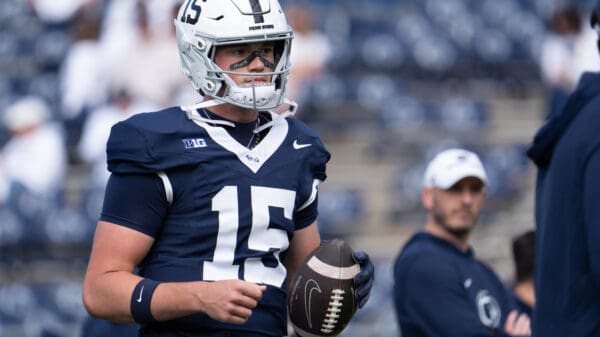
On fourth-and-two, season, bowl eligibility, and perhaps Smith’s own job prospects hanging in the balance, Smith pushed his chips to the center of the table. The play call was bold: a fake to Allen that fooled the defense, followed by a perfectly placed pass from Ethan Grunkemeyer to tight end Andrew Rappleyea in the flat.
Ballgame.
Great coaches understand that sometimes the bigger risk is not going for it but relinquishing momentum. Smith had felt that sting against Indiana. Against Rutgers, he chose decisiveness.
It was one of many lessons Smith has absorbed in his six-game tenure. Whether that résumé is strong enough to earn him the full-time job remains unknown.
But no matter the outcome, Smith learned something invaluable about himself.
“It meant a lot,” he said. “It taught me a lot. It taught me that I know I can truly do this job.”