










UNIVERSITY PARK, Pa. — The warning signs were there before Penn State ever took the field against Wisconsin.
Penn State was creating pressure through its first three games. It was affecting quarterbacks. It was finding different ways to get into the backfield.
But it wasn’t consistently finishing.
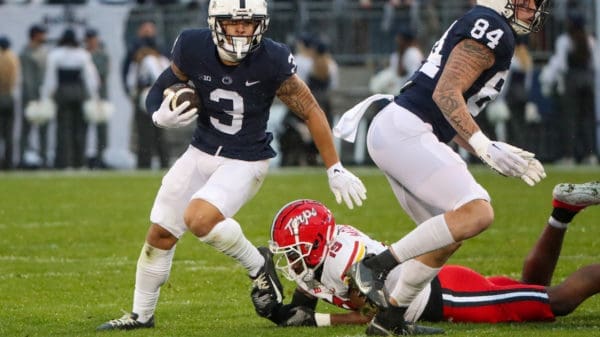
Against Wisconsin, it went from an interesting statistical concern to one of the defining reasons Penn State walked out of Beaver Stadium with a 24-20 loss.
Entering Big Ten play, Penn State had generated 50 pressures through three games, according to Pro Football Focus, but turned them into only five sacks. Against Buffalo alone, 18 pressures produced just one sack.
The question entering Wisconsin wasn’t whether Penn State could disrupt the quarterback. It was whether the Nittany Lions could finally turn that disruption into drive-ending plays.
The answer was largely no.
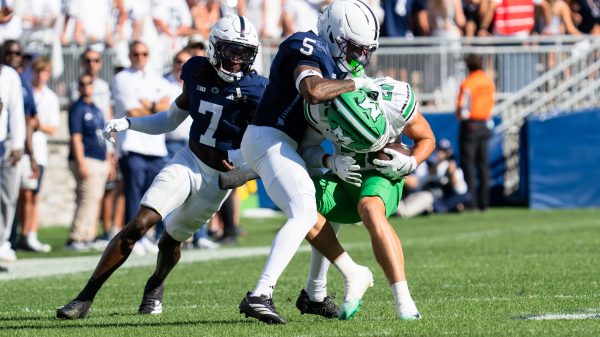
PFF credited Penn State with 14 pressures against Wisconsin with one sack, four quarterback hits and nine hurries. Linebacker Tony Rojas recorded the lone sack. Linebacker Kooper Ebel led Penn State with three pressures, including two hits and a hurry, while EDGE Ike Ezeogu produced four pressures with one hit and three hurries.
Those numbers don’t describe a defense incapable of reaching Wisconsin quarterback Colton Joseph.
They describe one that couldn’t finish when it mattered.
The Nittany Lions were credited with seven quarterback hurries, but only one sack for two yards.
Joseph survived long enough to change the game.
After throwing three interceptions, Joseph responded in the second half and ultimately finished 18-of-38 for 235 yards and two touchdowns while adding 39 rushing yards and another score. His two touchdown passes came in the final 3:31, including the decisive 72-yard strike to tight end Jacob Harris with 1:13 remaining.
That’s what makes the ending so painful for Penn State.
The defense had spent much of the night doing enough.
It intercepted Joseph three times. Cornerback Josiah Zayas returned one 51 yards for a touchdown. Linebacker Tony Rojas and cornerback Daryus Dixson also picked him off. Penn State repeatedly put Wisconsin behind schedule and forced Joseph into mistakes.
But Wisconsin kept getting another opportunity.
 Add Nittany Sports Now as a preferred source in Google! Click here to add us.
The Badgers converted only 1-of-7 third downs in the first half before going 3-of-8 after halftime and 2-of-4 in the fourth quarter. They were also 2-for-2 on fourth down for the game.
The defense that had repeatedly escaped trouble earlier couldn’t escape it at the end.
Ebel pointed toward execution when asked afterward about Penn State’s inability to finish plays.
“I think a lot of it goes back to pre-snap, getting aligned. Obviously, it’s awesome to play in Beaver Stadium. Sometimes it’s almost harder to play in Beaver Stadium on defense, though, just because it’s so loud. It’s hard to hear yourself and hard to hear your teammates.
“Get lined up, know your assignment and play fast. Obviously, it’s really hard to practice tackling and do those things live at practice while staying healthy throughout the season. But that’s something we definitely need to improve on and something we’re going to continue to hammer away at this week.”
Ebel’s comments went beyond the pass rush. He described Wisconsin’s explosive plays as stemming from Penn State’s mental mistakes and said the defense was sometimes only “a hair off.” Against a good opponent, he said, being a hair off is enough for an explosive play.
That is essentially what happened.
Even Penn State’s best pass-rush performance reflected the problem. Ebel earned a team-best 71.1 PFF pass-rush grade, with Ezeogu at 68.6, Zion Tracy at 64.5 and Rojas at 62.3. Yet 14 total pressures resulted in Joseph going down behind the line just once.
That continues a trend Penn State knew it needed to reverse.
Before Wisconsin, the Nittany Lions’ pressure rate had improved in each game rom roughly one pressure every 3.3 pass-rush opportunities against Marshall to one every 2.5 against Temple and one every 1.9 against Buffalo. The concern was whether those pressures would become sacks once Penn State reached conference play.
Wisconsin provided the first meaningful answer.
Pressure is valuable. Hits matter. Hurries can create turnovers, and Penn State’s three interceptions demonstrated that.
But eventually a defense has to finish the play.
Penn State had opportunities to do that Saturday.
Joseph kept escaping them.
And eventually, Wisconsin made Penn State pay.