



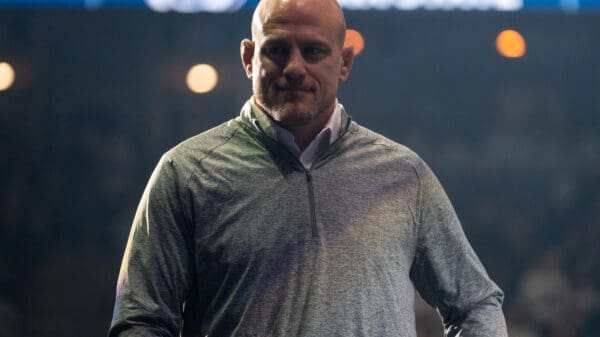






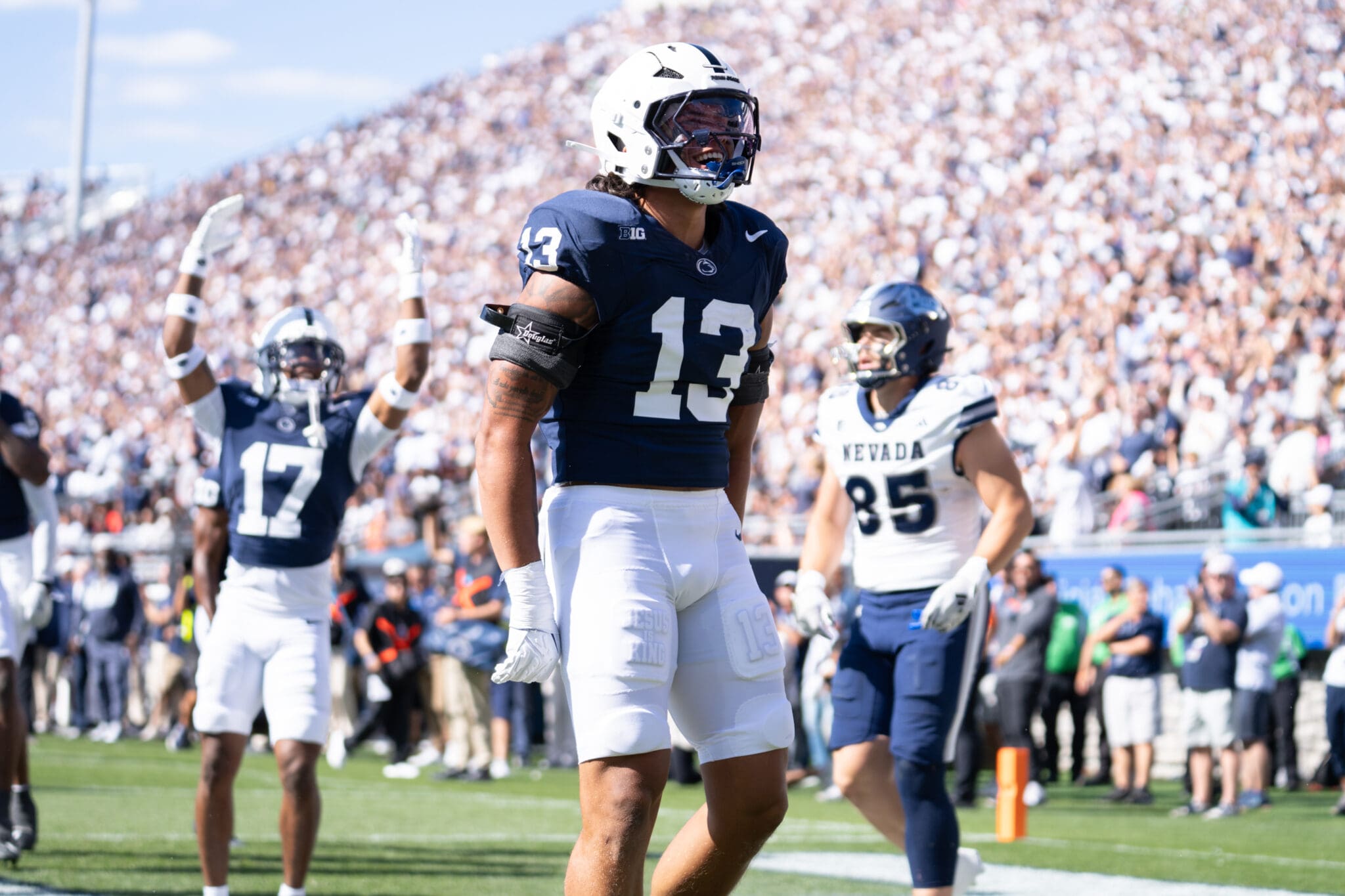
Matt Campbell didn’t inherit a broken defense.
He inherited one that needed to evolve in the game where the offense spreads it out fully and leverage has to come from supporting players.
Penn State still boasts the speed, length and athleticism that have defined the program for years, but Campbell and defensive coordinator D’Anton Lynn have quietly reshaped the roster with players who understand their system without sacrificing the Nittany Lions’ defensive identity.
The result is a unit that may not feature the household names of recent Penn State defenses, but one that enters 2026 with legitimate playmakers at every level and enough versatility to become one of the Big Ten’s stingiest groups.
The biggest questions aren’t about talent.
They’re about whether Penn State can consistently pressure quarterbacks off the edge and whether the safety depth can hold up over a 12-game schedule.
If those answers are yes, the Nittany Lions have the personnel to make life miserable for opposing offenses.
The Front Is Built Differently
The first thing that jumps out during Penn State practices isn’t speed.
It’s size.
The projected defensive tackle rotation averages nearly 315 pounds, giving the Nittany Lions the kind of interior mass capable of controlling the line of scrimmage against the Big Ten’s increasingly physical rushing attacks.
Keanu Williams and Armstrong Nnodim headline the interior, while freshman Siale Taupaki and Dallas Vakalahi provide depth that simply wasn’t available a year ago.
That size should allow linebackers Tony Rojas and Kooper Ebel to play downhill instead of constantly navigating traffic.
It also fits perfectly within Lynn’s philosophy of collapsing the pocket from the inside while allowing his edge defenders to finish plays.
The Biggest Question Is Also The Biggest Opportunity
No position has generated more discussion throughout fall camp than defensive end.
Penn State believes Ike Ezeogu is ready.
The veteran has arguably enjoyed the strongest offseason of anyone on the defensive front and has steadily separated himself as the projected starter. His development has been one of camp’s biggest stories.
But the player everyone continues talking about is Caleb Bacon.
Originally recruited and developed as an off-ball linebacker at Iowa State, Bacon proved to be one of the Cyclones’ most disruptive defenders whenever he attacked the quarterback.
According to Pro Football Focus, Bacon produced a 14.5 percent pressure rate in 2025.
For perspective, a 15 percent pressure rate is generally considered elite among college edge rushers.
The remarkable part is Bacon accomplished that while playing linebacker.
He finished last season with three sacks, 16 quarterback pressures and 9.5 tackles for loss, leading Iowa State in sacks while ranking second in pressures.
Campbell quickly recognized the opportunity.
“As we kind of got through spring, we kind of felt like, man, we’d be missing the boat not to add his multiplicity,” Campbell said. “He’s a great edge player. He certainly has the ability to slide back and play Mike or Will linebacker at times as well because he’s great in coverage. He’s a smart football player.”
Bacon’s ability to consistently win one-on-one battles may make it impossible to keep him off the field.
While Penn State lists Bacon now at defensive end, the biggest question is who will emerge to play opposite of Ezeogu, whether it is Bacon, Yvan Kemajou, or Max Granville.
Linebacker Remains The Heartbeat
Penn State has become synonymous with elite linebacker play.
 Add Nittany Sports Now as a preferred source in Google! Click here to add us.
That tradition appears safe.
Tony Rojas returns after seeing his 2025 season cut short by injury, but his production before getting hurt reminded everyone why NFL scouts remain so intrigued.
In just four starts last year, Rojas recorded 25 tackles, 4.5 tackles for loss and two sacks. Across his career, he has accumulated 105 tackles, 14 tackles for loss, four interceptions and three sacks, showcasing the rare range that makes him one of the conference’s most complete linebackers.
Alongside him is Iowa State transfer Kooper Ebel, who quietly brings one of the most consistent resumes in the Big Ten.
Ebel finished 2025 with 77 tackles, eight tackles for loss and a sack while earning Academic All-Big 12 recognition. He has started 27 collegiate games and gives Penn State another veteran communicator in the middle of the defense.
Together, Rojas and Ebel should provide the leadership and reliability Lynn wants in the second level.
Experience Defines The Secondary
Penn State may not have a deeper safety room than recent seasons, but its starting tandem could rank among the conference’s best.
Marcus Neal returns after another productive season in Happy Valley and pairs with former Iowa State standout Jeremiah Cooper to give Penn State two experienced playmakers capable of disguising coverages and creating turnovers.
The concern comes immediately behind them.
There is a noticeable drop-off in experience, making Vaboue Toure’s development one of the defense’s biggest storylines throughout September.
If Toure proves capable of handling meaningful snaps, Penn State’s safety concerns diminish considerably.
At cornerback, Daryus Dixson and Audavion Collins possess the length and athleticism Lynn covets.
Dixson quietly developed into one of Penn State’s most reliable coverage defenders last season, while Collins arrives with experience and physicality that should translate well to the Big Ten.
Zion Tracy gives the Nittany Lions another versatile defensive back capable of handling nickel responsibilities against today’s spread offenses.
That versatility becomes increasingly important considering how often Penn State will face three- and four-receiver sets.
Speed, Size and Versatility
The common thread throughout Penn State’s defense is flexibility.
Bacon can play linebacker or edge – which he is now listed at.
Rojas is equally comfortable blitzing or dropping into coverage.
Several defensive backs can rotate between safety, nickel and corner without forcing schematic changes.
That positional versatility allows Lynn to disguise pressure packages and coverage rotations before the snap, making quarterbacks hesitate just long enough for the pass rush to arrive.
The defense may not produce the gaudy sack totals Penn State fans became accustomed to in recent seasons, particularly early in the year while the edge rotation settles.
But it should be significantly more difficult to run against, more multiple in coverage and better equipped to adjust week-to-week against different offensive styles.
Ultimately, that’s what Campbell wanted when he rebuilt his roster.
He didn’t just bring familiar faces from Iowa State.
He assembled a defense capable of playing fast, communicating seamlessly and adapting to whatever offenses the Big Ten presents.
If Penn State finds the consistent edge pressure it has been searching for throughout camp, this defense has every ingredient to finish among the nation’s elite once again.