






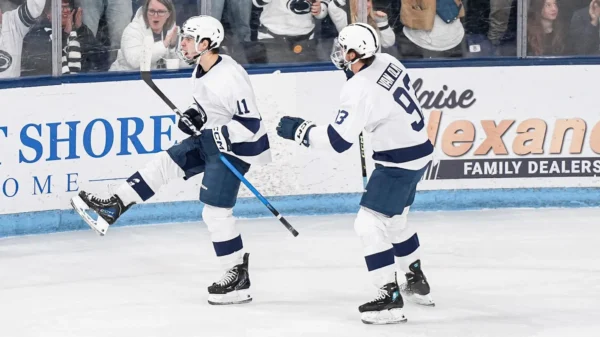
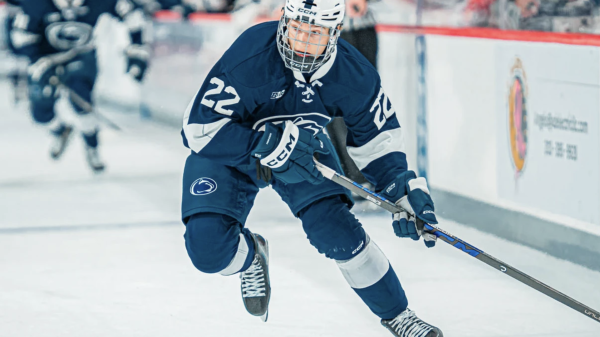








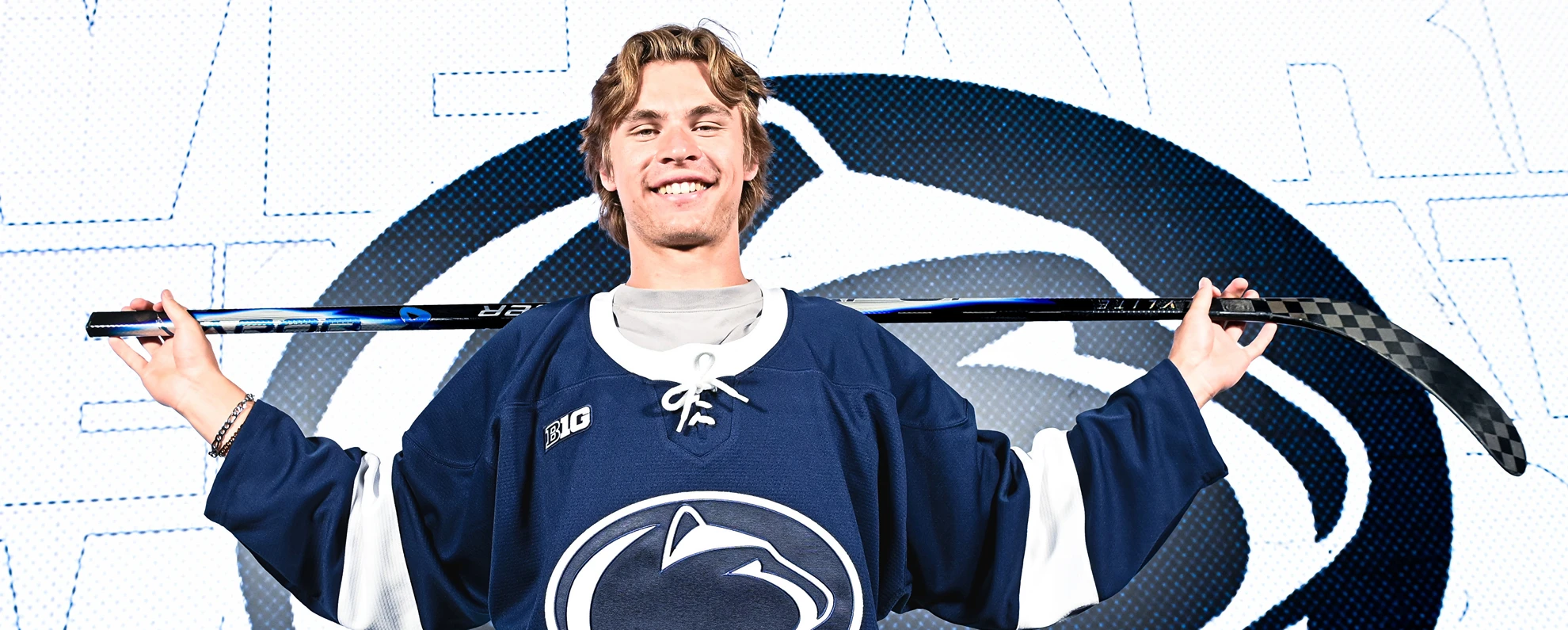
Gavin McKenna arrived at Penn State as one of the most hyped prospects in recent hockey memory.
He leaves his freshman season looking exactly like what NHL teams believed he could be: a potential No. 1 overall pick and a franchise-altering offensive talent.
McKenna’s path has already been unusual.
After starring with the Medicine Hat Tigers in the WHL, he became the face of the new era of college hockey eligibility for former CHL players.
Instead of spending his draft year dominating junior competition again, McKenna challenged himself against older, stronger and more structured NCAA opponents.
That decision may end up helping his NHL projection.
At Penn State, McKenna was not just productive. He was one of the most dynamic offensive players in college hockey. He finished with 51 points, including 15 goals and 36 assists, in 35 games. He also won the Big Ten scoring title, became the Big Ten Freshman of the Year and earned a spot as a Hobey Baker Award top-10 finalist.
For a draft-eligible freshman playing in one of the toughest environments in college hockey, that production many NHL talent evaluation are hopeful translates..
Offensive Skill Set
McKenna’s best trait is his hockey sense.
He sees the ice at an elite level and processes plays faster than most players around him. That is what separates him from a player who is simply skilled. McKenna does not need a clean rush or a perfect setup to create offense. He can slow the game down, draw defenders toward him and open passing lanes that were not there a second earlier.
His playmaking is NHL-caliber already.
McKenna is especially dangerous off the half wall and in transition.
On the power play, he can operate as the primary creator because of his patience, vision and passing touch. He is comfortable holding the puck under pressure, waiting for a defender to overcommit and then slipping a pass into the slot or across the ice.
His shot is also a real weapon. McKenna is not just a pass-first winger. He can beat goalies clean with his release, especially when defenders give him space at the circles. His ability to change angles before shooting makes him harder to read, and his quick hands allow him to turn broken plays into dangerous looks.
The next step will be adding more strength behind that shot and becoming harder to separate from the puck against NHL defenders.
Skating and Pace
McKenna is not merely fast; he is deceptive.
His skating allows him to manipulate defenders rather than simply skate around them. He changes pace well, uses hesitation moves effectively and can attack through layers of coverage. That ability to vary speed is a major reason he projects as a high-end NHL offensive driver. This is why the comparisons to Connor McDavid are appropriate as McDavid with his blinding speed forces NHL defenders to make quick decisions and manipulating them mentally as he is several steps ahead.
He is at his best when he has the puck on his stick with space to read the ice. But as the season went along at Penn State, he became more comfortable creating offense in tighter areas. That adjustment was important because NHL teams will want to see that his game can translate against bigger, stronger opponents.
He does not need to become a power forward, but he does need to continue building strength and balance so he can win more inside battles and absorb contact without losing possession.
Compete Level and Two-Way Game
McKenna’s defensive game is not the selling point of his profile, but it should not be viewed as a major red flag either.
 Add Nittany Sports Now as a preferred source in Google! Click here to add us.
Like many elite offensive prospects, his biggest defensive challenge is consistency away from the puck. There are times when he can be more engaged below the puck, more assertive on back pressure and more committed to winning defensive-zone battles.
That said, McKenna is smart enough to become reliable defensively. He reads plays well, understands spacing and has the instincts to anticipate where the puck is going. The issue is less about awareness and more about strength, habits and maturity.
What NHL evaluators are looking for is not for McKenna to be a Selke Award defensive level player, but more is not a defensive liability and competing at the same level for the full 200-feet of ice.
His Penn State season was valuable because it forced him to play against older college players who could lean on him physically and take away time and space. He had to learn how to pick his spots, manage contact and impact games even when he was not physically dominant.
That experience should help him when he reaches the NHL.
NHL Projection
McKenna projects as a top-line NHL winger with game-breaking offensive upside.
His ceiling is that of a franchise offensive centerpiece: a player who can run a power play, drive transition offense and produce at a point-per-game level in his prime. He has the creativity, puck skill and playmaking vision teams search for at the very top of the draft.
The safest projection is that he becomes a high-end top-six forward and power-play weapon. The upside projection is much higher.
The reason McKenna is viewed as the likely top pick is simple: elite offensive talent is the hardest thing to find. Teams can develop defensive structure, add complementary size and surround a player with two-way support. They cannot easily manufacture McKenna’s vision, creativity and ability to tilt the ice.
Areas to Improve
McKenna’s biggest developmental needs are strength, physical maturity and consistency in heavy-traffic areas.
At 6-foot and around 170 pounds, he still has room to add muscle. That will matter in the NHL, where defenders will challenge him physically, especially along the boards and in the offensive zone. He does not need to become a punishing player, but he does need to become stronger on pucks.
He can also continue improving his defensive-zone details. NHL coaches will want to trust him late in games and against top competition. That means more consistent backchecking, stronger wall play and better habits when the puck is below the goal line.
The other question is how quickly he adjusts to the pace and physical demands of the NHL. His track record suggests he figures out new levels quickly, but the jump from college hockey to the NHL is still significant.
Bottom Line
Gavin McKenna is the type of prospect teams build draft boards around.
His freshman season at Penn State strengthened his case as the top player in the 2026 NHL Draft because he proved he could produce against older competition, handle pressure and continue improving as the season progressed. His World Juniors performance only added to the profile.
There are areas to refine, particularly strength and defensive consistency, but the upside is obvious.
McKenna has the vision of an elite playmaker, the skill of a top-line scorer and the confidence of a player used to carrying expectations. For whichever NHL team lands him, the appeal is not just what he is now.
It is what he can become.
And what he can become is a franchise-changing forward.