








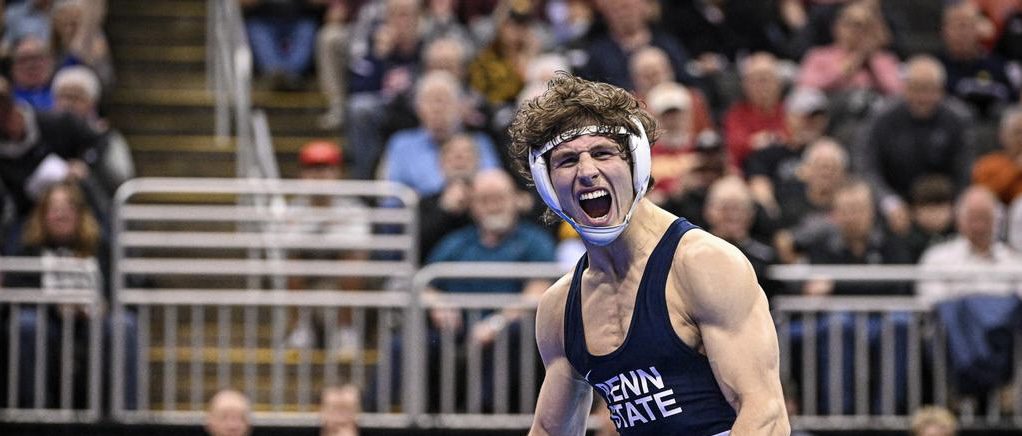
It looked like Penn State wrestling would be losing Levi Haines to graduation, but that might not be the case.
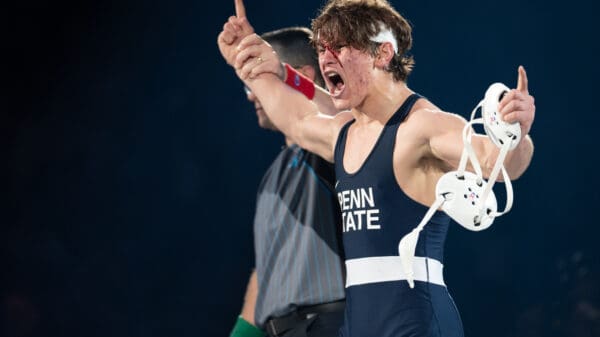
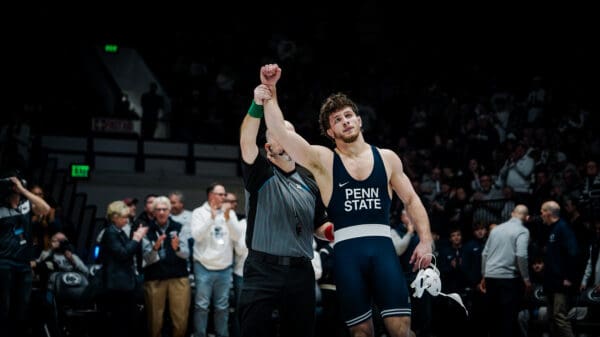
When Haines beat Nebraska’s Christopher Minto last month to win his second national championship, that looked like a perfect end to Haines college career.
Haines is a rarity in 2020s college sports, having competed four years at the same school without redshirting, and the results were fantastic.
Four All-America honors. Four Big Ten Championships. Three NCAA final appearances and two individual national titles. But there’s a chance Haines isn’t done.
FloWrestling’s Christian Pyles reported Thursday afternoon that wrestlers who competed for four years straight out of high school are looking more and more likely to get a 5th year of eligibility.”
“There is increased momentum around 5 for 5,” Pyles wrote. “Many coaches believe and expect it to become reality sooner rather than later.
“Nothing certain, but you should know these are the realities coaches are preparing for as we speak.”
“Five for five” is what it sounds like: The idea of athletes having five years of eligibility instead of four.
But this doesn’t mean that, say, athletes who redshirt their first year can be with a program for six years instead of five. Therefore, as much as Penn State would love to have 2026 Hodge Trophy winner Mitchell Mesenbrink back for two more years instead of one, this would not change his eligibility situation since he’ll be goin into Year 5.
 Add Nittany Sports Now as a preferred source in Google! Click here to add us.
The eligibility clock would start either on an athlete’s 19th birthday or at the beginning of their first college season.
In short, this would make the redshirt obsolete.
It’s not guaranteed that this will come to pass, but it’s more than a pipe dream.
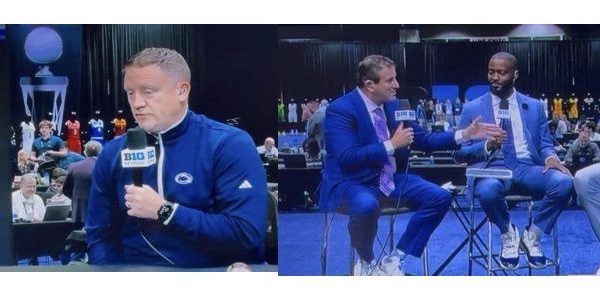
NCAA President Charlie Baker is openly advocating for it, and said so at the NCAA Men’s Basketball Final Four in Indianapolis earlier this month.
“The goal here was to come up with something that was a lot simpler and sort of familiar,” Baker said. “If you think about it, we all grow up playing sports and our kids grow up playing sports and it’s U-10, U-12, U-15, U-18, U-20, U-22 leagues, right? The idea of an age-based dynamic or parameter is pretty familiar. That’s the way most of amateur sports is organized in who gets to participate.”
For this to pass, the NCAA Division I council— which consists of athletic directors, conference commissioners, faculty members and student athletes— will have to vote to approve the proposal.
ESPN reported that this vote could happen as soon as next month and, if it passes, could go into affect in June.
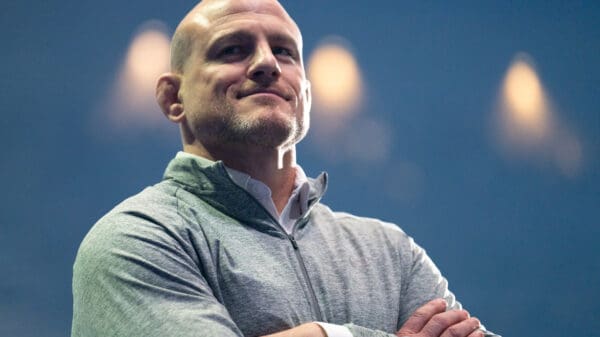
Penn State would be the heavy favored to win its 14th national title in 16 seasons under Cael Sanderson with or without Haines. But it’s hard to argue that the team wouldn’t be better with him.