




















College football in this era magnifies every hard decision a coach or player has to make.
Programs are being rebuilt in real time. Rosters turn over faster than ever. Coaches are judged almost immediately. In that kind of environment, it can be easy to focus only on the next practice, the next portal addition, the next recruiting win, or the next season.
But one of the most dangerous mistakes a program can make is forgetting what built it in the first place.
There is an old saying: The past is a lesson, not a place to live, but ignoring it comes at a cost.
That cost can show up in ways that are hard to measure at first. It can weaken a program’s identity. It can disconnect players from the standard they are supposed to uphold. It can create distance between a team’s present and the people who helped make its success possible.
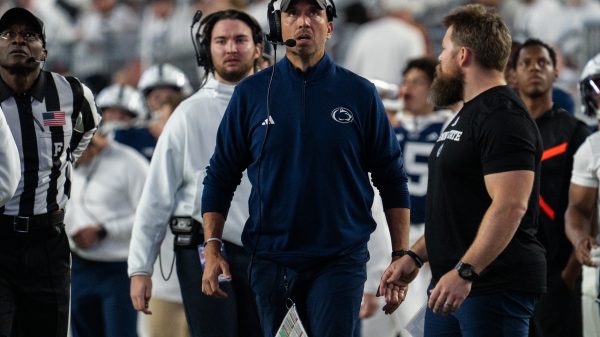
New Penn State football coach Matt Campbell does not appear willing to let that happen.
Campbell opened his introductory press conference with a statement that revealed a great deal about how he intends to build.
“Culture and excellence is always built on leadership,” Campbell said. “We talk so much in our program that everything rises and falls with great leadership.”
Many of his early comments centered on Penn State athletic director Pat Kraft and president Neeli Bendapudi, but as Campbell continued, he turned to a part of the program that had not been emphasized enough in recent years: Penn State’s football lettermen.
“I think to a really special group, this Penn State football lettermen,” Campbell said. “I walked into Lasch yesterday and this incredible lettermen wall, 2,200 names. You could almost feel goosebumps going down the side of your arms looking at some of these incredible names. Some of the best, Jack Ham. Some of the best ever to play the sport of football. You knew their excellence and what they stood for, a blue-blood football program. No question.”
That was not empty praise. It was a signal.
Campbell’s emphasis from the start has been clear: reconnect Penn State football’s present with its past.
That might sound simple, but it matters more than ever in modern college football. In an age when so much of the sport is transactional, programs need anchors. They need traditions that are more than slogans. They need former players to be part of the living culture rather than names on a wall or highlights in a video montage.
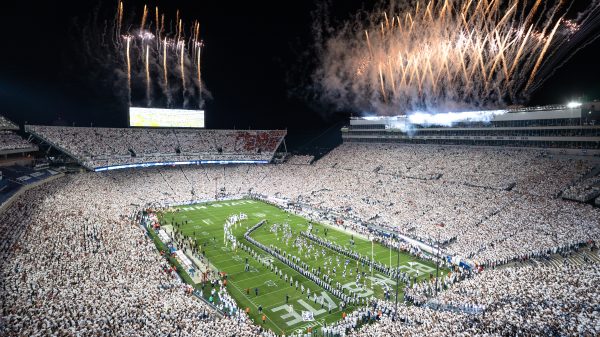
Penn State has one of the richest football traditions in the country. But tradition only has power if it is active.
It is not that lettermen were entirely shut out in the later stages of the James Franklin era. It was still possible for them to reconnect with the program they helped build. But by many accounts, it was not nearly as easy or as natural as it should have been.
Campbell has moved quickly to change that.
He has reopened the Lasch Football Complex to former players and their families, creating a more welcoming environment for the people whose names and accomplishments helped turn Penn State into one of the sport’s blue-blood programs. More importantly, he is not treating that as a ceremonial gesture. He appears to view it as part of the foundation.
That foundation matters.
A program like Penn State should not have to choose between honoring its past and building its future. The best programs do both. In fact, the past often makes the future stronger.
Campbell seems to understand that.
There has already been a wave of former Nittany Lions returning around the team, and the new staff has welcomed them back with open arms.
“Yeah, it’s real,” 13th-year Penn State assistant and former Nittany Lions receiver Terry Smith said. “He’s met with almost all of the lettermen.”
That is not a small detail. It shows intentionality. It shows that Campbell is not merely paying tribute to Penn State history in press conference language. He is putting in the work to bring those relationships back to life.
Over the weekend, Campbell welcomed back lettermen from the 1960s, 1970s, and 1980s to visit and speak with the team.
Among the notable former players to return were Pro Football Hall of Fame linebacker Dave Robinson, two-sport star D.J. Dozier, and former quarterback turned prime-time broadcaster Todd Blackledge.
That is a remarkable cross-section of Penn State history.
 Add Nittany Sports Now as a preferred source in Google! Click here to add us.
Robinson represents more than football greatness. He played during a transformative era in American history, when the Civil Rights Movement was reshaping the country. His perspective carries weight beyond the field, and that kind of voice can reach players in a way no generic motivational talk ever could. Add in the fact that he played for Vince Lombardi, one of the most iconic figures in football history, and it becomes easy to understand why younger players would want to absorb every word.
Dozier brings a different kind of credibility. As a standout running back who also played professionally for the New York Mets and the Minnesota Vikings, he embodies versatility, achievement and the broad possibilities that can come from a Penn State career. He also was a major figure on Penn State’s 1986 national championship team, the last team in program history to win it all.
Blackledge offers yet another dimension. As the quarterback who led Penn State to its first national championship in 1982, he understands what it means to reach the pinnacle at Penn State. But as a longtime broadcaster, he also knows how to articulate that journey in a way modern players can understand.
The former players clearly valued the opportunity to return.
“Well, I mean, I get to come back when I’m doing a game here, but to come back for an occasion like this, I think is really special,” Blackledge said. “At first, it’s always great to be around teammates and guys that were when you were or before you or a little after. And so I think it’s great that he’s doing it. And the event we had the other night was really awesome. A lot of people felt really special to be back here and to have a chance not only to see each other, but get to meet the new staff and the new team.”
That matters because programs often talk about family, but players can usually tell when that language is real and when it is just branding.
This felt real.
“Yeah, I mean, it’s a great opportunity,” Dozier said. “Anytime you can talk to the younger generation, it’s an opportunity to pass on, hopefully, great information, also inspire and encourage. A lot of kids coming in here for the first time, everything’s new. So to be able to be a part of that, Coach Campbell, Coach Smith, inviting us in has been terrific and I just appreciate the opportunity to speak to the kids and hopefully it’s been helpful for them.”
That is the bridge Campbell is trying to build.
And the value of that bridge should not be underestimated.
Penn State is in the early stages of spring practice under a new coaching staff. This is the point where identity starts taking shape. This is when players begin learning not just scheme, but expectations. This is when culture is either installed or merely talked about.
Campbell seems determined to make sure Penn State’s players understand that putting on the uniform means joining something much bigger than themselves.
When asked about the importance of bringing former players back, Campbell doubled down on that philosophy.
“The history of this football program, to be able to represent this, to understand the lineage, it’s bigger than me. It’s bigger than any of us,” Campbell said. “What we’re upholding every day we go on a practice field and certainly anytime you get the opportunity to put that uniform on and step in that stadium. You have to know what you’re representing.
“And to be able to have so many of these former players back around, being able to articulate their journey, again, these journeys aren’t just no success goes straight up the mountain, right? There’s setbacks, there’s tough days, how they overcame it, and for our kids to understand what they overcame, who they’ve become through the journey, not only as football players, but as men, leaders, and what they’ve done in their career. I think it’s great for our guys to understand the big picture of what it means to play here at Penn State.”
That answer says a great deal about how Campbell sees his job.
He is not trying to build Penn State in his image alone. He is trying to connect his era to the lineage that already exists. That approach is smart, and more than that, it is necessary.
Programs that lose touch with their identity often spend years trying to manufacture one. Penn State does not need a manufactured identity. It already has one. The task is to strengthen it, modernize it where necessary, and make sure a new generation feels it every day.
That is why Campbell’s early focus here is so important.
He is not just welcoming back familiar faces for nostalgia’s sake. He is restoring a vital part of what should make Penn State football different.
In a sport increasingly driven by short-term thinking, Campbell is betting that long-term success still starts with roots.
That is not backward thinking. That is smart leadership.
The past should never be a place a program gets trapped in. But it absolutely should be a source of strength, perspective and standard.
Matt Campbell appears to understand the difference.
And if he can keep Penn State’s bridge between past and present strong, it may become one of the smartest early moves of his tenure.