











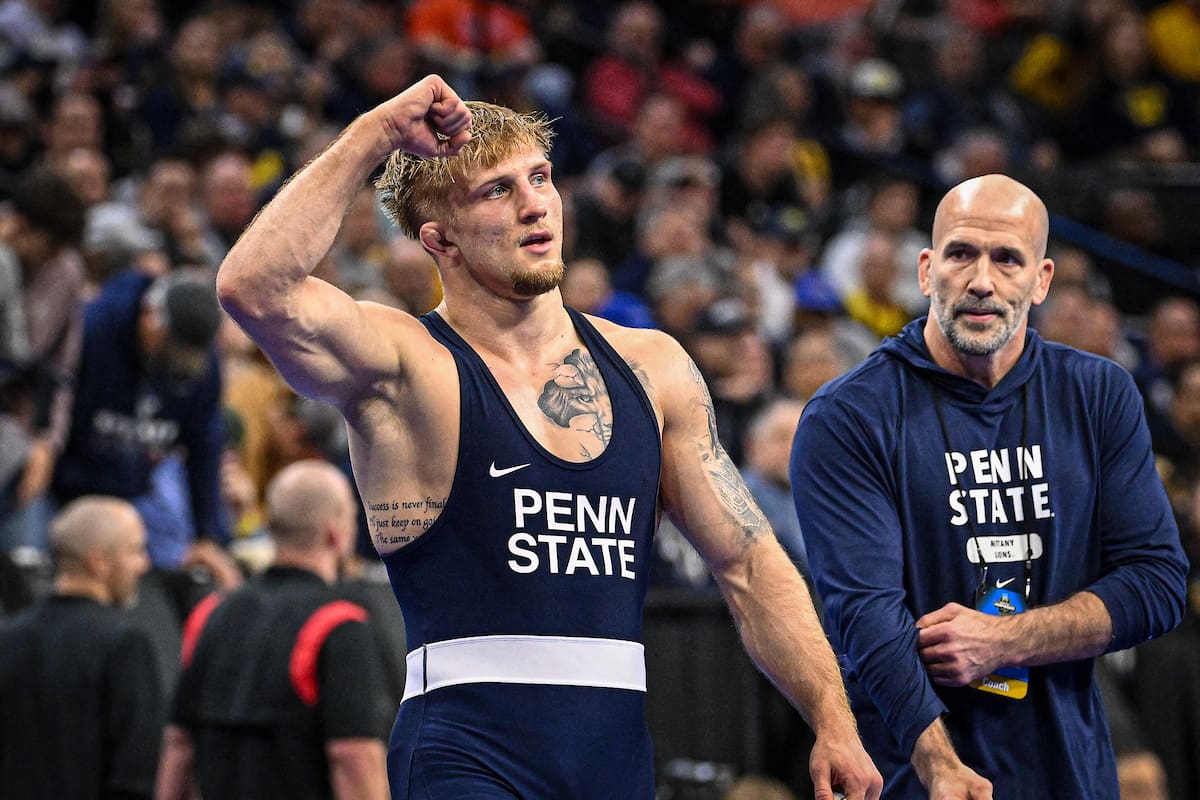
Penn State heads to the 2026 NCAA Wrestling Championships looking less like a team chasing one more trophy and more like a program trying to add another layer to an already absurd dynasty.
The Nittany Lions won the 2025-2026 Big Ten Championships with 184 points, captured their fourth straight conference title, and set a program record with seven individual champions: Luke Lilledahl, Shayne Van Ness, PJ Duke, Mitchell Mesenbrink, Levi Haines, Rocco Welsh and Josh Barr.
Marcus Blaze fell in the 133 final to Ohio State’s Ben Davino in tiebreakers, but still enters nationals as one of the most dangerous title threats in the country.
The historical backdrop is ridiculous.
Penn State’s 13 NCAA team championships, including 12 under Cael Sanderson. In Sanderson’s 16 seasons entering 2025-26, Penn State had already produced 101 All-Americans and 40 national champions at PSU.
The 2025 NCAA team title was also record-setting, as Penn State scored 177 points and became only the second team in NCAA history to produce 10 All-Americans in one year.
That is the standard this group is chasing in Cleveland.
Luke Lilledahl, 125
Lilledahl enters nationals as the No. 1 seed after winning the Big Ten title and carrying an unbeaten record into the NCAA Championships. He has been one of the team’s most productive wrestlers, piling up takedowns and technical falls throughout the season.
For Lilledahl, the opportunity is obvious. He can win a national title.
If he does, it would make him one of the most significant lower-weight champions of the Cael-era.
Penn State’s dynasty has often been powered by stars in the middle and upper weights, so a title at 125 would stand out. It would not just be another champion. It would be proof Penn State can dominate from the lightest class all the way through the lineup.
Even if he falls short of a title, an NCAA finals run or top-three finish would still cement him as one of the cornerstones of Penn State’s next wave.
Marcus Blaze, 133
Blaze might have the most intriguing long-term upside on the roster.
He lost to Ohio State’s Ben Davino in triple overtime in the Big Ten final, but that result did little to change the bigger picture. Blaze still heads to nationals as the No. 3 seed and one of the most dangerous wrestlers in the bracket. He entered Big Tens unbeaten and has been one of Penn State’s best point scorers all season.
There is a very real chance Blaze sees Davino again in Cleveland, and if he flips that matchup, he is right in the middle of the national-title conversation.
Historically, a freshman national championship would be enormous.
At Penn State, that is how careers begin to take on all-time potential right away. Even a finals appearance would be a major statement, because it would show Blaze is not just a star freshman but likely a future multi-time title contender.
Braeden Davis, 141
Davis is probably the toughest Penn State wrestler to project.
He enters nationals as the No. 14 seed, which makes him far more volatile than the Nittany Lions’ title favorites.
But Davis has also shown before that he can score in March, when he finished fifth at the 2025 NCAA Championships.
That is why Davis still matters so much in Cleveland.
His path to a title is clearly steeper than some of Penn State’s other stars, but another podium finish would be huge both for the team race and for his own legacy. Davis may not project as a likely champion, but another All-America finish would strengthen his place as the kind of proven postseason scorer championship teams need.
Not every important Penn State wrestler has to be a national champ.
Some become vital because they make loaded lineups feel even deeper. Davis has a chance to be that guy again.
Shayne Van Ness, 149
Van Ness enters nationals as one of Penn State’s best bets to stand on top of the podium.
He is the No. 1 seed, was unbeaten entering the postseason and has produced huge numbers all year, including takedowns, bonus points and technical falls. He also already owns a major NCAA credential after placing third nationally last season.
That makes this tournament a legacy event for him.
Van Ness is already an outstanding Penn State wrestler.
A national title is what would elevate him into a much more serious historical tier.
Once a wrestler with his talent breaks through for one championship, the next question immediately becomes whether more are coming. That is the territory Van Ness can move into this March.
PJ Duke, 157
Duke’s rise has been one of the biggest stories on the team.
He won the Big Ten title, earned the tournament’s Most Outstanding Wrestler honor and now enters nationals as the No. 1 seed at 157. He has also delivered the kind of offensive production that travels in March, with pins, bonus points and consistent scoring all season.
For Duke, this tournament is about announcing himself on the biggest stage.
A national title would instantly put him in the conversation as one of the most important young wrestlers in the program. Even a finals run would matter a lot because it would signal he is not merely having a breakout season but building the kind of resume that can grow into something special over time.
At Penn State, early March success tends to be the beginning of larger stories. Duke has a chance to start one now.
 Add Nittany Sports Now as a preferred source in Google! Click here to add us.
Mitchell Mesenbrink, 165
Mesenbrink has perhaps the clearest path to elite Penn State status because he is already most of the way there.
He enters NCAAs as the No. 1 seed and already owns a national title after winning the 2025 championship at 165. Mesenbrink has also captured the NCAA technical-fall award last season. This year, he has again been one of the team’s most dominant and productive wrestlers, looking to become the program’s sixth Hodge Trophy winner.
What is at stake for Mesenbrink is not just another great season. It is separation.
At Penn State, one national title makes you memorable. Two can put you in a different class.
If Mesenbrink repeats, he strengthens a resume that already looks capable of landing in the upper tier of Cael-era careers.
Levi Haines, 174
Haines has one of the strongest overall cases on the roster already.
He heads to nationals as the No. 1 seed, a four-time Big Ten champion and one of the most accomplished wrestlers in the country, carrying a perfect 48-0 career record against Big Ten opponents into the conference tournament. Haines won the 2024 NCAA championship and was a 2025 third-place finisher.
Another national title would do a lot for Haines historically.
He already has the kind of resume that ages well in Penn State history because it combines conference dominance, championship pedigree and sustained excellence.
But another NCAA title would push him from star to one of the defining wrestlers of this era.
Rocco Welsh, 184
Welsh has put together an outstanding season and enters nationals as the No. 1 seed at 184 after winning the Big Ten title.
He has also been one of Penn State’s most balanced performers statistically, combining takedowns with strong bonus production.
The historical angle with Welsh is especially interesting because of the weight class.
Penn State is coming off the Carter Starocci era at 184, which means anyone who wins there is going to be measured against one of the best to ever do it.
That is a tough comparison, but it also creates a major opportunity.
If Welsh wins a national title, he becomes an immediate centerpiece of the post-Starocci chapter of Penn State wrestling.
Josh Barr, 197
Barr may have one of the most obvious legacy opportunities on the team.
He enters as the No. 1 seed at 197 after winning the Big Ten title, and was the 2025 NCAA runner-up.
In other words, his ceiling is not theoretical. He has already been on the sport’s biggest stage.
Now he gets another shot to finish the job.
If Barr goes from runner-up to champion in year two, that is exactly the kind of leap that sets up a Penn State wrestler for long-term historical relevance.
He already looks like one of the next great names in the room. A title would make that feel much more official.
Cole Mirasola, 285
Mirasola is different from the other Penn State stars because the historical bar for him is not necessarily a title right now.
He enters nationals as the No. 9 seed at heavyweight and gives Penn State another wrestler capable of scoring real team points.
His production this season has been strong enough to show he is more than just a lineup placeholder.
For Mirasola, the biggest step would be earning All-America status.
That might sound modest compared to the title talk around much of the lineup, but it would still matter.
At heavyweight, a reliable NCAA scorer can be a huge piece of a championship team.
Historically, Mirasola has the chance to establish himself as a meaningful contributor in Penn State’s upper-weight tradition, and a podium finish would be a big start.
The Bigger Picture
This is what makes Penn State’s NCAA outlook so compelling.
Mesenbrink and Haines are chasing the kind of second-title boost that changes how careers are remembered. Barr and Van Ness are trying to turn previous NCAA success into championships. Blaze, Duke, Lilledahl and Welsh are trying to use breakout seasons to launch themselves into much bigger conversations. Davis and Mirasola are trying to become the kind of postseason scorers that make title teams feel unfair.
That is the reality of wrestling at Penn State now. Winning is expected. Greatness is routine. History is always nearby.
And when the Nittany Lions hit the mats in Cleveland, every one of them will be wrestling for more than a bracket. They will be wrestling for a place in the next chapter of Penn State history.