














To the unnamed individual who secretly recorded a private team meeting, an action that violates Pennsylvania’s felony wiretapping laws, your decision exposed far more than you may have intended.
The leak provided the outside world with a rare, unfiltered look into what is unfolding inside Penn State’s football program. Although there is plenty to critique, laying the entire situation at the feet of athletic director Pat Kraft would be overly simplistic.
Kraft has made missteps, and his handling of James Franklin’s termination drew criticism from fans, donors and national observers. Yet, the leaked audio almost serves as a twisted validation of why Kraft believed decisive action was necessary.
In the recording, Kraft acknowledges a jarring fact: Penn State pays 103 players through NIL collectives, while he claims many schools pay only 65 to 70. That disparity appears to have contributed to fractured decision-making within the program.
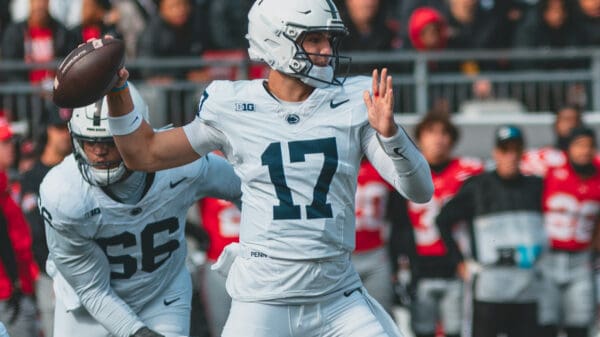
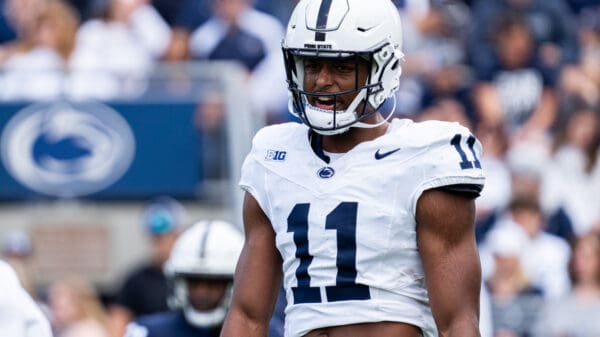
Franklin, according to the discussion, was willing to prioritize NIL payouts for his top talent even when doing so may have hindered the development and playing time of younger players specifically wide receivers Tyseer Denmark and Koby Howard.
The implication is that roster management may have been compromised by financial considerations.
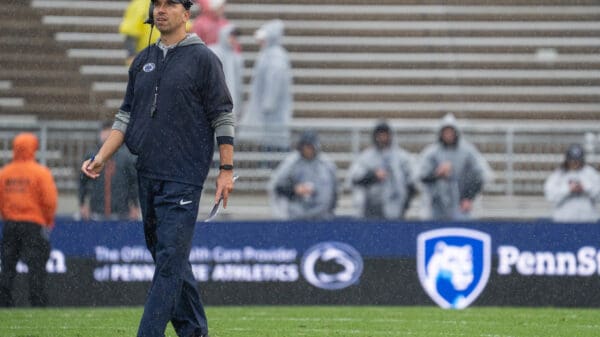
Kraft faced the difficult task of addressing the team in the wake of Franklin’s firing and amid a coaching search that had spiraled into a public relations nightmare. In speaking with players, he attempted both transparency and reassurance, though his words carried the weight of his own professional uncertainty.
He told the team:
“I wanna tell you this, I don’t know what the future holds. Terry (Smith) is a legitimate, real, real candidate, I’m looking you all in the eye. If I don’t get this right? My career is over. Understand that. If I don’t hire the right person, my career is over. So, it’s very serious to me. If I don’t find the right person, they’ll fire my ass and I don’t get another AD job. So, I’m gonna do what’s right for you guys, what’s right for this program.”
This is the first candid acknowledgment— albeit one that wasn’t supposed to be public— that we’ve heard from Kraft about the pressure he is under and he is not wrong.
The fallout has gone far beyond normal coaching-search turbulence.
Reports from FootballScoop indicate that senior Penn State administrators have begun inserting themselves into the hiring process. That is rarely a good sign. When your superiors feel compelled to intervene, it signals both an erosion of confidence and a breakdown in internal communication.
Kraft has championed numerous initiatives to modernize Penn State athletics, enhance athlete welfare and position the department for a future in which NIL, branding, and professional development matter more than ever. Those efforts are commendable. But leadership is not just about vision; it is about composure, communication, and the ability to inspire confidence downward and upward.
Kraft’s decision to vent openly in a room full of players, not senior staff, not administrative peers, reflects a lapse in judgment. Leaders who “vent down” risk undermining the authority and steadiness their teams expect.
Having run a nonprofit with over $50 million in assets and a $10 million operating budget for two years as President, numbers smaller than Penn State’s but still substantial, I understand the responsibility that comes with managing both people and public trust.
You simply do not vent to those you are supposed to lead.
 Add Nittany Sports Now as a preferred source in Google! Click here to add us.
Had Kraft held this exact conversation with the women’s volleyball team or the fencing program, the reaction likely would have been just as negative, if not worse.
Still, even as we critique Kraft, it is impossible to ignore a deeper, more systemic issue: Penn State has a massive trust problem.
This problem predates the leaked audio and will not be solved by naming the next head football coach.
Consider the room in which the recording occurred. Kraft believed he could speak openly and level with players and staff. Instead, someone chose to violate the privacy and trust of that environment for leverage, influence, or personal gain. That breach alone shows a fractured relationship between players and the administration. Added to that are the damaging snippets from the recording: insinuations about recent decommitments, comments implying Michigan cheated, grievances toward Oregon, and even remarks about Penn State’s geography.
Opposing coaches will use every bit of this against Penn State on the recruiting trail.
Layer on top the complications with coaching-agent dynamics.
Todd McShay’s report suggests that Jimmy Sexton and other CAA-affiliated coaches have been reluctant to engage seriously with Penn State. If true, this goes back to how Franklin’s exit was handled. Not providing Franklin or Sexton the courtesy of a negotiated, dignified departure appears to have signaled disrespect and instability.
In the coaching world, trust and relationships matter.
To illustrate: would Leonardo DiCaprio’s agent ever block him from working with Martin Scorsese without a compelling reason? The same principle applies here.
Trust is the thread running through every part of this situation. Can the next coach trust the administration to support them? Can players trust that the new coach will maintain unity in the locker room amid the ever-shifting transfer portal? Can Kraft trust his own staff when conversations are being secretly recorded?
Most importantly: can Penn State leadership trust Kraft to complete the coaching search once doubt has already seeped in?
Penn State finds itself at a crossroads, not simply in need of a head coach but in need of an internal recalibration. This is a moment for serious introspection. Before any coach signs on to rebuild the football program, Penn State’s administration, athletic department, staff, and players must rebuild something far more foundational—trust.
Without it, no hire will succeed, no roster will stabilize, and no program can truly move forward.