
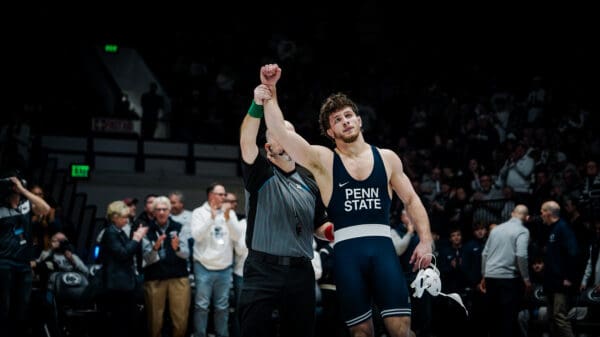








I can understand the Penn State fatigue among NCAA wrestling purists.
When a program has won 12 of the last 14 NCAA Championships contested, won 86 consecutive dual meets and produced a John Wooden-esque level of dominance, it becomes easy to understand why people are searching for the team that will finally end the dynasty.
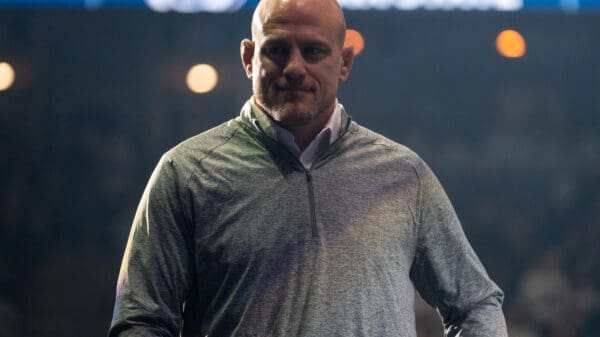
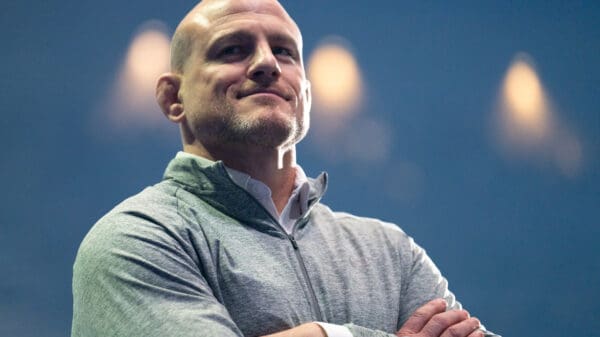
Cael Sanderson having almost as many national championships (12) as career dual-meet losses (16) only adds to the absurdity.
Everybody wants to identify who is next.
I can tell you this: It isn’t happening this year.
Pick your favorite wrestling outlet and many are leaning into the analytics giving Oklahoma State roughly a 17% chance of winning the national championship.
Eventually, however, you have to acknowledge the other side of that model: Penn State sits north of 80%.
Everyone has a fighter’s chance to dethrone Penn State. But when the Nittany Lions win the championship in more than four out of every five simulations, I’m not ready to call this a changing of the guard.
The biggest loss people will point toward is Levi Haines.
Haines graduated after an incredible Penn State career, going 99-4 while winning four Big Ten championships, becoming a four-time All-American and winning two NCAA championships.
Many already expected Haines to be gone this season, although uncertainty surrounding the eligibility of athletes from the 2022 season created some possibility of his return.
But look at what his departure potentially does to Penn State’s lineup.
If FloWrestling’s early rankings prove accurate and reigning Hodge Trophy winner Mitchell Mesenbrink moves from 165 to 174, it creates room for both PJ Duke and Tyler Kasak.
Without that movement, Duke and Kasak potentially would have been locked into one of the most fascinating lineup battles in recent Penn State memory.
Instead, Penn State potentially gets both.
Then there is Masanosuke Ono, perhaps the most intriguing addition to the lineup.
Ono is already one of the world’s most dangerous freestyle wrestlers and now takes aim at folkstyle. Adding someone with his international pedigree to a lineup that just set NCAA scoring records hardly feels like Penn State taking a step backward.
Marcus Blaze gives the Nittany Lions another fascinating piece.
Blaze is competing at the World Championships at 61 kilograms (134.5 pounds), making 133 a logical destination for him in folkstyle.
His freestyle results this offseason only strengthen that argument.
 Add Nittany Sports Now as a preferred source in Google! Click here to add us.
Blaze won the U.S. Open by defeating Ben Davino. At Final X in June, he secured his place on the U.S. World Team by defeating reigning NCAA champion Jax Forrest two matches to one. He followed that by winning gold at the Poland Open, finishing with an 11-0 technical fall over Kyle Burwick.
Consider the names involved there.
Davino won the Big Ten championship and defeated Blaze in a tiebreaker in the NCAA semifinals at 133. Forrest won the NCAA championship.
Blaze has now proven he belongs with both.
That’s why I buy Oklahoma State as Penn State’s first legitimate long-term threat in years. What I don’t buy is the leap from “closing the gap” to “ready to dethrone Penn State.”
Oklahoma State is loaded.
I’ve talked with Jax Forrest, Sergio Vega and Landon Robideau, and those three NCAA champions are going to provide an incredible foundation for David Taylor.
There are fascinating potential battles everywhere.
Mesenbrink moving to 174 would put him into a loaded field featuring wrestlers such as Nebraska’s Christopher Minto, Michigan’s Beau Mantanona and Iowa’s Gabe Arnold, along with Stanford transfer Lorenzo Norman potentially making an immediate impact for Oklahoma State.
Josh Barr could find himself contending for a Hodge Trophy, but Oklahoma State’s Cody Merrill is a worthy adversary and a potential NCAA finals opponent.
Few question the phenomenon that is PJ Duke, but Oklahoma State’s LaDarion Lockett could provide the perfect counter.
Those matchups are why Penn State-Oklahoma State has the potential to become college wrestling’s defining rivalry.
But there’s a difference between being Penn State’s biggest threat and being better than Penn State.
Dynasties eventually fall. Penn State’s will, too.
Maybe David Taylor and Oklahoma State ultimately become the program that does it.
But when I look at Penn State entering this season, I don’t see a dynasty showing obvious cracks.
I see a team that may have gotten better.
And until somebody proves otherwise on the mat, the wrestling world still belongs to Penn State.