










At some point, potential has to become production.
For Penn State running back Quinton Martin Jr., the numbers suggest that opportunity should come sooner rather than later.
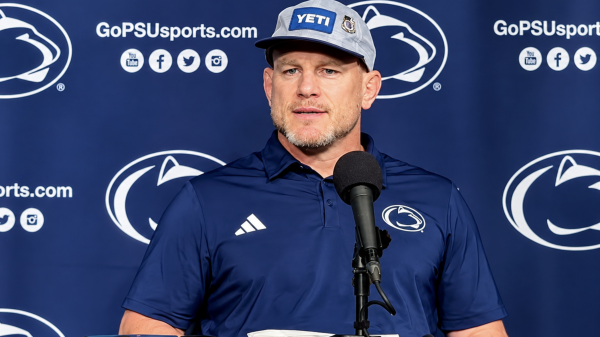
Seven games into the 2026 season, Penn State is still searching for consistency offensively especially for a ground attack that entered the weekend ranking 109th nationally. The Nittany Lions have struggled to establish an identity, where the rotation at running back has remained a work in progress under head coach Matt Campbell.
Yet one of the more intriguing options in the backfield continues to wait for an expanded role.
Martin has carried the football just 31 times for 160 yards and a touchdown, averaging 5.2 yards per attempt, the best among Penn State’s three primary running backs and trailing only Cam Wallace at 5.7 yards per attempt.
For comparison, Carson Hansen has 288 yards on 71 carries, averaging 4.1 yards per attempt, while Ohio State transfer James Peoples has 246 yards on 57 attempts, averaging 4.3 yards.
The disparity in opportunities raises a reasonable question.
Why isn’t Martin getting more touches?
Campbell has maintained that playing time is earned through preparation, consistency and execution during practice.
“We have a lot of playmakers,” Campbell said last month. “That’s why practice is so critically important right now.”
Campbell explained that the coaching staff evaluates which players have earned specific packages and opportunities in critical moments.
“Quinton is certainly one of those guys. We all have great belief in him,” Campbell said.
That philosophy is understandable. Practice matters, particularly when evaluating pass protection, assignments and the responsibilities that extend beyond carrying the football.
But seven games provide enough evidence to question whether Martin deserves a larger opportunity.
According to Pro Football Focus (PFF), Martin has generated 130 yards after contact on his 31 carries, averaging 4.19 yards after contact per attempt.
That’s particularly impressive considering Hansen averages 3.15 yards after contact and Peoples averages 2.74.
Martin isn’t simply benefiting from favorable blocking. He’s creating additional yardage when defenders get their hands on him.
His 70.2 rushing grade also reflects a player who has been productive despite limited opportunities.
Perhaps the most revealing numbers come from examining where Martin has been successful.
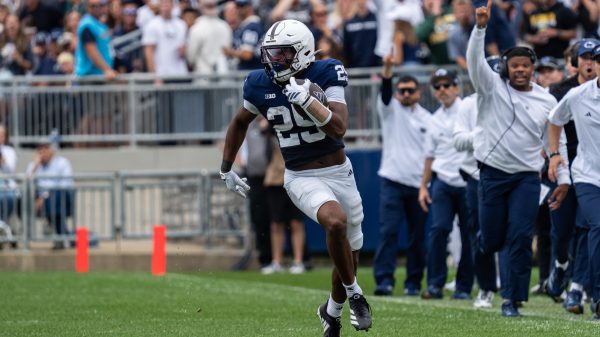
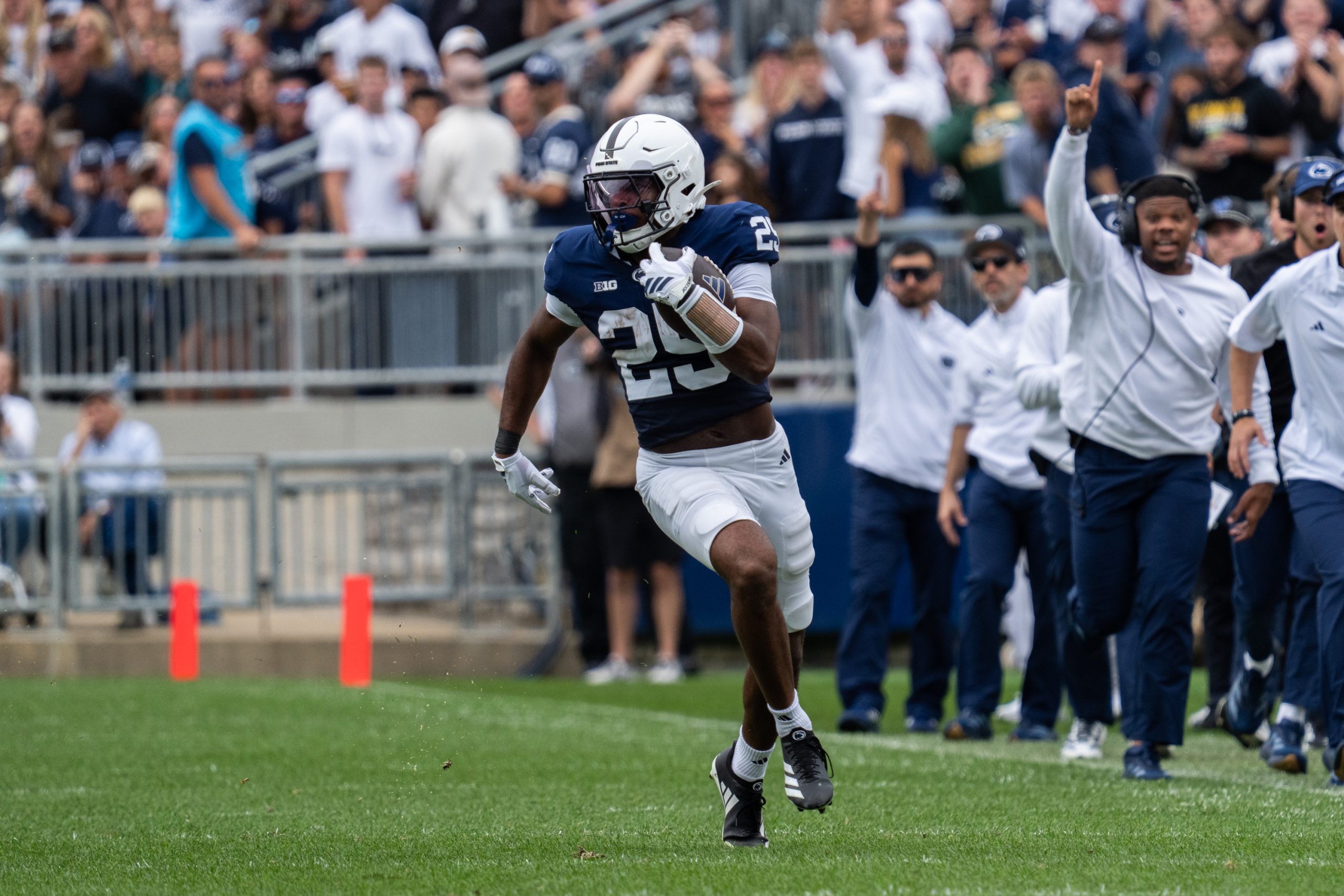
On seven carries outside the left end, Martin has accumulated 85 yards, averaging 12.1 yards per attempt.
That includes a 61-yard run, Penn State’s longest rushing gain of the season.
 Add Nittany Sports Now as a preferred source in Google! Click here to add us.
He’s also forced 11 missed tackles on just 31 attempts.
Hansen has forced 12 on 71 carries, while Peoples has forced 11 on 57 attempts.
That difference should command attention from offensive coordinator Taylor Mouser.
Martin is forcing a missed tackle approximately once every 2.8 carries. Hansen does so once every 5.9 attempts, while Peoples averages one every 5.2 carries.
For an offense that has struggled to generate explosive plays consistently, Martin offers something Penn State desperately needs: the ability to create when the blocking isn’t perfect.
“Everything is being evaluated to help our pass game better and run game better,” Mouser said. “And Quinton is earning the right to get touches in the offense.”
Martin’s limited involvement hasn’t occurred without explanation.
August injuries disrupted his preparation, while the competition with Hansen and Peoples created a crowded backfield.
The coaching staff has also emphasized the importance of daily consistency and earning trust.
Following an early stretch without significant opportunities, Martin responded with one of his strongest practice weeks leading into the Buffalo game.
Still, there comes a point when production should influence the distribution of carries.
Nobody is suggesting Hansen or Peoples should disappear from the rotation, both have demonstrated value, but Martin brings a different dimension.
His ability to break tackles, create yards after contact and attack the perimeter gives Penn State an opportunity to diversify an offense that has become too predictable.
The solution doesn’t require a dramatic overhaul.
Give Martin eight to 10 carries that incorporate designed opportunities to get him outside. Let Martin’s production determine whether that workload increases.
Penn State doesn’t need to manufacture a controversy in its running back room.
It needs to identify which players give the offense its best opportunity to succeed.
Through seven games, Martin has demonstrated that he deserves more chances to prove himself.
The numbers are there, albeit in a small sample, but now it’s time for the touches to follow.