

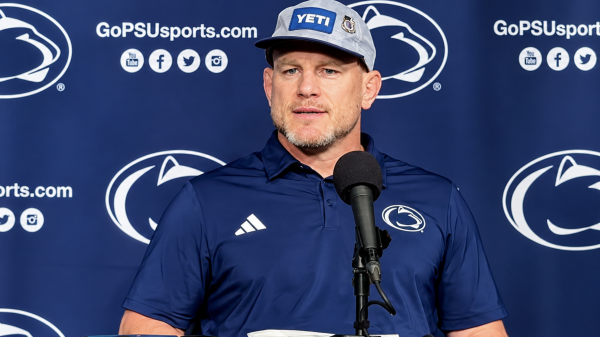











PHILADELPHIA, Pa. — Penn State head coach Matt Campbell keeps coming back to the same description of his running game.
A hair off.
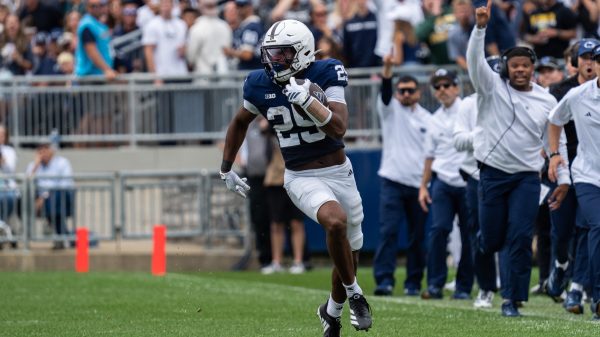
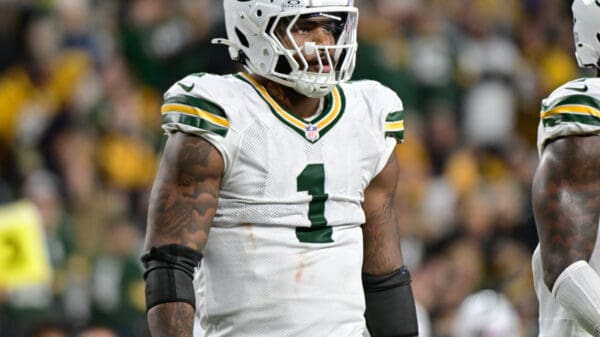
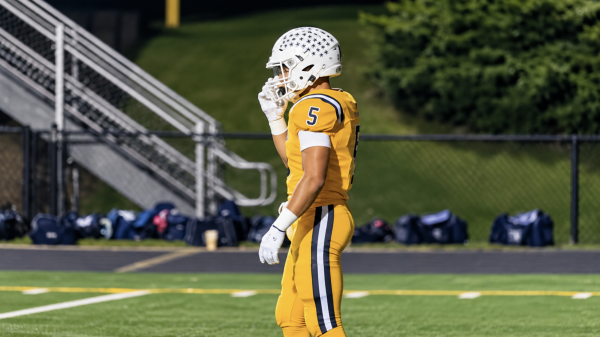
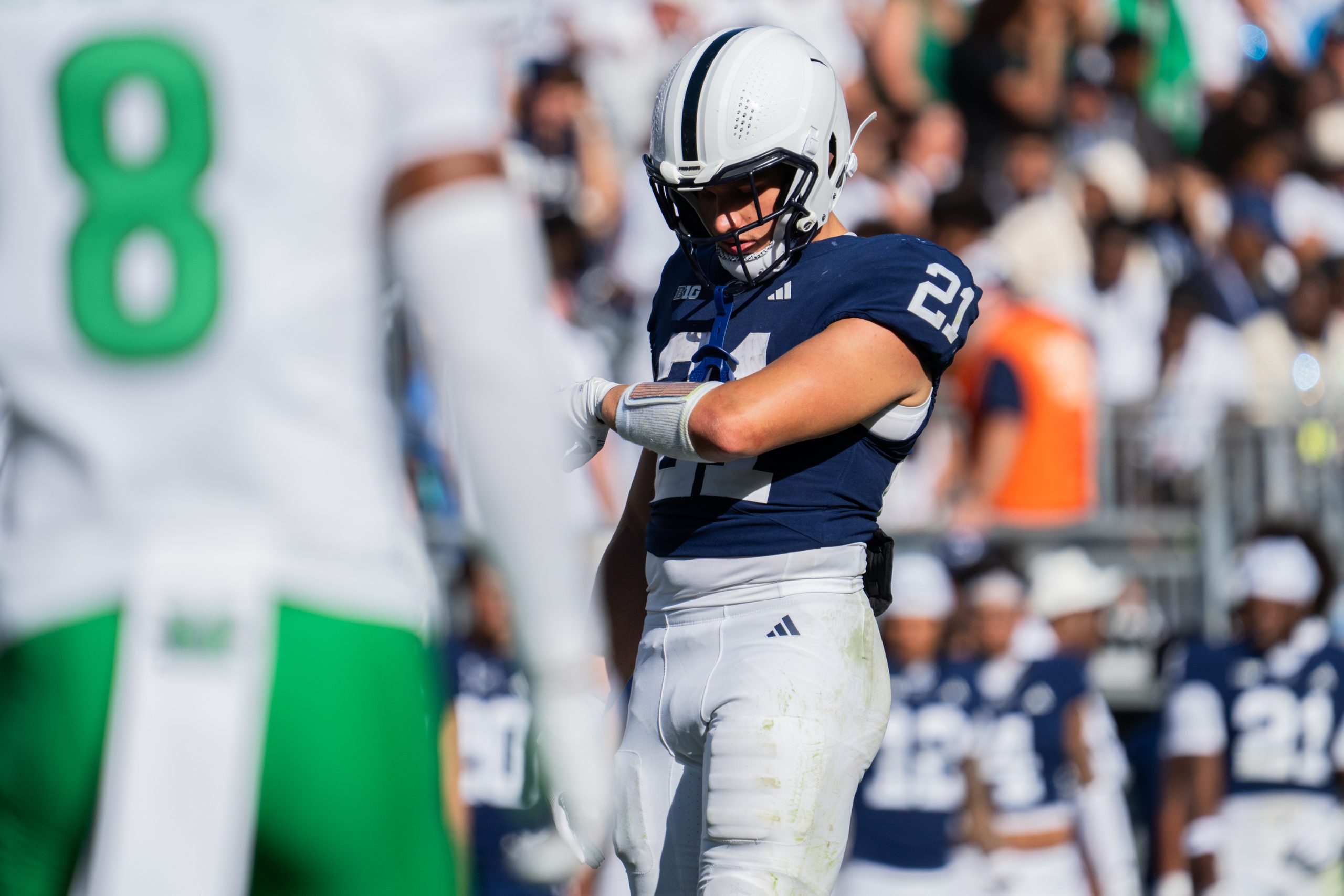
Through two games, the Nittany Lions have shown enough flashes to suggest the pieces are there. They have been physical. They have generated yards after contact. There have been moments when Carson Hansen, James Peoples, Quinton Martin, and Cam Wallace appeared one block or one broken tackle away from turning an ordinary gain into the explosive run Penn State has been searching for.
The problem is that “almost” doesn’t show up on the scoreboard.
“There were some really great Carson Hansen runs,” Campbell said following Penn State’s 27-9 win over Temple. “I feel like I probably felt last week, you know? We’re like a hair off on some things and I thought there was probably good growth.”
The underlying numbers support Campbell’s assessment.
Penn State has rushed 76 times for 308 yards, averaging 4.1 yards per attempt. But only four of those 76 carries have gained at least 10 yards.
That is the disconnect.
Penn State has produced 202 yards after contact, according to Pro Football Focus (PFF), meaning roughly two-thirds of its rushing production has come after contact. Hansen, who has gotten the majority of the carries, accounts for 92 of them ranking 13th overall amongst Big Ten running backs.
The Nittany Lions have also forced 15 missed tackles. The backs are working for their yardage.
What Penn State hasn’t consistently done is create clean opportunities for those runs to become explosive, something the Nittany faithful have grown accustomed to the last four seasons with Kaytron Allen and Nick Singleton..
The directional splits are particularly revealing.
Penn State has been devastating running to the right edge, producing 107 yards on 17 attempts (6.3 yards per carry) with three runs of at least 10 yards. The Nittany Lions have generated 87 yards after contact on those carries alone.
Compare that with the left edge, where Penn State has 80 yards on 22 attempts, averaging 3.6 yards, without a single 10-yard run.
There is production, but not consistency.
Hansen’s response isn’t to blame the offensive line.
“I need to take accountability for it and I need to fix those things in the run game,” Hansen said. “Whether that’s the free hat or whatever it is, [I need] to be able to have a plan for that guy.”
That might be the most important point when evaluating Penn State’s running game.
 Add Nittany Sports Now as a preferred source in Google! Click here to add us.
There is a difference between a rushing attack that is fundamentally broken and one that simply hasn’t finished plays.
James Peoples has arguably been Penn State’s most efficient runner, producing 72 yards on 15 carries for 4.8 yards per attempt. Fifty of his 72 yards have come after contact, and he has forced four missed tackles.
Quinton Martin Jr. has 38 yards on 10 attempts, while Cam Wallace has 44 on 12. Neither has consistently broken loose, either, but in the same vein neither has had enough reps to really break loose.
Collectively, Penn State’s longest run is just 16 yards.
That has forced the offense to earn virtually everything methodically.
Hansen understands where the next step has to come.
“Just get north and south, get downhill,” Hansen said of his mindset. “I need to do better by using my weapon arm in the open field and just being able to beat that free hat.”
That “free hat” is often the difference between four yards and 40.
Campbell sees improvement at the point of attack. Hansen sees opportunities he needs to finish himself. The statistics show backs who are generating considerable yardage after contact but aren’t yet creating explosive plays.
All three can be true.
“I thought that we took a step forward,” Campbell said. “But, the team that we want to be and the team that we were today is still not equal to what we want to become.”
Penn State doesn’t need to reinvent its running game.
It needs to finish it.
The blocking needs to eliminate one more defender. The backs need to defeat the free hitter when it doesn’t. And eventually, one of those runs that has been a “hair off” needs to become the explosive play that has been missing.
Because two games into Campbell’s tenure, Penn State’s rushing attack looks close.
Now it has to prove how close it really is.