





















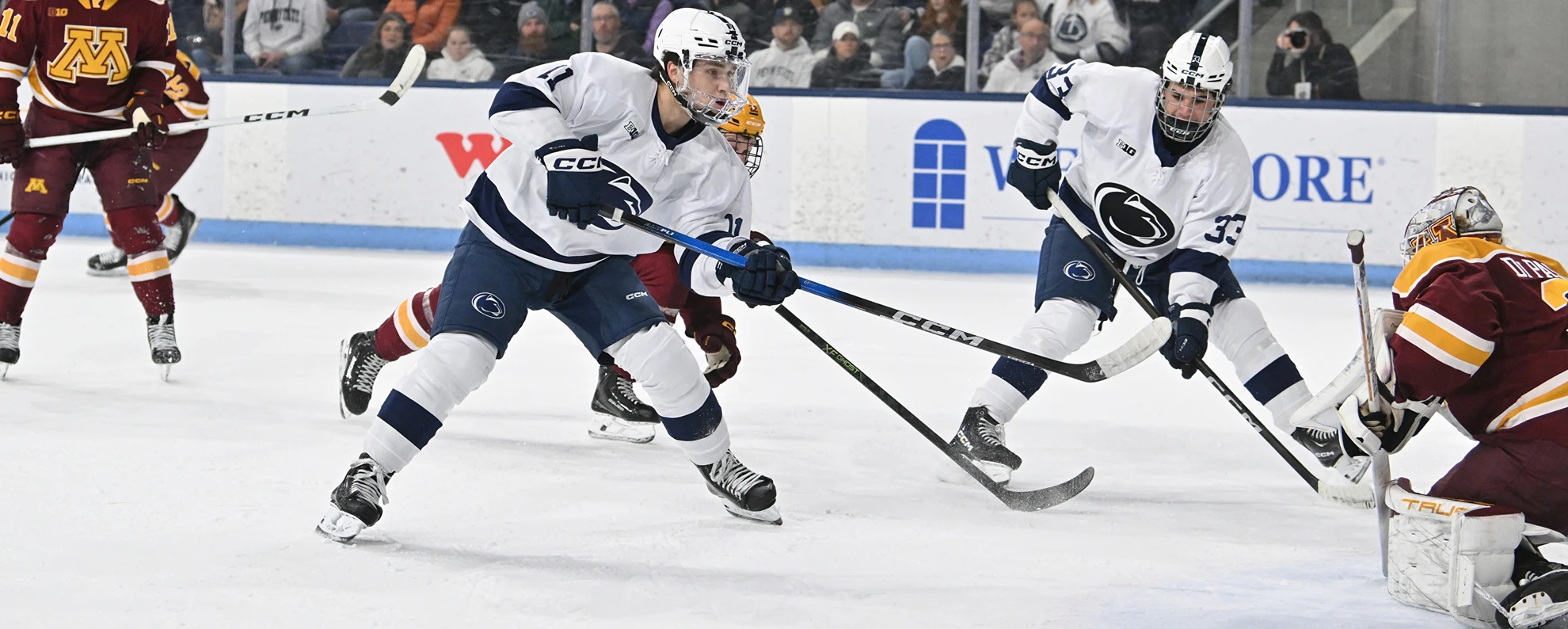
Penn State looked like one of the hottest teams in college hockey after its 3-1 win over Wisconsin on January 24. That victory completed a sweep of what was then the No. 5 team in the country and extended the Nittany Lions’ winning streak to seven games. Momentum was building at exactly the right time.
Then came Michigan State week.
Under normal circumstances, a Top-5 showdown against the No. 2 team in the country would have been massive on its own. But Penn State was also about to become the center of the college hockey world, with its January 31 game set to be played at Beaver Stadium. The spotlight could not have been brighter.
Michigan State, though, showed why it was one of the nation’s elite teams. The Spartans were more physical in a 6-3 win on January 30, then showcased their skill in a 5-4 overtime win the following night. Since the Beaver Stadium Classic, Penn State has gone 3-5-2.
That record tells part of the story, but the more troubling part is how hard it has been to pin down exactly why Penn State has struggled. This has not been a slump driven by one glaring weakness. It has been a more volatile stretch, one in which the problems have shifted from game to game. At times it has been defensive-zone coverage. At others, it has been shot suppression, discipline, or game management. That inconsistency has made things especially difficult for head coach Guy Gadowsky, who has had a hard time identifying one clear issue to target and correct.
Injuries have only complicated things further. Penn State has at times been down to eight available forwards, making it difficult to roll three full lines and sustain the aggressive pace that usually defines Gadowsky’s system. A team built around tempo and pressure becomes far more vulnerable when it cannot maintain its depth.
Over this 10-game stretch, Penn State has been outscored 44-42. On the surface, that number does not look disastrous. But it is somewhat misleading because the 11-goal explosion against Ohio State on February 20 inflates the offensive totals. If Penn State had scored its average of roughly four goals that night instead of 11, it would have been outscored by 11 goals over the same span. That paints a much harsher picture of what has really been happening.
The simplest way to frame Penn State’s recent slide is this: the Nittany Lions are not failing to score. They are failing to suppress.
When the offense has produced, the margin for error has still been razor thin because Penn State has been giving too much back defensively and through game management. That has shown up in both the volume of chances allowed and the quality of those chances.
Across the 10 games, Penn State has been outshot 357-321, which amounts to just a 47.3% shot share. That matters because it shows Penn State has not consistently been driving play the way it did during its midseason surge. The contrast is sharp. In the 11-4 win over Ohio State, Penn State was outshot 42-38 and still won in a blowout. Over a one-game sample, that can happen. Over time, it is not sustainable. By the time the Wisconsin series and March meeting with Michigan arrived, Penn State was losing both the scoreboard and the overall shot battle.
Even in games where Penn State has won, or nearly won, the shot count, opponents have often been more efficient with their opportunities. Over the 10-game sample, Penn State converted 42 goals on 321 shots, good for a 13.1% shooting percentage. Opponents scored 44 goals on 357 shots, or 12.3%. At first glance, that seems to suggest Penn State has actually been slightly more efficient.
But that overall number hides the more important detail. In Penn State’s five losses during the stretch, the Nittany Lions shot just 8.8%, while opponents shot 15.3%. That is a massive gap and strongly suggests Penn State’s defensive breakdowns are leading to cleaner, more dangerous looks against than the ones it is generating offensively. Michigan scoring six goals on 26 shots on February 14 and Wisconsin scoring seven on 41 shots on March 5 are the clearest examples. Penn State may still be creating offense, but too often opponents are creating better offense.
 Add Nittany Sports Now as a preferred source in Google! Click here to add us.
Special teams present a similar split between what looks acceptable on paper and what has actually hurt Penn State in games.
The penalty kill, in aggregate, has not been terrible. Penn State has killed 37 of 45 penalties during the stretch, an 82.2% success rate that would generally be considered solid. The problem is the volume and the timing. Penn State has still allowed eight power-play goals and taken 135 penalty minutes, an average of 13.5 per game. That is simply too much time spent shorthanded, especially for a team that has struggled to find stability at five-on-five.
In losses, the penalties have repeatedly forced Penn State into long defensive stretches and prevented it from re-establishing momentum. The March 5 loss to Wisconsin is a prime example. Penn State took 22 penalty minutes, handed Wisconsin five power-play opportunities, and eventually paid the price as the Badgers controlled the third period. Even when the penalty kill holds up reasonably well, the sheer number of penalties can tilt the flow of a game.
The power play, by contrast, has largely done its job. Penn State has gone 11-for-44 over these 10 games, a 25% conversion rate. In its three wins during the stretch, the power play was a major factor. Against Ohio State on February 20, Penn State went 5-for-6 with the man advantage in an 11-4 rout. The next night, it went 2-for-4 in another win. Even in the March 6 loss to Wisconsin, Penn State still scored a power-play goal.
That is what makes Saturday night’s 0-for-8 performance against Michigan stand out even more. For most of this stretch, Penn State’s power play has been one of the few reliable bright spots. When it goes cold, the team becomes even more vulnerable because its five-on-five play has not been steady enough to compensate.
Late-game performance has also been an issue, though the numbers require context. In aggregate, Penn State has been nearly even in the third period, scoring 13 goals and allowing 14 over the 10-game stretch. On paper, that does not sound alarming. In practice, though, a few games have swung dramatically in the final period. Wisconsin scored four third-period goals on March 5. Michigan outshot Penn State 18-6 in the third period of the Big Ten tournament game and scored twice to take control.
Those are not random bounces. They point to structural problems when Penn State loses its footing: extended defensive-zone time, more scrambling off broken plays, and a reduced ability to generate sustained offensive pressure. When the Nittany Lions are right, they attack in waves. When they are off, they spend too much time trying to survive.
The good news for Penn State is that there is still time to address these issues before the NCAA Tournament. The Nittany Lions still have the talent to make another run, and the offensive ceiling remains high enough to threaten anyone in the field. But foundationally, Penn State feels shakier now than it did a month ago.
Over the last 10 games, the warning signs have been clear. Penn State has not consistently controlled possession. It has not defended efficiently enough. It has taken too many penalties. And even when it has generated chances, opponents have too often made more of theirs.
That is the core problem facing Penn State as the postseason begins. The Nittany Lions can still score. They can still beat quality teams. But right now, opponents are making more of their chances, especially in terms of shot quality and game-defining moments. That is not a formula for a long tournament run, and it is why Penn State’s recent struggles feel more concerning than a simple bad stretch.