














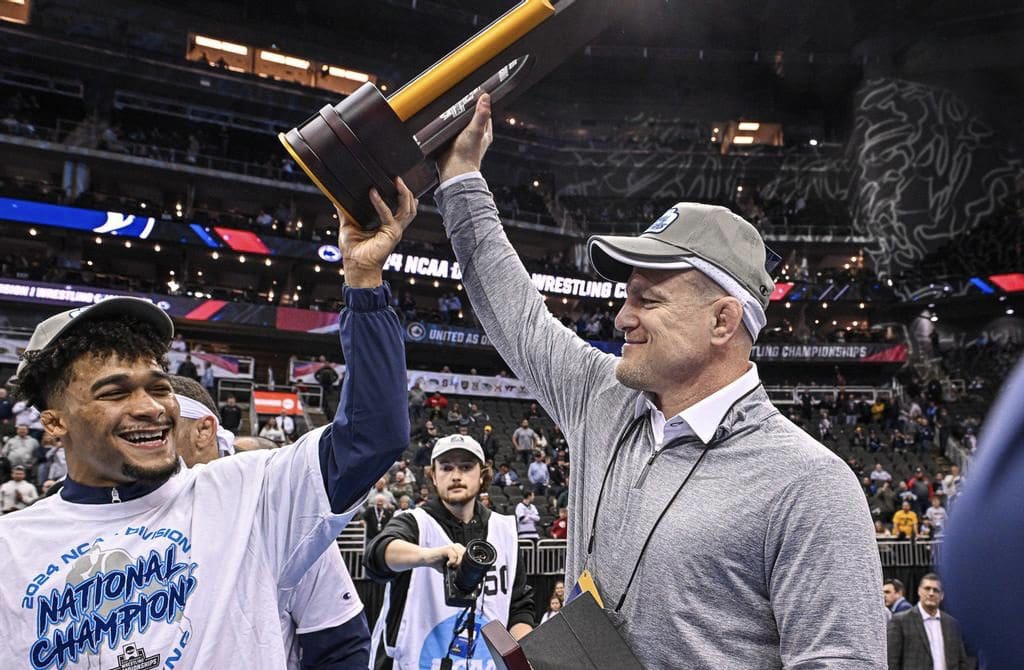
On Saturday at the Journeyman Collegiate Duals in Nashville, history was secured in a moment that felt routine only because of how often Penn State makes the extraordinary look ordinary.
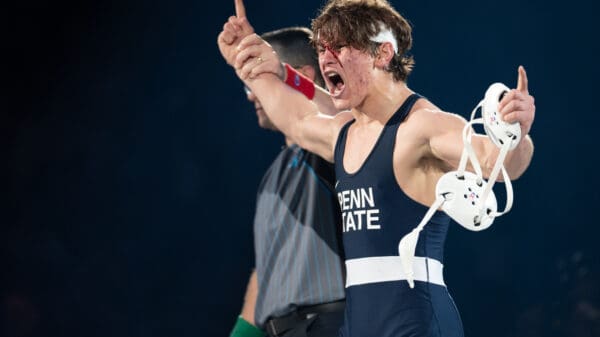
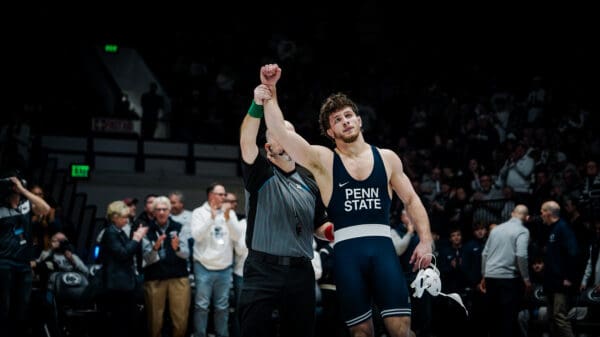
When top-ranked Levi Haines scored a major decision over Stanford’s Lorenzo Norman at 174 pounds, the bout clinched Penn State’s 77th consecutive dual meet victory, a new NCAA Division I record.
With that win, the Nittany Lions eclipsed Oklahoma State’s legendary 76-dual streak from 1937–51, a run built under Hall of Fame coaches Ed Gallagher and Art Griffith.
Nearly three-quarters of a century later, Penn State didn’t just surpass that mark it has redefined what sustained dominance looks like in modern college wrestling.
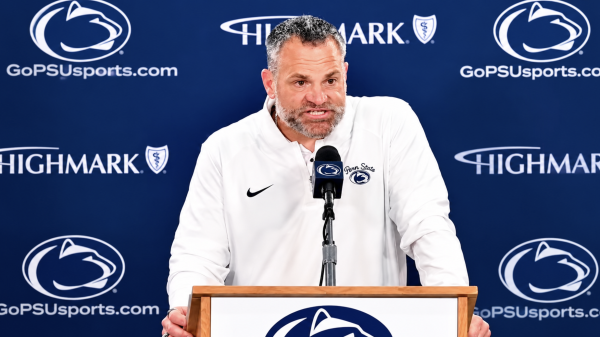
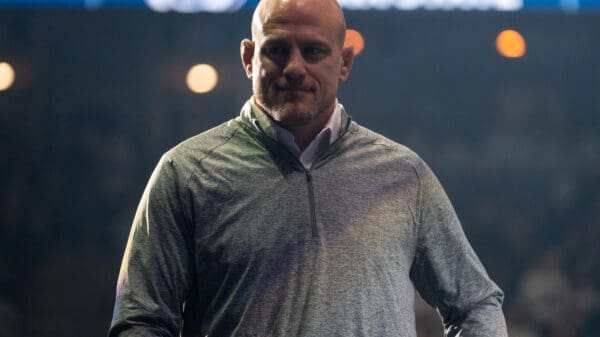
This is the second time under head coach Cael Sanderson that Penn State has reached a streak of 60 or more consecutive dual victories. The first, from 2015–18, remains the sixth-longest in NCAA history. The current run stands alone at the top.
Over the course of this historic streak, 58 different wrestlers have contributed, underscoring that this is not the story of a single generation or a handful of stars.
Penn State has outscored its dual opponents 2,666–514 during the streak, winning by an average score of 35–7. In most duals, the outcome is decided long before the final whistle.
There have been moments of tension, all legendary streaks have scares in them.
A 20–16 win over Ohio State on Feb. 15, 2020, and another 20–16 victory against Penn on Dec. 3, 2021, served as reminders that perfection is fragile.
Yet even in those moments, Penn State held firm, another hallmark of championship culture.
Great winning streaks exist across all collegiate sports, whether it is Bud Wilkinson’s Oklahoma Sooners winning 47 straight football games, John Wooden’s UCLA basketball teams claiming 88 consecutive victories, Patty Gasso’s Oklahoma softball teams winning 70 in a row, or Geno Auriemma’s UConn women’s basketball teams rattling off 111 straight wins.
What separates Penn State wrestling under Sanderson, however, is not just the length of the streak but the context in which it has been achieved.
Penn State’s dominance is statistically unprecedented because it combines era-adjusted difficulty, massive scoring margins, individual excellence, and year-to-year consistency in ways no Division I wrestling dynasty, that includes Dan Gable’s run at Iowa or Oklahoma State winning 23 national championships in the Gallagher and Griffith eras at their peaks, has ever matched.
Sanderson has guided Penn State to 12 national championships, trailing only Gable’s 15, the Nittany Lions have claimed 10 titles in a 12-tournament span from 2011–24, excluding the canceled 2020 championships.
That is an 83 percent championship rate in the modern era, a time defined by scholarship limits, deep national parity, advanced analytics, and nationwide recruiting. No dynasty before has dominated under such constraints.
Penn State’s margins of victory further separate it from history. In 2017, the Nittany Lions won the NCAA Championships by 50 points. In 2018, they won by more than 60. In 2019, the margin was 43 points. In 2022, it was 47. The 2024 title featured one of the largest winning margins ever recorded. Historically, a 10- to 15-point team title margin was considered overwhelming. Penn State shattered that standard.
A key driver of that dominance lies in bonus-point efficiency, the hidden stat that breaks tournament math.
Penn State consistently leads the nation in pins, technical falls, and major decisions. Its wrestlers don’t just win; they score early and decisively.
 Add Nittany Sports Now as a preferred source in Google! Click here to add us.
That forces opponents to chase points, alters match strategy across the board, and creates a psychological gap before tournaments even begin.
Individually, the resume is just as staggering.
Under Sanderson, Penn State has produced multiple four-time All-Americans, multiple Hodge Trophy winners, and multiple four-time NCAA champions like Carter Starocci, David Taylor, and Bo Nickal.
There have been tournaments where Penn State crowned four or five individual national champions, something previously unheard of in wrestling especially at the highest peaks of Oklahoma State and Iowa.
Earlier dynasties often relied on a few transcendent stars, sometimes masking weaker weights. Penn State does not.
The Nittany Lions score at nearly every weight class, reload without rebuilding, and routinely develop recruits into champions regardless of initial ranking. There is no soft spot in the lineup.
The era-adjusted comparison matters most. Past dynasties operated in a less nationalized sport with fewer programs, limited recruiting reach, and lower athlete specialization.
Penn State dominates in an era where elite wrestlers exist at every weight across the country, where resources are widespread, and where parity should make this level of control impossible.
There is also an unmistakable psychological effect.
Opponents wrestle knowing the margin for error is razor-thin.
Coaches openly acknowledge it.
Wrestlers feel it before stepping on the mat.
No program, not Iowa, not Oklahoma State created this level of inevitability year after year.
Most dynasties peak, plateau, and fall. Penn State loses legends, replaces them with new champions, and somehow widens the gap. That defies historical precedent.
Penn State is not merely the most dominant program of its era. It is dominating a harder version of the sport at a higher statistical level than anyone before it.
If Iowa and Oklahoma State defined greatness for their generations, Penn State has broken the scale for the modern one.
That is why this streak is not just historic, it is unprecedented, but feels normal for a program that makes the extraordinary seem rather ordinary and routine.