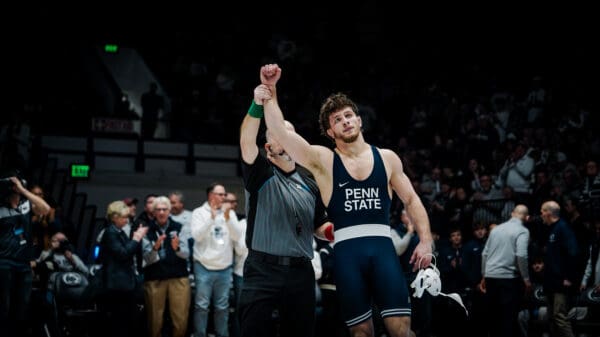


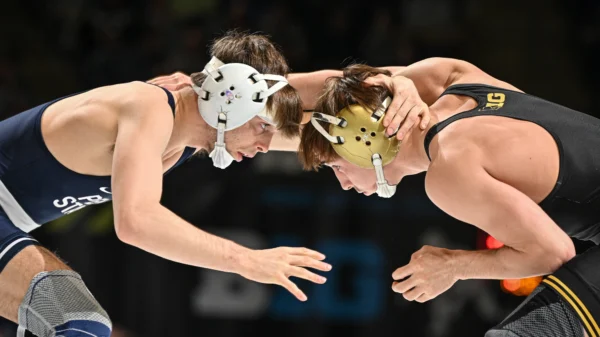

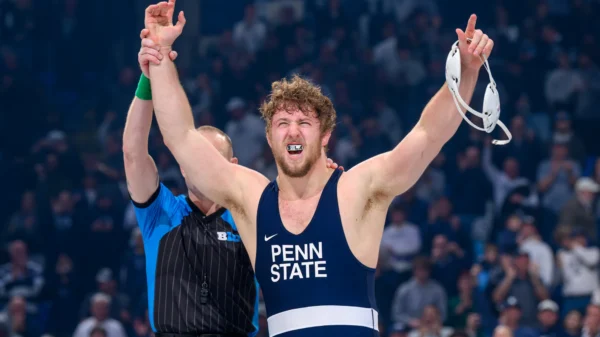
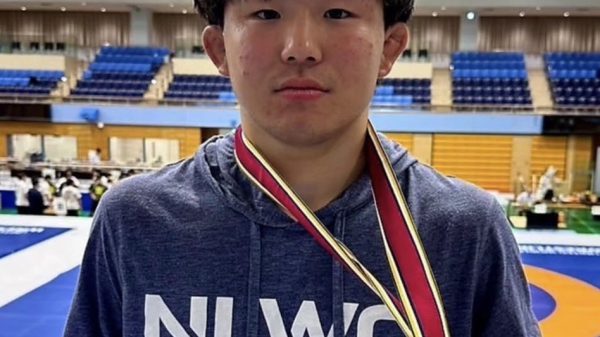












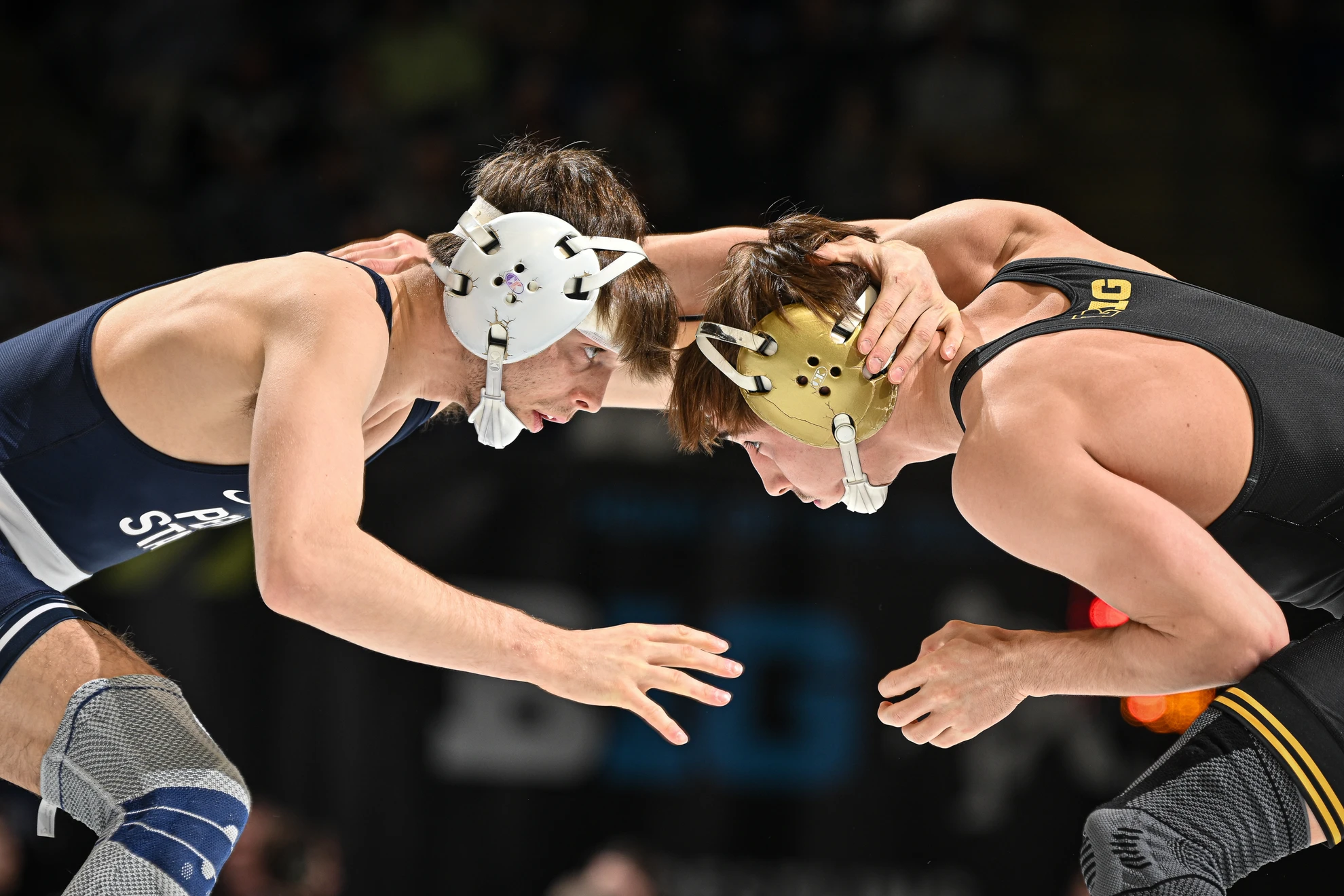
Marcus Blaze’s move to 141 pounds changes the names waiting for him in March. It does little to soften the challenge.
Instead of navigating a 133-pound field featuring Oklahoma State’s Jax Forrest and Ohio State’s Ben Davino, Penn State’s sophomore enters a division with Virginia Tech’s Bo Bassett and Lehigh’s Luke Stanich.
One just won a senior world championship.
The other owns a U20 world title and two NCAA All-America finishes.
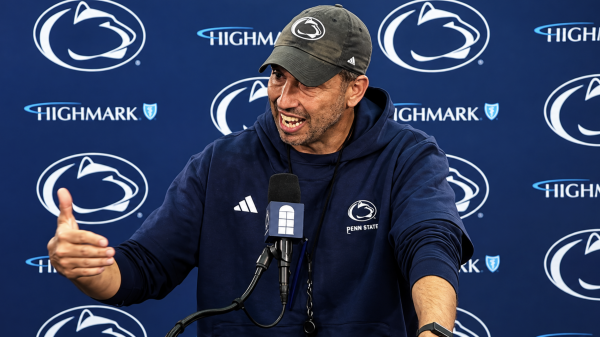
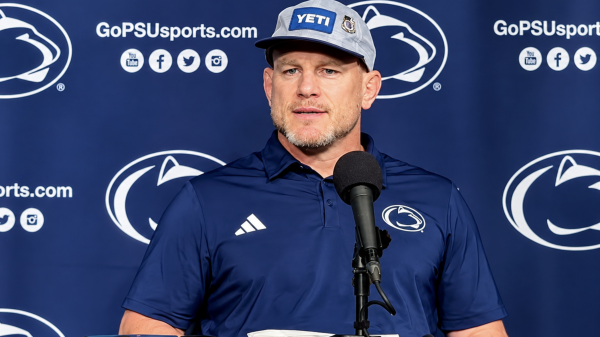
Cael Sanderson’s explanation, though, centered on Blaze himself.
“He’s getting a little bigger,” Sanderson said. “He’s very disciplined in his life, so he could do what he needed to do to get down to 133, but we feel like this was a good move for him.”
Sanderson said Penn State was still working through Blaze’s return timetable following the World Championships. Size, however, was no concern.
“He’ll be a good-sized 141-pounder,” Sanderson said. “We’re not worried about his size. He can continue focusing on getting better and competing hard.”
That puts a different backdrop around Christian Pyles’ assessment during an interview with Nittany Sports Now’s Joe Smeltzer.
Pyles expected Blaze to remain at 133 when they spoke, but his championship evaluation extended beyond that weight.
“I can’t say that Marcus Blaze isn’t a title contender any weight he goes,” Pyles said.
His reasoning deserves attention after Blaze’s freestyle season.
Blaze won the U.S. Open at 61 kilograms, then beat Forrest in their best-of-three Final X series to secure his first senior world team spot. After Forrest won the second match 6-1, Blaze answered with a 5-2 victory in the deciding bout.
 Add Nittany Sports Now as a preferred source in Google! Click here to add us.
That response carried into the World Championships in Astana, Kazakhstan. A 3-2 quarterfinal loss stopped his gold-medal pursuit, but Blaze returned through repechage and defeated Kazakhstan’s Assyl Aitakyn 4-2 for bronze.
He arrives at 141 with evidence that he can recover from a loss and beat elite opponents under pressure. Bassett and Stanich will test how that translates back to folkstyle.
Bassett has already provided an introduction. Fresh off his senior world title, the Virginia Tech freshman beat Stanich 13-9 in his collegiate debut. He scored three takedowns across the opening two periods before Stanich rallied with two in the third.
For Blaze, that result illustrates the offensive demands awaiting him.
Pyles wanted more scoring from Blaze at 133, particularly against opponents capable of piling up points. Moving up leaves that concern relevant.
“At 141, Bo Bassett is a sensation,” Pyles said. “Luke Stanich is a U20 world champion like Marcus.”
Stanich brings more college experience than either Blaze or Bassett. He finished third at 141 last season after placing fifth at 125 in 2024. His response against Bassett also showed why an early deficit does not remove him from a match.
Blaze’s senior world medal gives him a credential Stanich does not possess. Stanich’s longer college résumé offers a reminder that freestyle success does not settle NCAA matches.
“Those two are going to have a lot to say about it, but you can’t tell me Marcus can’t compete with those guys either,” Pyles said.
Sanderson also sees a longer horizon. Blaze plans to compete at the Olympic weight of 65 kilograms, making growth toward that division part of the calculation.
“In the long term, as a guy who’s planning on wrestling at 65 kilograms, and with the upcoming Olympic year, the move up makes a lot of sense for him,” Sanderson said.
The immediate assignment remains demanding: bring the confidence earned internationally into a weight class where Bassett can force the pace and Stanich has already proved he can reach the NCAA podium. Blaze has earned his place in that conversation.