





The late Joe Paterno was a man of many words and always had an opinion or thought on nearly any subject or issue.
But if you asked him how Penn State outlasted Miami in the 1987 Fiesta Bowl, he had very little to offer.
“To this day, I don’t know how we beat Miami.”
In an era that would look almost unrecognizable compared to today’s college football landscape, if there was ever a squad that epitomized the “Success with Honor” mantra, or what Paterno believed football should be, the 1986 team was it.
On the field, the blueprint was the essence of power football. Paterno had a stable of running backs in D.J. Dozier, Blair Thomas, Tim Manoa and Steve Smith powered through opposing defenses to the tune of 240.6 rushing yards per game.
Unlike the 1982 national championship squad that was dubbed “Air Paterno,” the 1986 offense wasn’t as explosive.
The late Beano Cook once said of the unit, “Penn State had less firepower than Sweden did in World War II.”
Complementing that elite ground game was a suffocating defense that destroyed the opposition’s offensive psyche and rarely beat itself.
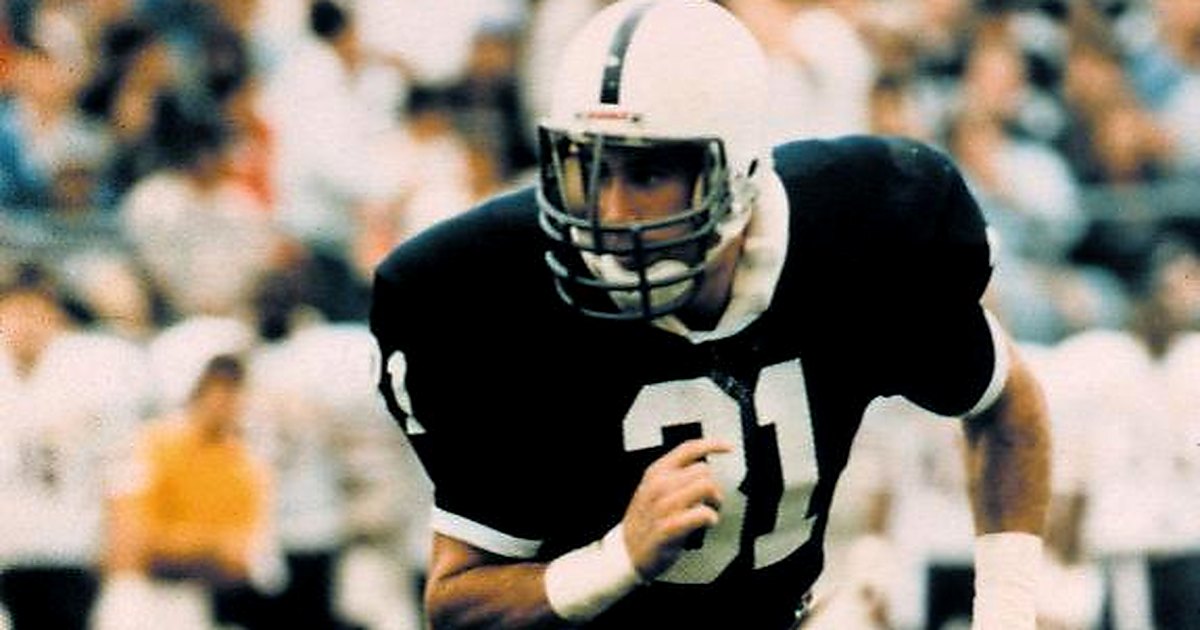
Penn State’s starting linebackers of Trey Bauer, Pete Giftopoulos, Don Graham and Shane Conlan epitomized what Paterno wanted from the position: instinctive, intelligent and relentlessly prepared players who were always in position to make a play.
Overall, the 1986 defense was the third-best scoring defense in the nation, allowing 11.1 points per game and surrendering only 69.7 rushing yards per contest.
The team also had extra motivation after coming up short against Oklahoma in the 1986 Orange Bowl. A victory would have completed a 12-0 season and secured the program’s second national championship.
Instead, a group of seniors returned to complete its mission.
Penn State rolled to a 6-0 start, marking the eighth time in Paterno’s first 20 seasons that his team won its first six games. At that point, the Nittany Lions reached their season-defining game.
“We knew that our whole season would ride on the Alabama game,” offensive lineman Keith Radecic said.
“We knew that we had to play well the first half of the season, but, you know, the biggest game to that day would be Alabama. But we went down there saying, ‘We have nothing to lose.’ They were ranked ahead of us. We have nothing to lose, but let’s go down there and give everything we’ve got.”
Before facing second-ranked Alabama, the Crimson Tide owned the nation’s longest unbeaten streak at 12-0-1 and had already defeated Ohio State, Florida, Tennessee and Notre Dame.
Penn State’s schedule was also ridiculed by the Alabama media.
“After disposing of a bum a week since the start of football season, Penn State returns to the big time,” Bill Lumpkin wrote in the Birmingham Post-Herald.
With rain in the forecast for Tuscaloosa, Paterno was asked whether he hoped the conditions would help his Nittany Lions.
Paterno somewhat shocked the media with his confidence.
“Naw, I don’t want it to rain because I don’t want them to have any excuses when we beat them.”
The seeds of the greatness that lay ahead were planted by the statement Penn State made at Bryant-Denny Stadium – a venue where the Crimson Tide had lost only 12 times since it opened in 1929.
Penn State was nearly flawless, producing 378 yards of total offense. Quarterback John Shaffer was pristine, completing 13 of 17 passes, while the Nittany Lions forced five turnovers in what remains arguably the most dominant road victory in program history, 23-3.
For Alabama, it was the program’s worst home defeat since 1955. For those who questioned the Nittany Lions’ mettle, the response was deafening.
The game demonstrated one of Paterno’s greatest strengths: confidence. His belief was that if you prepared, worked hard and carried yourself with confidence, dominance would follow.
That performance became the foundation for believing a national championship could become reality.
After shutting out West Virginia, Penn State returned home for the first time in two weeks and faced its next major pressure point.
Maryland had entered the 1985 season with national championship aspirations and was ranked No. 7 in the nation, but Penn State pulled off a major 20-18 upset that gave the Nittany Lions the momentum to challenge for the national championship.
Now, Maryland was looking to return the favor and derail Penn State’s perfect season. No one should have been surprised that the game came down to the wire, as the previous two meetings had been decided by three total points.
Although Penn State’s defense had kept Maryland’s offense in check for much of the game, Terrapins quarterback Don Henning began to find a rhythm, pushing the Nittany Lions to the brink.
Henning connected with John Bonato to bring the Terrapins within two points, setting up a potential game-tying conversion. Penn State’s season had reached its most consequential moment to that point.
“We had called timeout, and defensive coordinator Jerry Sandusky communicated a great call,” linebacker Trey Bauer said. “He said, ‘This is what they’re going to do. They’re going to sprint out, and they’re going to try to throw it out.’ That’s exactly what they did.”
“So, as far as the defense, we all got together, and we found that we would play that play as hard as possible,” defensive back Ray Isom said. “It happens, they did run the pick play, and they first looked inside, and I was there, and a couple other linebackers were there, and they threw it outside. Duffy Cobbs made just a tremendous play.”
Cobbs’ pass defense preserved the undefeated season, but crunch-time heroics would be needed again the following week when the Nittany Lions visited Notre Dame.
Penn State wasn’t facing a Gerry Faust-coached team with obvious breaking points. It was facing a 4-4 team that had been rejuvenated by college football’s “Dr. Frankenstein.”
In his first season at Notre Dame, Lou Holtz had the Irish believing again something he had previously done at William & Mary, North Carolina State, Arkansas and Minnesota, guiding each program to a bowl appearance.
Notre Dame matched Penn State blow for blow, and it was Paterno who chose to alter the trajectory of this unanticipated heavyweight fight.
“It was a great play call,” quarterback John Shaffer said. “Coach Paterno called that play himself, and it was a situation where they were in the perfect coverage for the play that we called. I remember dropping back and trying to look off the defender, and I did a decent job of doing that. Ray Roundtree was wide open, just sitting there, kind of waving at you.”
Roundtree’s 37-yard touchdown reception extended Penn State’s lead, but Notre Dame clawed its way back to 24-19 and marched to the Penn State six-yard line.
 Add Nittany Sports Now as a preferred source in Google! Click here to add us.
Penn State could feel its season beginning to slip away, but the mental toughness Paterno always emphasized had prepared the Nittany Lions for their biggest moment of the season.
Paterno believed a team could never win consistently if it continually beat itself.
The decisive play came on a second-down sack by Bob White, who dropped Notre Dame quarterback Steve Beuerlein for a nine-yard loss.
Notre Dame would not get any closer.
Penn State capped its undefeated regular season with a 34-14 demolition of Pitt, setting the stage for what was, at that time, the biggest game in college football history.
Miami represented almost everything Penn State was not.
The Hurricanes were loud, brash and overflowing with future NFL talent. They arrived in Arizona dressed in military fatigues, embracing the spectacle and intimidation surrounding what had become college football’s ultimate championship game.
Penn State arrived in suits.
That contrast has been simplified over the years into good against evil, establishment against rebellion and Joe Paterno against Jimmy Johnson. Beneath all the theater, however, was a football matchup that revealed precisely what Paterno believed a team should be.
Miami had the speed. It had the stars. It had Heisman Trophy-winning quarterback Vinny Testaverde, Michael Irvin, Alonzo Highsmith, Jerome Brown and Bennie Blades.
Penn State had something more difficult to measure.
It had discipline, preparation and complete confidence in the man standing beside you.
The Hurricanes gained 445 yards compared to Penn State’s 162 and repeatedly appeared capable of breaking through. But every time Miami threatened to take control, Penn State forced another mistake.
Testaverde threw five interceptions, while the Hurricanes committed seven turnovers overall.
Still, Miami had one final opportunity.
Trailing 14-10, the Hurricanes reached the Penn State five-yard line in the final minute. The national championship, the perfect season and the unfinished business carried over from the previous year had been reduced to one defensive stand.
Yet there was no panic inside the Penn State huddle.
The senior leadership of Shane Conlan, Tim Johnson and Bob White had established the tone. There was no screaming and no frantic attempt to manufacture confidence. The Nittany Lions calmly received the call and prepared to execute it.
On fourth down, Pete Giftopoulos intercepted Testaverde in the end zone with 18 seconds remaining.
Penn State was the national champion.
“To this day, I don’t know how we beat Miami,” Paterno would later say.
Perhaps Paterno never found a satisfying football explanation because the answer went beyond formations, statistics or individual matchups.
Penn State won because it was more composed when the pressure was greatest. It trusted its preparation, remained fundamentally sound and refused to be intimidated by a team considered bigger, faster and more talented.
Legendary sportswriters Bill Lyon and Edwin Pope summed it up best.
“It was the kind of game Penn State almost always wins. Keep it close, make it come down to making the big play at the end,” Lyon wrote for The Philadelphia Inquirer.
Pope kept it simple in the Miami Herald.
“Penn State deserves to be No. 1 simply because it did what it had to when it had to.”
Against Miami, perhaps the most valuable player wasn’t the most talented player on the team.
While the Penn State offense sputtered, John Bruno’s punting forced the potent Hurricanes offense to deal with long fields all night.
Bruno punted nine times, averaging 43.4 yards per punt, and executed several coffin-corner kicks.
“When we won that national championship against Miami, we wouldn’t have won it without him,” Paterno said of Bruno. “He was good in the clutch.”
“He had a lot to do with that championship team,” offensive coordinator Fran Ganter added. “There was talk after that game that he was the MVP.”
The 1986 Nittany Lions were not Paterno’s most explosive team. They may not have been his most individually talented team, either.
But they were experienced, selfless, intelligent, physically tough and nearly impossible to break mentally. When their season reached its most consequential moments against Maryland, Notre Dame and finally Miami, they never lost their identity.
Forty years later, that is what makes the 1986 national champions perhaps the most quintessential Joe Paterno team of them all.
They did not always overwhelm opponents with talent.
They prepared. They endured. They believed.
And when the opportunity arrived, they finished the mission.