











I have sat through many bad losses covering Penn State football. I endured “6-4” against Iowa. I watched helplessly in 2022 as Michigan ran for 418 yards against a Manny Diaz defense. I was there for the nine-overtime debacle against 2–5 Illinois, where Penn State was bullied for 20 rushing first downs. All of them were brutal. But none of them — not one — approaches the disaster that unfolded in an empty stadium in Pasadena.
This was the worst loss of the James Franklin era, by a country mile.
A winless UCLA team, a program in disarray that had already fired its head coach (DeShaun Foster) and offensive coordinator (Tino Sunseri) and had been humiliated in each of its first four games, broke Penn State’s jaw clean in two.
This is the first time since 1985 when UTEP upset No. 7 BYU that a winless team 0-4 or worse defeating a Top 10 team.
Entering Saturday, UCLA ranked 105th nationally in rushing, averaging a meager 124.3 yards per game. Against Penn State, the Bruins exploded for 266 rushing yards.
Sophomore quarterback Nico Iamaleava alone gashed the Lions for 128 yards and three touchdowns, summoning memories of Vince Young terrorizing defenses two decades ago. The difference? Young did it for a national champion Texas team. Iamaleava did it for a winless roster left for dead.
What exactly is Penn State paying Jim Knowles to do? Franklin spent the week touting Knowles’ “Ohio State journey” as a blueprint. Ohio State’s defense doesn’t get mauled by 0–4 teams in half-empty stadiums. It doesn’t get embarrassed like this.
“It’s embarrassing. It’s bad,” said defensive end Dani Dennis-Sutton. “We all got to look in the mirror. There’s not one person, it’s not one coach, not one player. It’s literally everybody.”
Dennis-Sutton is right. The defensive front was manhandled. UCLA’s backs were three and four yards downfield before anyone touched them. Tackling was atrocious — too high, too soft, too easily shed. Everything about Penn State’s defense screamed soft. Iamaleava repeatedly made spies miss, outran pursuit angles, and exploited blown assignments for chunk plays that broke the Lions’ will.
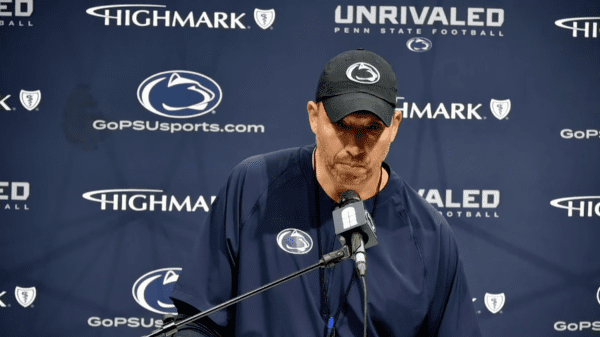
Franklin’s postgame explanation rang hollow. “We spied, and he ran away from the spy. We spied, and he made the spy miss. A couple other times we got caught in man coverage without a spy. He made a ton of plays,” Franklin said.
Translation: Penn State had no answers.
And while the defense collapsed, the offensive line — touted as one of the best in program history — disgraced itself.
UCLA entered today surrendering 232.8 rushing yards per game (131st nationally). Against that sieve, Penn State’s top two running backs managed just 89 yards.
 Add Nittany Sports Now as a preferred source in Google! Click here to add us.
The misuse of personnel was baffling. Nick Singleton, once an explosive playmaker, averaged just 3.5 yards per carry, yet continued to get the bulk of the touches. Kaytron Allen, who averaged 6.2 yards per carry and scored twice, was inexplicably limited to eight carries. What more does he need to do?
Center Nick Dawkins compounded the misery with yet another false start — his third in two weeks. How a center commits that many presnap penalties is unfathomable. If Franklin wants accountability, Dawkins should not be the starter next week.
Then came the fourth-down fiasco. A quarterback power read turned into a demolition derby, with UCLA’s defensive front blowing up blocks, collapsing the edge, and swarming Drew Allar for a turnover on downs. Franklin’s explanation — that the defense brought pressure they “knew was coming” — only highlighted how unprepared his team was to stop it.
The postgame messaging was even weaker. Allar told Jenny Dell of CBS that the team “didn’t want to get beat twice,” a message Franklin echoed while lamenting the team’s “energy” and “travel” issues. Those are excuses, not explanations.
Franklin loves to preach his “1-0” mantra, but that philosophy evaporated the moment the team stepped off the plane in Los Angeles. Instead of responding to last week’s Oregon loss with urgency, Penn State sulked and sleepwalked — and paid the price.
UCLA didn’t just expose Penn State’s physical flaws. It shattered the mental makeup of this program. This was a team with playoff aspirations, yet it folded against the worst opponent on its schedule. It wasn’t just the players who broke; Franklin did too. His words sounded like a man who can’t take a punch. His team can’t either.
Franklin insists his worst losses “don’t define his career.” But they do.
Weigh his top-25 wins against his top-25 losses, and the scale tips heavily toward humiliation. The defining trait of his tenure has been a repeated failure to rise in big moments — and now, apparently, even in small ones.
Even if Penn State beats Ohio State and Indiana, this loss is unforgivable. Combined with a soft nonconference slate, it obliterates any College Football Playoff argument. More importantly, it strips away the illusion of toughness Franklin has tried to build.
Because tough teams don’t let winless opponents run for 266 yards. They don’t let sophomore quarterbacks look like Vince Young. They don’t blame travel and energy for a season-crippling defeat.
No, tough teams punch back. And right now, Penn State football — from Franklin on down — doesn’t know how.