











One of the most overlooked aspects of football is special teams.
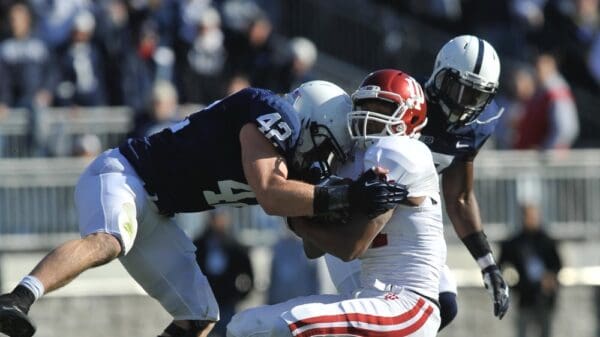
Coaches often refer to it as one-third of the game, but its impact goes well beyond that. Special teams can dictate field position, swing momentum, create scoring opportunities and directly influence what an offense and defense are able to accomplish. Just as importantly, it often serves as the proving ground where young players earn trust and begin carving out larger roles.
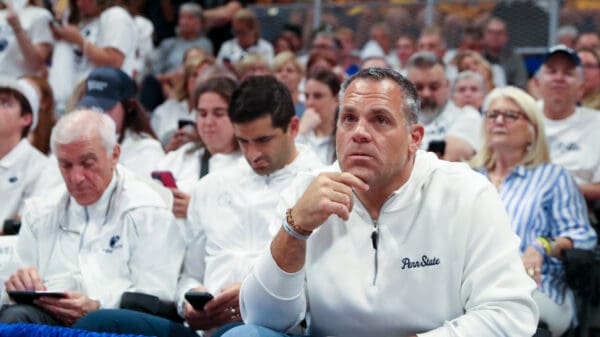
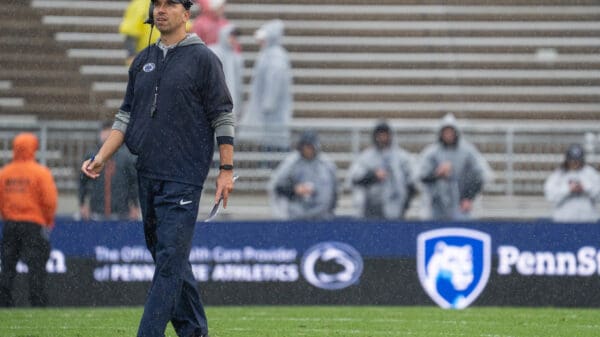
Head coach Matt Campbell echoed that sentiment during Penn State Media Day, noting that many players “earned the right to play on special teams where every great player usually is either made or found.”
That philosophy holds true from highly touted NFL rookies to eventual Hall of Famers.
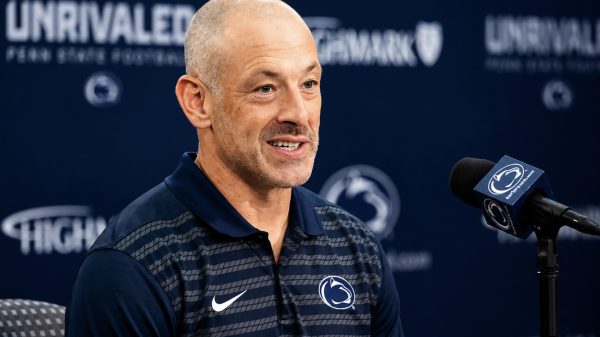
“We use examples all the time,” Penn State special teams coordinator Justin Lustig said. “Myles Garrett played on punt return and field goal block. Abdul Carter played on punt protection and punt return as a rookie with the Giants. He didn’t do a lot of that for us at Penn State, but he had to do it in the NFL. Showing players that reality is critically important.”
Lustig is entering his third season as Penn State’s special teams coordinator, and in his first two years he has transformed the Nittany Lions’ special teams units into one of the nation’s best.
Throughout his coaching career, Lustig has mentored 56 all-conference selections, coached 2018 Lou Groza Award winner Andre Szmyt at Syracuse and helped develop a Ray Guy Award finalist.
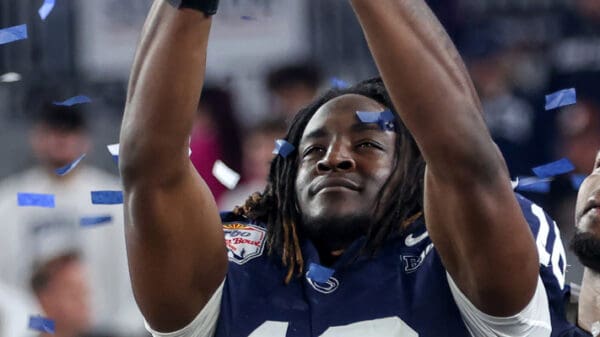
His impact at Penn State was immediate. In his first season, long snapper Tyler Duzansky, kicker Ryan Barker and kick returner Nicholas Singleton all earned All-Big Ten honors under his guidance.
One of Lustig’s defining moments at Penn State came during the 2024 win over Minnesota.
Clinging to a 26-25 lead with less than four minutes remaining, the Nittany Lions faced a critical fourth down. Rather than simply punting the ball away, Penn State successfully executed a fake punt that helped preserve the victory.
Lustig explained that the play was far from a spur-of-the-moment decision.
“Just like an offense has a playbook, we have a library of fake punts,” Lustig said. “We practice them throughout the spring, summer and training camp so the players know them inside and out. Then you’re simply waiting for the right opportunity.
“Our personal protector is essentially the quarterback of the punt unit. He’s responsible for making checks and adjustments based on the defensive look. On that play, he made the correct call, communicated it to everyone, and everyone communicated it back. Communication is a two-way street, and everybody was on the same page and executed their job. Luke Reynolds gets a lot of the credit, but Dom Rulli was really the unsung hero of that play.”
Last season, while Penn State endured an up-and-down campaign, special teams remained one of the program’s biggest strengths.
According to Pro Football Focus, the Nittany Lions finished the 2025 season with the nation’s No. 13-rated special teams unit, earning an overall grade of 85.3.
Lustig credits that success to the players’ willingness to embrace roles that don’t always receive the spotlight.
 Add Nittany Sports Now as a preferred source in Google! Click here to add us.
“It starts with the players,” Lustig said. “We had talented players who bought into what we were asking them to do. There was a lot of selflessness. Dani Dennis-Sutton is a great example. He didn’t have to be a special teams player, but he bought into what it could do for our team and for his own future. It always starts with the players, and I think that’s the biggest reason for our success.”
The mental demands of special teams are also unique.
Unlike an offense or defense, where players have another snap moments later, special teams often presents just one opportunity to make an impact before returning to the sideline. That makes mental preparation just as important as physical execution.
“It’s definitely a challenge,” Lustig said. “We end every meeting talking about a ‘one-shot mentality.’ You have to have a goldfish mindset – a very short memory.
“For example, if you’re a starting receiver and you just dropped a pass on third down, but now you’re on the punt unit, if you’re still thinking about that dropped pass, you’re probably not going to execute your assignment on punt. It’s critically important that our players are mentally locked in. That’s something we constantly talk about and reinforce in practice.”
As Penn State prepares for the 2026 season, Lustig believes his unit has plenty of players capable of making game-changing plays. Rather than relying on one standout contributor, he sees depth throughout the roster.
“I don’t know that I’ve identified one or two guys yet, but there’s a group of about 10 players who have shown they can make those kinds of plays,” Lustig said. “Guys like Zion Tracy, Audavion Collins, Brett Eskildsen and someone who doesn’t get talked about enough, John Klosterman, will all be significant contributors on special teams.
“At the end of the day, though, you’re only as good as your specialists—the punter, the kicker and the returners. Those players are incredibly important.”
Beyond the X’s and O’s, Lustig also sees his role as helping reinforce the culture Campbell is building within the program.
Rather than viewing special teams as a separate phase of the game, he believes those units should embody the identity of Penn State football every time they take the field.
“I see myself as an extension of the head coach,” Lustig said. “If someone watches a Penn State game and focuses only on our kickoff, punt or field goal units, they should be able to understand the culture of our football program.
“As a team, we emphasize toughness, togetherness and discipline. Those values are constantly reinforced on special teams. Then it’s about consistently holding players accountable for their actions and their words every single day. Over time, that’s what builds your culture.”
It’s a philosophy that has already paid dividends.
Whether it’s executing a perfectly timed fake punt, blocking kicks, flipping field position or developing future stars before they become household names, Penn State’s special teams have become much more than a supporting cast under Lustig.
They’re a reflection of the program’s identity and one of the reasons the Nittany Lions believe they can win in every phase of the game.