








Chicago, IL – After playing for a different defensive coordinator in each of his first three seasons, Penn State linebacker Tony Rojas immediately noticed something different about D’Anton Lynn: Penn State’s new coordinator was asking players what worked for them.
Tony Rojas has spent his Penn State career learning that change is the only constant. Manny Diaz coordinated the defense in his first season, Tom Allen in his second and Jim Knowles in his third. Now D’Anton Lynn becomes coordinator No. 4 in four years.
Turnover can leave a player fluent in terminology and various verbiage but unsure which language comes next.
Yet Rojas’ first impression of Lynn is not about a formation or pressure package. It is about a coach willing to listen and adapt.
“He’s (Lynn) even coming back to us players and asking for advice so he can get better as a coach,” Rojas said.
Coaches often talk about tailoring schemes to personnel. Too often, that means finding players who can execute the coach’s favorite ideas. Rojas describes something different: a coordinator beginning with the strengths in his meeting room as a foundation and working outward to improve on weaknesses.
“At the end of the day, he wants to call the plays that we’re best at, not what he likes,” Rojas said. “I think that’s a big change for us.”
So far, Penn State is moving toward a four-down foundation after new head coach Matt Campbell became associated with the 3-3-5 at Iowa State. The easy mistake would be forcing either Campbell’s old identity or Lynn’s previous playbook onto this roster. Their better choice is the one Rojas describes: decide what these players do well, teach it thoroughly and build from there.
Lynn has evidence that he can adapt during his first three seasons as a defensive coordinator with stops at UCLA in 2023 and USC the last two seasons.
UCLA allowed 29 points and 403.3 yards per game in 2022. In Lynn’s only season coordinating the Bruins’ defense, those figures fell to 18.4 points and 301.5 yards in 2023. PFF gave that UCLA defense a 92.9 grade, tied for seventh nationally, with grades above 90 in run defense, pass rush and coverage.
The next challenge was different.
Lynn inherited a USC defense that had surrendered 34.4 points per game in 2023, that was costly in the Trojans attempt at their first College Football Playoff berth.
The Trojans cut that to 24.1 in his first season and 23.0 in his second. Those units were not identical to UCLA’s breakthrough group. But the trajectory strengthens Campbell’s description of Lynn as a teacher rather than merely a collector of calls.
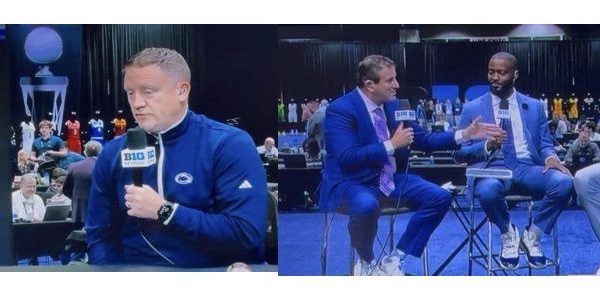
Campbell praised Lynn’s three seasons as a coordinator and his understanding of the Big Ten while he was on the main stage at the 2026 Big Ten Media Days in Chicago.
“He understands this conference, the style of play and what it takes to build great defenses,” Campbell said. “You’ve seen the impact he’s had at both UCLA and USC.”
Campbell also pointed to Lynn’s history as a former Penn State player and his family’s connection to the school.
Lynn played for Joe Paterno between 2008-2011 racking up 162 career tackles, 7 tackles for loss, 4 interceptions, a fumble recovery, and three times was an honorable mention to the All-Big Ten team.
 Add Nittany Sports Now as a preferred source in Google! Click here to add us.
That background gives him credibility, but nostalgia will not stop a Big Ten running game. His ability to communicate might.
Rojas said Lynn has deliberately slowed the installation, a notable decision for a program undergoing so much change.
“In past years, it’s been kind of a rush to get the defense installed,” Rojas said. “But this year, he’s taking his time, and we’re really getting to know it very well.”
Last season, Rojas was part of a very complicated transition as Penn State imported Jim Knowles from the defending national champion Ohio State.
Knowles has a reputation of employing very complex schemes that take time to install but when fully in operation they have delivered championship results.
Unfortunately for Rojas and the rest of the teammates, the installation never fully materialized as Penn State struggled mightily at times stopping the run.
The approach this season is taking the time necessary.
Slow installation does not have to produce slow football. Done correctly, it creates the opposite. A defender who understands why a call works can recognize formations, anticipate adjustments and react without hesitation. Memorization gets a defense lined up; comprehension allows it to play fast.
“Coach Lynn has done a great job going slowly, not just teaching us how to do it, but teaching us why we’re doing it,” Rojas said. “I think that’s important for us defenders.”
It may be especially important for Rojas. Every coordinator has asked him to absorb something different, and the accumulated knowledge now appears to be an asset instead of a burden.
“I’ve had a different coordinator every year,” Rojas said. “I’ve learned different types of defensive schemes every year, so this season I feel like it’s a mixture of all three. It’s pretty easy.”
The best example of Lynn’s approach is also the simplest. When Lynn asked what Rojas wanted to do, the linebacker did not answer with coaching jargon.
“I just want to blitz,” Rojas told him. “I want to be off the edge, even off the ball, whatever it may be.”
That does not mean Lynn will send Rojas on every snap. It means he understands the player’s defining trait. Rojas is most dangerous when his athleticism is activated and doubt is removed.
“I’m at my best when I play fast,” he said, “and I think he’s going to put me in position to do so.”
There is still a long distance between favorable offseason reviews and a defense that wins in November. Lynn’s calls will be judged against real offenses, and player input cannot become player comfort at the expense of accountability.
But listening is not surrendering authority. It is gathering information. Teaching slowly is not lowering the standard. It is giving players the tools to reach it.
Penn State has hired celebrated defensive minds before. Lynn’s early distinction is that he does not appear interested in making players prove the brilliance of his playbook. He is trying to make the playbook reveal the best of his players.
After three years of adjustment for Rojas, that change may be the one that finally lets him and Penn State’s defense play free.