




















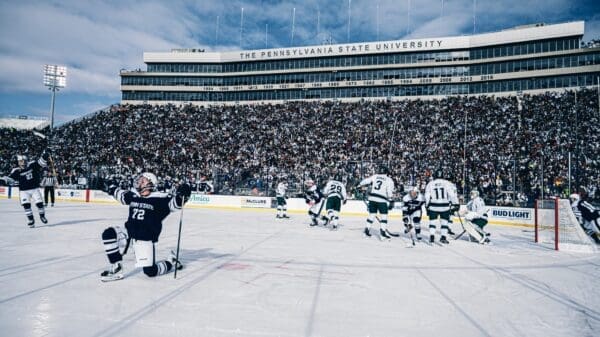










Albany, N.Y. – Penn State’s 3-1 loss to Minnesota Duluth in the opening round of the NCAA Tournament was disappointing, but it was not entirely surprising.
Overall, the Nittany Lions had too much high-end talent for the 2025-26 season to end this way. Gavin McKenna became a Hobey Baker Top-10 finalist, while Aiden Fink and Matt DiMarsico again provided major scoring punch. Penn State still finished the regular season and Big Ten Tournament at 21-13-2 and earned an NCAA Tournament berth. But the deeper numbers show why the season never fully stabilized and why the ending felt more like a slow unraveling than a sudden upset.
The first doom stat is the simplest one: 3.17 goals allowed per game. Penn State could score with anybody, averaging 3.75 goals per game, but the defensive side never matched that level consistently. That gap forced the Nittany Lions to live in high-variance hockey, where even strong offensive nights could be erased by breakdowns, loose coverage or momentum swings. Against better teams, that profile is dangerous because it leaves almost no cushion.
The second doom stat is even more revealing: 6.19 penalties per game. That is a massive number for a team trying to win postseason-style hockey. Overall, Penn State led the nation in penalty minutes with 682, although the number is somewhat inflated by the volume of misconduct infractions assessed to the Nittany Lions. Penn State’s penalty kill was respectable at 83.6 percent, but the sheer number of penalties kept putting stress on the roster. A good kill unit can survive occasional mistakes. It becomes much harder when a team is constantly handing over extra-man chances and interrupting its own rhythm.
The third doom stat shows how dependent Penn State became on special teams offense. The Nittany Lions were 16-5-1 when scoring a power-play goal but just 5-8-1 when they did not. That is a huge swing. It says Penn State’s offense was at its best when the power play could unlock a game, but when opponents stayed disciplined or the man advantage dried up, the team too often struggled to create enough margin at even strength to survive.
The fourth doom stat is one of the starkest in the packet: 0-9-0 when allowing five or more goals. For all the offensive talent on the roster, Penn State had no recovery gear once games turned chaotic. A team with national-level forwards can occasionally win a 6-5 type of game. Penn State, despite all that firepower, effectively had no comeback lane when the defensive structure broke down that badly.
The fifth doom stat points to territorial control. Penn State was 15-3-1 when outshooting opponents, but only 6-8-1 when outshot. That split says the Nittany Lions needed to dictate the pace and volume of play. When they were the aggressor, they looked like the dangerous, explosive team everyone expected. When the game tilted the other way, Penn State too often looked vulnerable, especially against teams capable of grinding down shifts and forcing mistakes.
 Add Nittany Sports Now as a preferred source in Google! Click here to add us.
The sixth doom stat is closely related. Penn State was 16-6-0 when winning more faceoffs and just 4-6-1 when losing more faceoffs. That is not just a trivia note. Faceoffs drive possession, and for a team already dependent on flow and offensive-zone pressure, losing draws meant spending too much time defending and too little time attacking on its terms.
The seventh doom stat explains why third periods felt so fragile late in the year. Penn State was 13-1-0 when leading after two periods, but only 6-8-1 when trailing after two and 2-4-1 when tied after two. In other words, this was not a team built to chase or consistently close coin-flip games late. If Penn State did not already have control, it often failed to seize it.
The eighth doom stat is the calendar itself. Penn State went 2-4-0 in November, then after a strong January stumbled to 2-2-2 in February and 1-3-0 in March before the NCAA Tournament. The season arc never truly leveled out. It spiked, dipped, surged again and then faded at the wrong time.
The ninth doom stat is performance against stronger competition. Penn State finished 7-9-1 against ranked opponents. That is not disastrous, but it is revealing. The Nittany Lions were dangerous enough to punch back, yet not consistent enough to impose themselves over time against the best teams on the schedule.
And the tenth doom stat is the one that hangs over everything: Penn State closed the stretch run 3-8-2 in its final 13 games, a skid that included damaging losses to Michigan State, Michigan, Wisconsin, Michigan again in the Big Ten Tournament and then Minnesota Duluth to end the year. Over that stretch, Penn State’s average expected goals (3.36 xG) trailed its opponents’ average expected goals (4.26 xG). That is the summary stat of the season’s collapse. Penn State was getting out-chanced by nearly a full expected goal per game. The offense remained talented and the ceiling remained high, but the discipline, defensive consistency, faceoff control and late-game resiliency were not good enough often enough when the games got biggest.
That is what doomed Penn State in 2025-26. Not one flaw, but a pattern: too many penalties, too many goals against, too much reliance on special teams scoring, too many nights losing the territorial battle and too little ability to recover once the game script turned against them. The talent was real. The numbers say the structure around it never held firmly enough.