








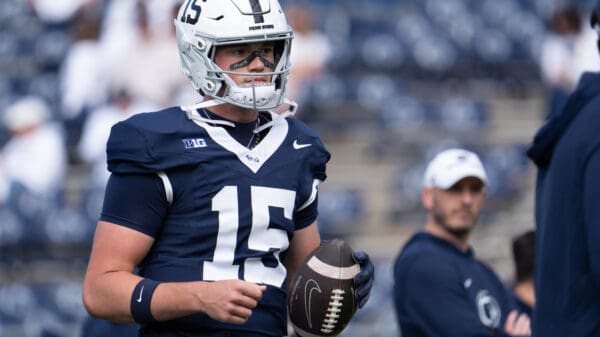

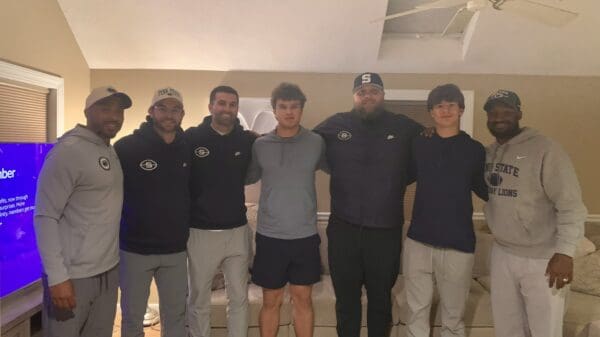
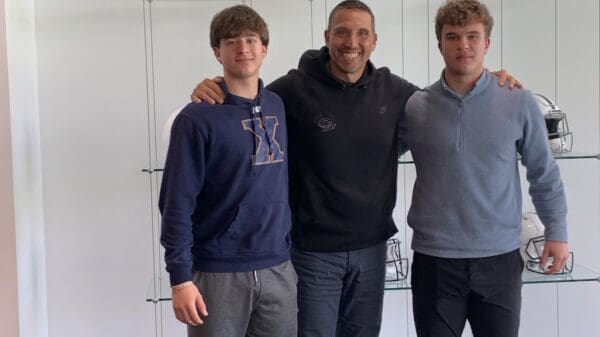


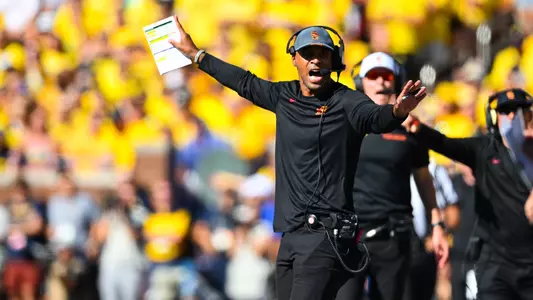
The first splash coaching hire in the Matt Campbell era was made Monday when it set itself up to land USC DC D’Anton Lynn for the same position.
‘A Young Mike Tomlin’: 5 Things to Know About New Penn State DC D’Anton Lynn
Lynn has been seen as a fast riser, having worked primarily in the NFL prior to becoming UCLA’s defensive coordinator in 2023 then moving crosstown to USC in 2024.
When Lincoln Riley began searching for a new defensive coordinator, the mandate was clear: USC needed not just better results, but a new defensive identity.
As Riley and USC squandered quarterback Caleb Williams’ time in Troy, the defense was poor all the way around.
The Trojan defense gave up a program-worst 447 points and was graded the 78th overall defense by Pro Football Focus with a 77.9 overall grade and the 75th tackling grade at 67.8.
The Trojans had cycled through schemes, philosophies and personnel without finding consistency. Riley wasn’t simply looking for play-calling; he was searching for a worldview.
Early in the process, Jim Leonhard’s name loomed large. Leonhard had overseen elite statistical defenses at Wisconsin and was widely respected as a tactician.
But Leonhard’s success came within a specific ecosystem, one he inherited from Justin Wilcox during his only season in Wisconsin in 2016, and his philosophical foundation was rooted in lessons learned as a player for Rex Ryan in Baltimore.
Ultimately, USC landed on a different name, but not a different lineage.
Lynn emerged as the choice, and although his résumé didn’t carry the same national brand recognition, his defensive DNA came from the same tree.
The difference is generational. Leonhard learned directly from Ryan. Lynn learned from Ryan’s disciples, most notably Don “Wink” Martindale, making his defense a modern evolution rather than a carbon copy, though he had brief exposure to Ryan as a player in 2012 and a staffer in 2014.
At its core, Lynn runs a flexible, aggressive, disguise-heavy multiple 3-4 defense that frequently morphs into a 2-4-5 nickel.
The numbers matter less than the intent.
In modern spread and read offenses, the leverage is using numbers to exploit gaps rather than schematically creating that gap to hit.
Like Rex Ryan’s best units, Lynn’s defenses are built to dictate terms, not react. They are designed to confuse protections, overload rules, and force quarterbacks to process post-snap rather than pre-snap.
The philosophical throughline begins with aggression but not recklessness.
Lynn emphasizes controlled pressure. His defenses often show five- or six-man pressures before the snap, only to rush three or four. Other times, those same looks send heat from unexpected angles.
The idea, straight out of the Rex Ryan playbook, is to make every pressure look the same and every coverage look different.
In Lynn’s only season at UCLA, he coordinated a Top 10 graded defense at 92.9 per PFF and tied Penn State for the top-graded pass rush in college football at a 91.5 grade.
This was one of the primary reasons Laiatu Latu was the top defensive player chosen in the 2024 Draft.
This “window dressing” is central to Lynn’s approach. Offenses may see a familiar alignment, but they rarely get the same outcome twice. That uncertainty is what creates hesitation, and hesitation is death for modern offenses built on timing and spacing.
Structurally, Lynn relies on a hybrid front that blends two-gap principles with aggressive linebacker play. The defensive line functions as the “shield,” occupying blockers and controlling space. The linebackers are the “sword,” attacking downhill, shooting gaps, and forcing disruption. It’s a concept that mirrors Ryan’s best Baltimore Ravens and New York Jets fronts, where interior discipline allowed second-level defenders to play fast and violent.
Linebacker aggression is non-negotiable in Lynn’s system.
 Add Nittany Sports Now as a preferred source in Google! Click here to add us.
Early downs are treated as opportunities, not moments to sit back. Stop the run first, earn the right to rush the passer later.
That mindset is particularly important in the Big Ten, where physical run games still dictate tempo and game flow. Lynn’s background under Martindale, who himself coached under Rex and Rob Ryan, reinforces that belief: you cannot pressure quarterbacks consistently if you can’t control the box.
One of the major issues that derailed Jim Knowles‘ time at Penn State was his inability to position linebackers to stop the run.
The secondary under Lynn, meanwhile, will be built on versatility.
Lynn values defensive backs who can play multiple roles: outside corner, slot, safety, allowing him to get the best five or six defenders on the field regardless of personnel groupings.
Coverages range from Cover 0 and Cover 1 to Cover 2, Cover 3, and Quarters, often disguised until the snap.
Again, this is Rex Ryan football updated for spread offenses: pressure married to coverage ambiguity.
This lineage is not theoretical. Lynn began his NFL coaching career as a defensive assistant with the Jets and Buffalo Bills while Rex Ryan was head coach. He later worked under Dennis Thurman, another Ryan lieutenant, and coached in Baltimore alongside Mike Macdonald, who spent seven years under Martindale. Simply put, Lynn comes from the house of Ryan and the “Blitzing Mullet.” The influence is unavoidable.
Lynn’s defenses reflect that lesson. They don’t blitz for blitzing’s sake. They blitz to create leverage elsewhere.
They’re willing to live in man coverage if the matchup is right, and willing to disguise into zone if the situation demands it. The core belief remains unchanged: attack the quarterback, force mistakes, and control the game’s emotional temperature.
That’s why Lynn’s turnaround at UCLA was so striking. In one season, the Bruins transformed from one of the nation’s worst defenses into one of its most efficient. The scheme was multiple, but the message was simple: effort, communication, and physicality elevate whatever you run. Lynn’s emphasis on “obnoxious communication” and relentless pursuit echoed the same cultural demands Rex Ryan placed on his best units.
Which brings the conversation to USC.
2025 didn’t see the next great jump Trojan fans expected.
After real improvement in Year 1 under Lynn, the regression has sparked questions about scheme, aggression and identity.
Some argue Lynn has grown too cautious, protecting a young secondary at the expense of pressure. Others point to discipline and execution failures rather than structural flaws.
The truth likely sits in the middle. Rex Ryan defenses were never conservative by nature, but they were always personnel-driven. When you lack the pieces to hold up in man coverage, aggression becomes riskier.
The answer Campbell is seeking is abandoning Knowles’ complex schemes that created pressure in gaps and minimizing leverage opportunities and going back to what made Penn State one of the best units in the nation at attacking football.
Manny Diaz’s best defenses dictated, confused and overwhelmed opposing offenses.
Knowles’ complex schemes created hesitation with the defense during 2025 and consequently they lost their edge.
Rex Ryan’s fingerprints remain all over modern defensive football, from simulated pressures to mug fronts to coverage disguise.
D’Anton Lynn is part of that lineage, carrying forward the same core message with updated tools: bring pressure with new wrinkles to the prowler package that made Penn State’s pass rush the best in the nation, trust your players, and never let the offense get comfortable.
Same tree. New branches.