









For a few seconds, Penn State could see the mountaintop.
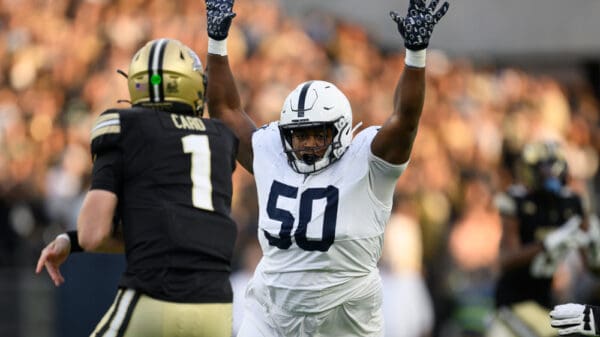
When Dani Dennis-Sutton intercepted Riley Leonard in the fourth quarter of the Orange Bowl, Penn State had the football, the lead and an opportunity to reach its first national championship game since the 1987 Fiesta Bowl.
That moment feels much longer ago than January 2025.
Notre Dame rallied. Penn State lost, 27-24, and what looked like the final step in a climb toward college football’s summit instead became the beginning of an astonishing descent.
Since that night, Penn State has gone from national championship contender to a program that needs to confront an uncomfortable possibility:
Maybe Penn State wasn’t quite what it thought it was.
The Nittany Lions are now 4-9 in their last 13 games against Power Four competition.
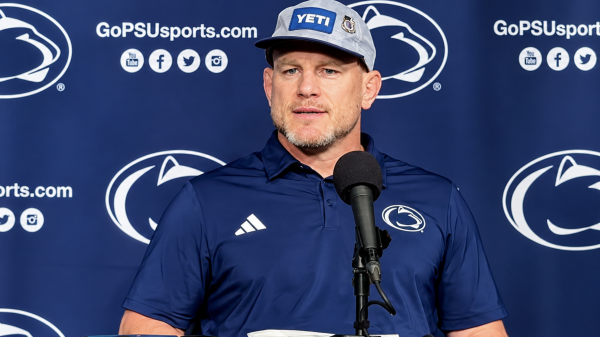
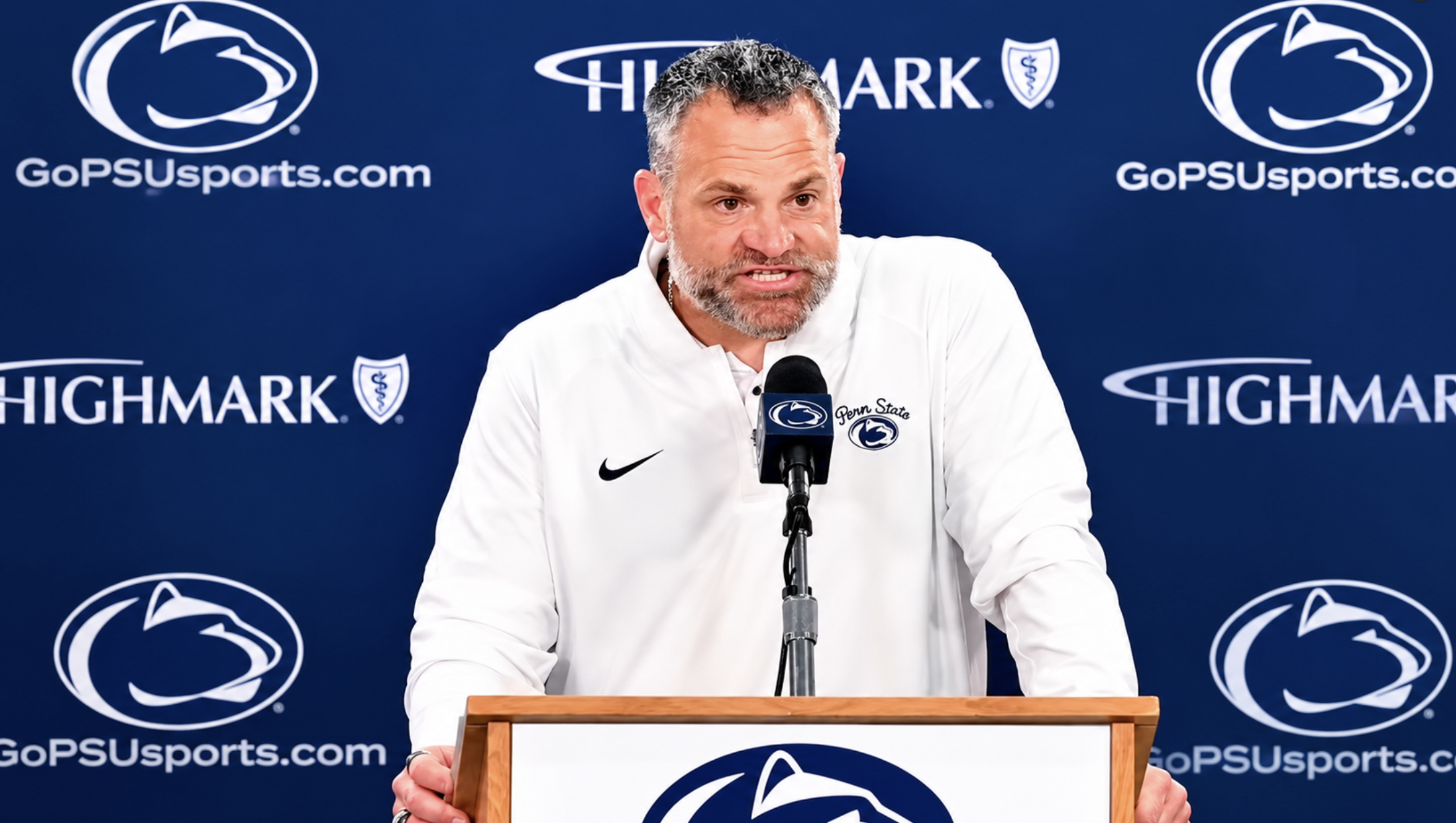
Friday’s 34-13 humiliation at Northwestern wasn’t merely another loss. Penn State was physically overwhelmed, allowing 413 rushing yards while producing only 48 of its own. Matt Campbell admitted afterward that Northwestern controlled both lines of scrimmage and that Penn State lacked the attitude, effort and toughness expected of the program.
Those aren’t symptoms of a contender having a bad night.
Those are symptoms of a program undergoing foundational repair.
That distinction matters when evaluating Campbell.
Penn State Made A Championship Decision
There was a strong case for firing James Franklin when Pat Kraft made the decision last October.
That shouldn’t be rewritten because everything that followed became messy.
Penn State entered 2025 ranked No. 2 after pouring resources into what was supposed to be a championship roster. Penn State invested millions into bringing defensive coordinator Jim Knowles in from the defending national champion Ohio State and then hit the transfer portal bringing in Devonte Ross, Trebor Pena, and Kyron Hudson who all were thought to fix the void at wide receiver.
Penn State struggled to put away a weak nonconference schedule in 2025. Then came the overtime loss to Oregon. Losing to Oregon wasn’t the fireable offense.
What happened afterward was.
Penn State went across the country and lost to a winless UCLA team, then returned home and lost to Northwestern. Franklin’s longstanding inability to consistently beat elite opponents suddenly collided with losses to teams Penn State had no business losing to.
Franklin finished 4-21 against AP Top 10 opponents at Penn State, including 1-18 against Top 10 Big Ten opponents. Kraft insisted his decision wasn’t based solely on three games but on the trajectory of the program. His standard was explicit: Penn State was investing to win a national championship.
At the time, there was considerable logic behind it.
But firing Franklin was only half of Kraft’s decision.
The other half was finding someone better.
That’s where Penn State’s problems multiplied.
The search lasted 56 days. Kraft conducted it without a search firm or committee. Candidates emerged, disappeared and recommitted elsewhere. Kalani Sitake and Jeff Brohm were among the names that ultimately didn’t come to Penn State.
Sitake was the one Kraft was confident that he was going to hire a coach away from BYU.
Kraft’s personal bravado along with his feeling of where Penn State is positioned he felt he could pull Sitake despite his roots. Those roots consisted of a man who played for that program, built it for a decade, grew up near campus and would frequent LaVell Edwards Stadium pulling for the Cougars.
I spoke with a former teammate of Sitake’s during this time and he asserted that it would take a lot more to pull Sitake from Provo.
Ultimately Sitake stayed and is currently coaching a BYU team that is ranked in the Top 10.
Penn State wasn’t able to hire Campbell until December, after the early signing period and after an enormous amount of roster uncertainty had already been created.
There was an unmistakable feeling during that search: We had to get somebody to do this.
Penn State may have believed at different points that it had somebody. Things fell through.
Eventually it got Campbell but only after some trials and tribulations trying to reach out to him in the first place.
The story of Penn State’s inability to directly connect to Campbell or with the right intermediary on the first go around of their search was the macrocosm of the entire search. Penn State’s inability to get things right and execute properly when it had sufficient lead time only exacerbated the operational failure in the athletic department that cascaded throughout the football program.
That delay had consequences far beyond public embarrassment.
Campbell Inherited A Roster Problem
The numbers circulating after Northwestern put the scale into perspective: roughly 20 players exhausted their eligibility, three ended their careers and around 50 entered the transfer portal.
Even if you debate exactly how every departure should be categorized, you cannot debate the larger reality.
Penn State experienced massive roster turnover while simultaneously operating without a permanent head coach through one of the most important roster-building periods of the modern college football calendar.
Its high school recruiting class was gutted.
Then Campbell had to construct a roster from what remained available.
That’s an important qualifier because the transfer portal isn’t a supermarket where Alabama’s starting left tackle and Ohio State’s best receiver sit on shelves waiting for Penn State to arrive in December.
Timing matters. Relationships matter. Money matters.
Penn State’s financial standing deserves scrutiny, too.
 Add Nittany Sports Now as a preferred source in Google! Click here to add us.
Recent reporting from The Athletic estimated Penn State’s current football player-spending operation in roughly the low-$30 million range, just inside the Top 25 nationally, while the richest operations are significantly higher.
Separately, Penn State’s own financial reporting showed $13.34 million in football NIL spending during the 2024-25 fiscal year. Franklin claimed his usable football NIL budget that season was only $7 million, illustrating how murky comparisons can be depending on what is counted.
Whatever accounting method one prefers, the broader question is unavoidable:
Is Penn State actually funding, recruiting and operating like the national championship program it believes itself to be?
That’s different from asking whether Penn State spends a lot of money.
It obviously does.
The question is whether Penn State is operating at the level of the handful of programs it expects to beat.
Campbell Isn’t Absolved
None of this means Campbell gets immunity.
He inherited a bad situation, but he also made choices.
He understandably brought players from Iowa State who knew his system and culture. That provided continuity when Penn State desperately needed some.
But there was an obvious gamble involved: Campbell became attractive to Penn State largely because he consistently did more with less at Iowa State.
Bringing the “less” with him and expecting it to immediately compete at a higher level is something different.
One NFL scout described this as the least-talented Penn State team he could remember. Penn State has had at least five players drafted in nine consecutive NFL drafts. That streak suddenly looks endangered.
Campbell also deserves examination for what Penn State didn’t retain.
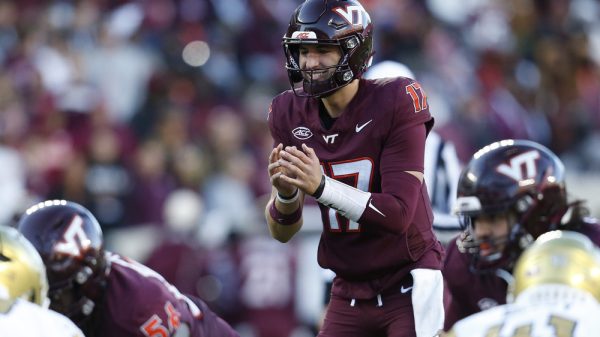
Quarterback Ethan Grunkemeyer and tight end Luke Reynolds are two obvious examples. Both followed Franklin to Virginia Tech. In total, 12 former Penn State players landed there.
Perhaps Campbell believed Rocco Becht gave him the best chance to stabilize Year 1. Perhaps he valued familiarity over upside. Maybe some departures were unavoidable.
But roster construction is part of coaching.
If Becht struggles while Grunkemeyer develops elsewhere, that’s going to become part of Campbell’s evaluation. The same applies to Reynolds, who entered this week leading all ACC tight ends in receptions and trailing only Miami’s talented wide receiver Malachi Toney in receptions, and every position where Penn State chose a familiar Iowa State solution instead of fighting harder to retain what Franklin left behind.
Campbell can simultaneously be handcuffed by circumstances and responsible for some of his own decisions.
Both things can be true.
This Is Bigger Than Northwestern
That’s why firing Campbell rhetoric five games into this experiment misses what’s actually happening.
Penn State isn’t experiencing a conventional first-year coaching transition.
It is dealing with the aftershocks of an organizational decision that detonated the existing football structure before the replacement structure was ready.
Kraft believed Penn State needed a different coach to get from the doorstep of a championship to actually winning one.
That was defensible.
But Penn State then spent nearly two months searching for that coach, lost enormous amounts of roster capital, essentially lost a recruiting class and handed Campbell the responsibility of assembling something functional from the remains.
Now everyone is shocked that it looks disjointed.
Penn State can demand better than getting embarrassed by Northwestern. Campbell should be held accountable for a team that looked unprepared and physically overmatched.
But evaluating whether Campbell can ultimately elevate Penn State requires first giving him something resembling a Penn State roster.
That probably means accepting something this fanbase doesn’t want to hear:
This isn’t a reload.
It isn’t even really a rebuild yet.
It’s a foundational repair.
Twenty-one months ago, Dennis-Sutton’s interception put Penn State a few plays from playing for a national championship.
Today, Penn State is 4-9 against Power Four competition and trying to figure out whether its talent, spending, recruiting operation and institutional expectations are actually aligned.
Before Penn State can return to the mountaintop, it needs to understand why the foundation underneath it collapsed so quickly.
And that examination cannot begin and end with Matt Campbell.