












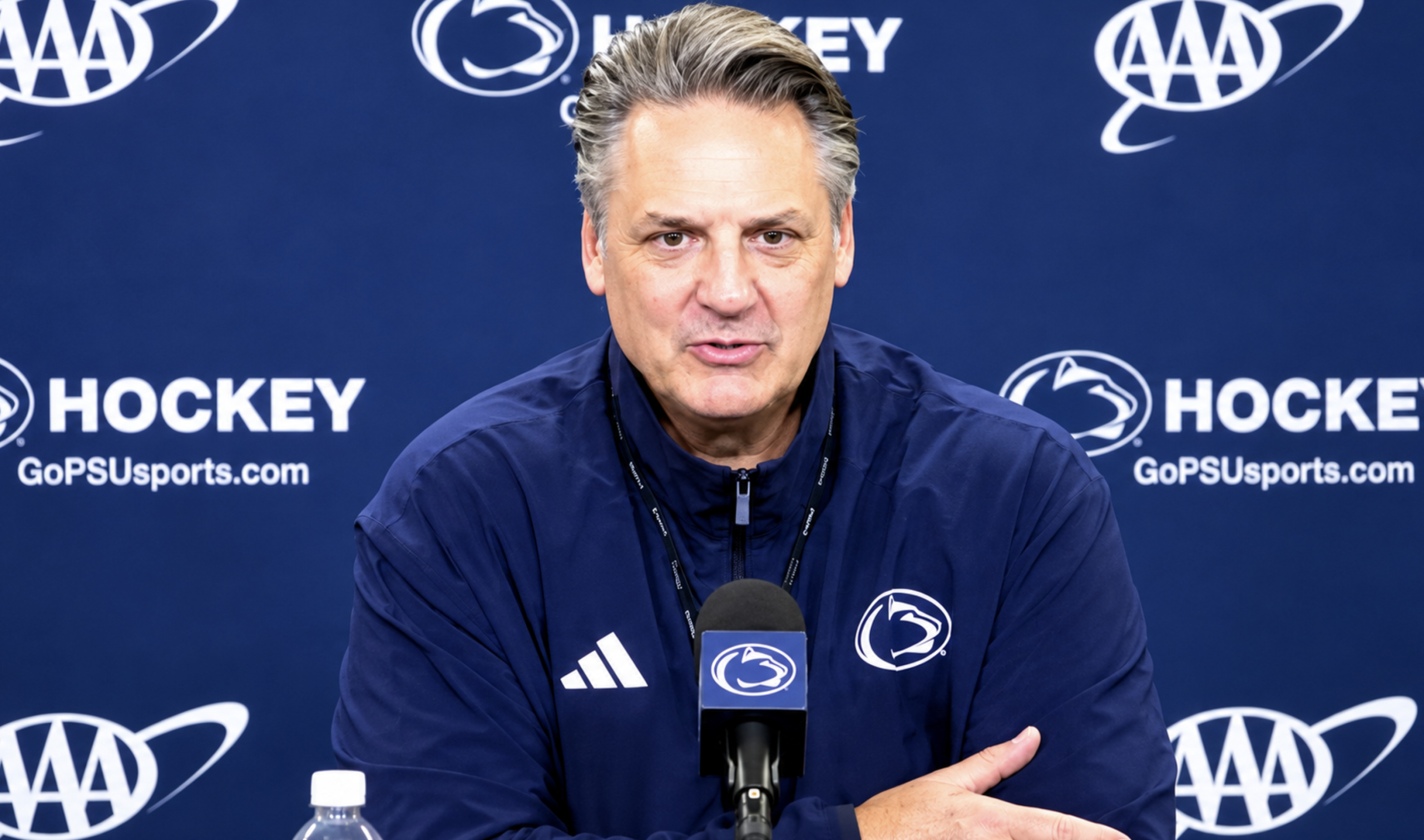
Penn State hockey has barely begun its 2026-27 season, but the Nittany Lions are already dealing with a heartbreaking injury, some early lessons about their identity and a challenging measuring stick on the horizon.
Junior forward Keaton Peters will miss the remainder of the season after suffering another devastating knee injury in his first game back. Meanwhile, head coach Guy Gadowsky is looking for greater consistency from his team following its opening games against UConn and Sacred Heart.
There have been encouraging individual performances, but Gadowsky understands that talent alone will not carry Penn State where it wants to go.
Here’s the latest from Hockey Valley.
Peters’ Comeback Ends in Heartbreak
For Keaton Peters, the opportunity to return to the ice was supposed to represent the end of a long and difficult journey.
Instead, it became the beginning of another.
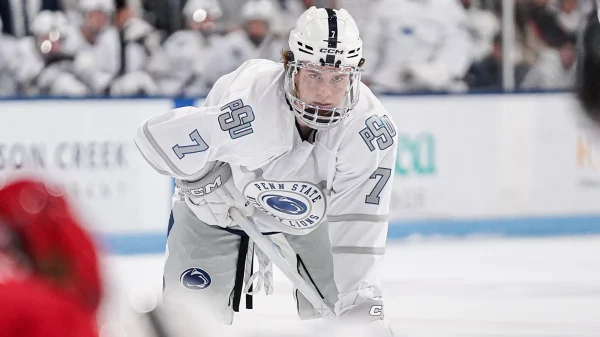
Peters, who missed the entire 2025-26 season recovering from ACL reconstructive surgery, suffered a devastating knee injury during his first shift against UConn in Penn State’s season opener.
The junior forward confirmed he tore his ACL and MCL while also sustaining injuries to both his medial and lateral menisci. The injuries will sideline him for the remainder of the season.
“I was extremely excited to get back on the ice with my teammates after months of work recovering from ACL reconstructive surgery from an injury suffered last preseason,” Peters wrote in a statement addressed to Hockey Valley.
“Unfortunately, during the first shift of my first game back, I sustained a knee-on-knee collision resulting in an ACL tear, MCL tear and medial and lateral meniscus injuries, which will sideline me for the remainder of the season.”
It is a crushing development for a player who had spent months working toward this opportunity.
Peters was expected to provide valuable depth at center, a position where experience, defensive responsibility and faceoff reliability can become particularly important as the season progresses.
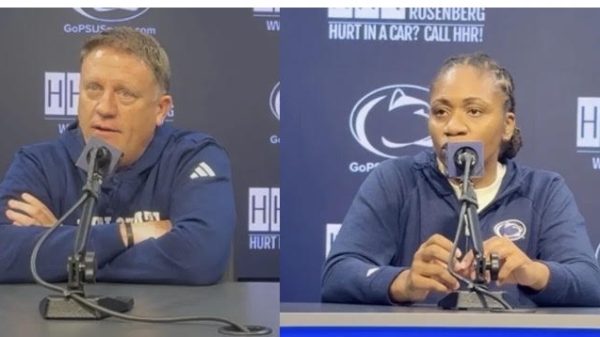
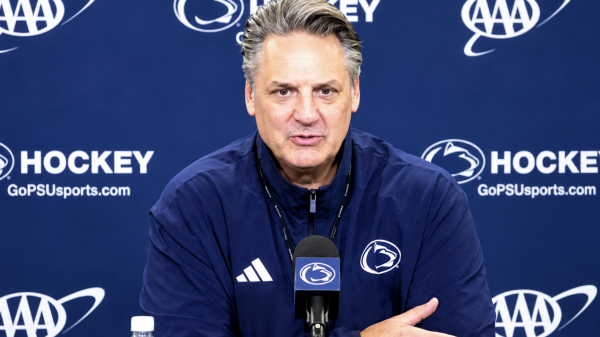
Gadowsky expressed how devastated the program was for Peters, praising the work he put into his rehabilitation and the mentality he demonstrated during Penn State’s run to the Frozen Four as a freshman.
Beyond the impact on Penn State’s lineup, there is a human element that makes this injury especially difficult.
Peters did everything asked of him to return. He endured surgery, rehabilitation and the uncertainty that accompanies a significant knee injury, only to have another season taken away almost immediately.
Yet his message was not one of surrender.
“I’m incredibly grateful for the support I’ve received from my family, friends, teammates and all the fans who have been there for me throughout this process,” Peters wrote. “I vow to attack this hardship head on and come back stronger than ever!”
For now, Penn State must move forward without Peters. His determination to return, however, remains firmly intact.
Gadowsky Wants Penn State’s Identity to Become Its Standard
Penn State’s opening games offered Gadowsky two distinctly different evaluations of his hockey team.
Against UConn, Gadowsky believed the Nittany Lions played the brand of hockey he expects from his program. He was pleased with their performance and how they competed.
The Sacred Heart game produced a different reaction.
Gadowsky was particularly disappointed with Penn State’s first two periods, identifying a lack of readiness and defensive organization as areas requiring immediate attention.
“How we started, being ready to compete. It has to be a standard and it wasn’t there,” Gadowsky said. “Hopefully, we learned a lesson.”
The second concern involved Penn State’s play away from the puck.
“Number two, our organization without the puck was slow,” Gadowsky said. “I think it is a factor of also not being ready to compete.”
Penn State has built its identity around pace, pressure and forcing opponents into uncomfortable situations. However, that approach requires five players working together, particularly when possession changes.
When the Nittany Lions are slow to organize defensively, their aggressive style can become a liability rather than an advantage.
Gadowsky’s concern is not necessarily that Penn State lacks the ability to execute its system. The UConn performance demonstrated otherwise.
The challenge is establishing that level of competitiveness as an expectation rather than something that appears intermittently.
For a team with postseason aspirations, that lesson cannot wait until conference play.
Faceoffs Could Determine Penn State’s Postseason Ceiling
One of Gadowsky’s more revealing observations concerned an area that rarely receives the same attention as goals, saves or highlight-reel plays.
Faceoffs.
“For us to be successful in March we have to be good from the face-off dot,” Gadowsky said.
Through the first two games, the Nittany Lions rank fourth in the NCAA with a 58.7% faceoff winning percentage.
Penn State’s offensive philosophy depends on generating opportunities through sustained pressure, quick transitions and territorial advantages. Winning faceoffs allows the Nittany Lions to establish possession without having to retrieve the puck.
Losing them, particularly in defensive-zone situations, creates additional pressure on the blue line and goaltending.
 Add Nittany Sports Now as a preferred source in Google! Click here to add us.
The importance becomes magnified in close games, when a single defensive-zone draw or offensive-zone possession can determine the outcome.
It also underscores why losing Peters hurts beyond the emotional impact. His anticipated role at center would have provided another option as Gadowsky develops his lineup.
Penn State’s ability to control possession will become increasingly important as the schedule strengthens.
Gadowsky is already thinking about March. His message is that the habits required to succeed then must be developed now.
Quinnipiac’s Wyttenbach’s Offensive Instincts Impress Gadowsky
Among the encouraging early developments has been the playmaking ability of Quinnipiac sophomore forward Ethan Wyttenbach.
Gadowsky offered particularly strong praise for Wyttenbach’s ability to create opportunities behind opposing defenses.
“He has an unbelievable ability to get behind the defense to make things happen,” Gadowsky said. “He’s as good as I’ve seen getting behind defensemen.”
That is considerable praise from a coach who has coached against with numerous talented offensive players during his Penn State tenure.
Wyttenbach’s ability to recognize openings and exploit defensive positioning provides Quinnipiac with another dimension offensively.
It is not simply about speed.
Finding space behind defensemen requires timing, anticipation and an understanding of how opponents react when the puck changes possession.
For a Quinnipiac team that wants to attack quickly, those instincts can turn seemingly harmless situations into dangerous scoring opportunities, something that will test the Penn State defense.
Larose Delivers a Highlight Worth Remembering
Justin Larose wasted little time providing one of Penn State’s most memorable early-season moments.
Larose produced a spectacular play against Sacred Heart that earned recognition as the No. 4 play on ESPN’s SportsCenter Top 10.
Gadowsky needed only three words to describe what he witnessed.
“That was spectacular.”
The recognition offered another reminder of the offensive talent Penn State possesses.
Although Gadowsky was unhappy with portions of the Sacred Heart performance, Larose’s individual brilliance demonstrated the kind of skill capable of changing a game in an instant.
The challenge for Penn State is ensuring those moments complement a consistent team performance rather than compensate for its shortcomings.
For Larose, however, the national recognition represents an early highlight in his Penn State career.
Quinnipiac Presents an Early Measuring Stick
Penn State’s upcoming matchup with Quinnipiac will provide an opportunity to evaluate its progress against one of college hockey’s most respected programs.
Gadowsky made it clear that his admiration for Quinnipiac extends beyond any particular season.
“They deserve every bit of credit they’ve been given because they’ve earned it and they earned it because they have done it consistently,” Gadowsky said.
That final word is particularly significant.
Consistency.
It is precisely what Gadowsky wants Penn State to develop.
Quinnipiac has established a reputation for disciplined, structured hockey, with its 2023 national championship serving as the program’s defining achievement.
The Bobcats have demonstrated that sustained success requires more than individual talent or occasional outstanding performances.
It demands attention to detail, defensive responsibility and the ability to execute regardless of the opponent.
Those are the same qualities Gadowsky emphasized when discussing Penn State’s early shortcomings.
For the Nittany Lions, the matchup represents more than another opportunity to collect an early-season victory.
It is a chance to demonstrate that the lessons from Sacred Heart have already begun to take hold.
Penn State has shown flashes of the team it believes it can become.
Against Quinnipiac, the challenge will be sustaining those flashes long enough to turn potential into performance.
The Nittany Lions hope to be playing meaningful hockey in March, that process must begin now.