






















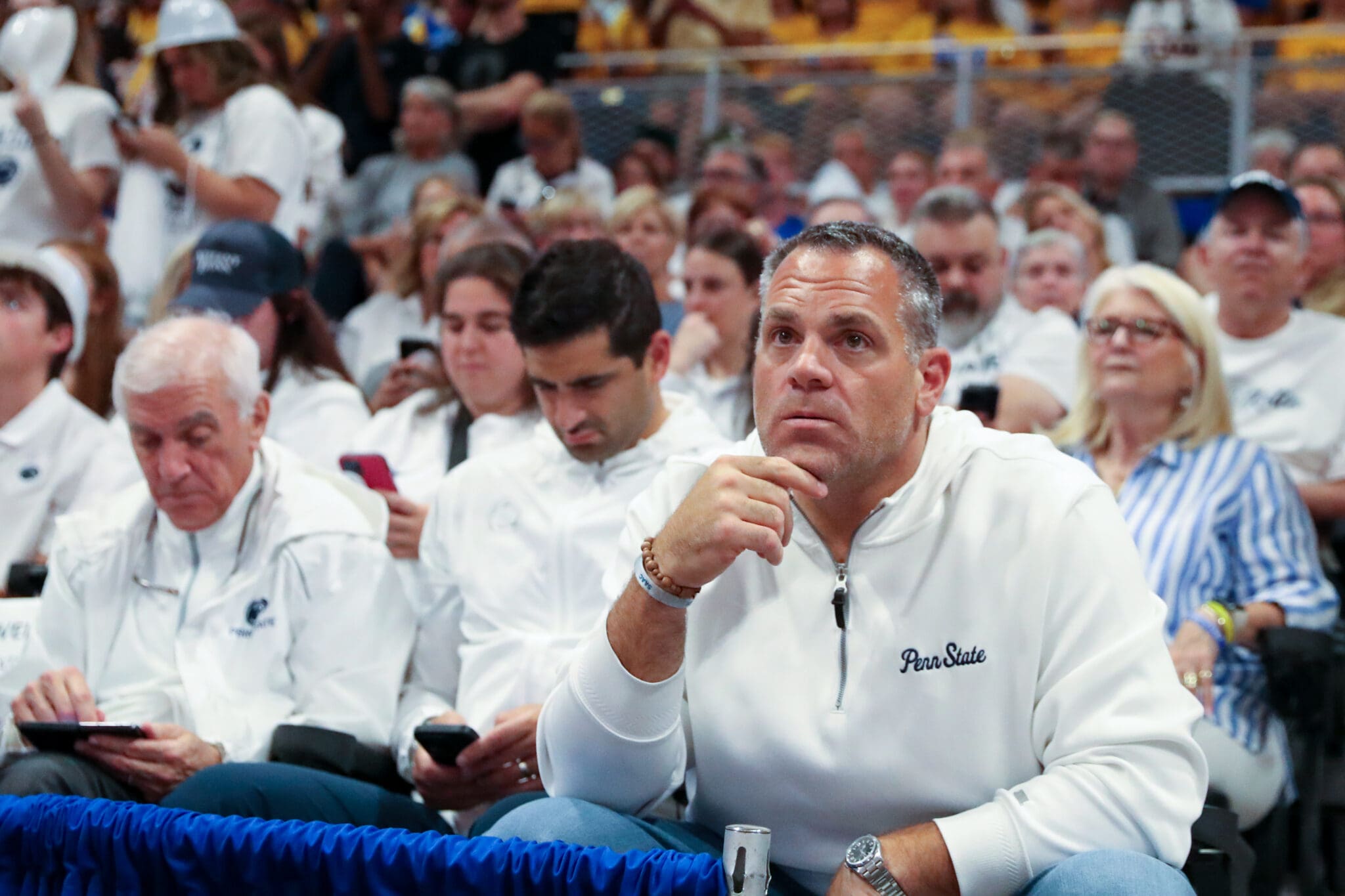
One year ago today, Pat Kraft stood before the media and delivered what amounted to his manifesto for Penn State athletics.
There would be no settling for good enough. No hiding behind tradition. Not accepting that competing for championships was somehow different from winning them.
James Franklin was gone, and Kraft made clear that Penn State football would operate under a standard that demanded more.
“Football is our backbone. We have invested at the highest level. With that comes high expectations,” Kraft declared on October 13, 2025.
Then came the statement that defined his vision.
“I’m here to win a national championship.”
It was bold. It was uncompromising. It was precisely what a frustrated fan base wanted to hear.
Twelve months later, those words deserve another examination.
Not because Kraft was necessarily wrong to fire Franklin, but because the turbulent year that followed has raised uncomfortable questions about whether Penn State’s athletic director has consistently demonstrated the leadership, judgment and accountability he demanded from his former football coach.
The standard Kraft established that afternoon was not exclusively for Franklin’s successor.
It applies to Kraft, too.
A Decision That May Have Been Building
Something about Franklin’s dismissal has never completely sat right with me.
Not necessarily the decision itself. Penn State had invested heavily in a championship-caliber roster, only to watch its national championship aspirations unravel with losses to Oregon, UCLA and Northwestern.
Rather, it was the speed.
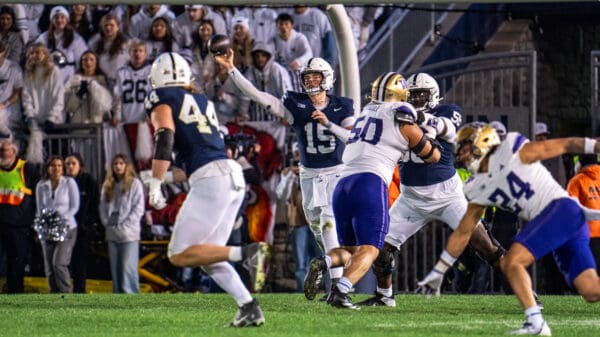
Penn State’s stunning defeat at UCLA on October 4 accelerated the scrutiny. Eight days later, following another loss to Northwestern, Franklin was unemployed.
Kraft insisted the decision extended beyond three disappointing games.
“This is not three-game thing,” he explained, pointing toward the program’s trajectory.
He also acknowledged that major decisions require preparation and consideration of different scenarios.
Kraft did not describe an impulsive reaction. He described a decision informed by broader evaluations, one that had contingency planning behind it.
It leaves me wondering whether the losses simply brought an already developing concern to its conclusion.
There is no established evidence that Kraft had predetermined Franklin’s dismissal. Nor is there proof their working relationship had deteriorated.
But I cannot shake the feeling that something wasn’t entirely right long before Northwestern delivered the final blow.
Consider the January 2025 hiring of Jim Knowles.
Penn State successfully recruited Ohio State’s national championship-winning defensive coordinator, making an extraordinary financial commitment to strengthen Franklin’s program.
ESPN’s subsequent examination of Knowles’ move offered a window into the complicated recruitment.
What intrigues me is the question of Kraft’s involvement and how the decision-making process unfolded.
Did Franklin believe his College Football Playoff semifinal appearance had earned him greater autonomy?
Did Kraft expect greater involvement in decisions carrying substantial financial consequences?
Those are questions, not conclusions.
The available evidence does not establish that Franklin deliberately circumvented Kraft or that the Knowles hiring damaged their relationship.
Still, the circumstances invite examination.
Successful organizations require alignment between their most powerful leaders. When that alignment disappears, even successful decisions can become sources of friction.
Perhaps there was nothing more to it.
But considering how abruptly the Franklin era ended, I believe the relationship between Franklin and Kraft deserves closer examination than it has received.
The Search That Exposed Penn State
Kraft’s October declaration promised a national search for someone possessing integrity, accountability, toughness and humility.
He emphasized recruiting, player retention and maximizing resources.
What followed was a 54-day coaching search that became increasingly difficult to defend.
Penn State pursued prominent candidates, watched possibilities disappear and eventually hired Matt Campbell from Iowa State.
Campbell may ultimately prove an excellent choice.
That does not retroactively make the search successful.
Meanwhile, Penn State’s recruiting class disintegrated.
The program that Kraft promised would remain a destination for elite talent watched its recruiting momentum evaporate. The departure of Franklin and the uncertainty surrounding his replacement created an opening for recruits to reconsider their commitments.
The subsequent roster exodus made matters worse.
As I detailed in Sunday’s column, Penn State eventually faced 48 players entering the transfer portal compared with 30 who had announced their return.
Campbell brought in 39 transfers, including 23 from Iowa State, to stabilize a roster that had been hollowed out.
Some attrition was inevitable following a coaching change. Players and recruits possess the right to determine their futures.
But allowing a transition to become a prolonged organizational vacuum carries consequences.
Kraft cannot be blamed for every departure or every decision made by outgoing personnel.
He can, however, be evaluated on the transition he supervised and the safeguards Penn State had in place to protect its future.
The athletic director who emphasized retention and recruiting watched both become enormous problems.
That contradiction cannot simply be ignored.
Leadership Is More Than Conviction
Then came the leaked audio.
During the coaching search, a recording emerged from a meeting between Kraft and Penn State players.
Kraft expressed frustration about recruiting and the stakes surrounding his coaching decision.
“If I don’t hire the right person, my career is over,” Kraft told the players.
The recording was edited, and its incomplete context warrants caution. Kraft subsequently apologized for his comments.
Still, I question the judgment behind the exchange.
These were young adults navigating an extraordinarily difficult period. Their coach had been fired. Their futures were uncertain. Some were trying to advocate for interim coach Terry Smith.
They needed reassurance, stability and leadership.
Instead, they heard their athletic director discussing the potential destruction of his own career.
 Add Nittany Sports Now as a preferred source in Google! Click here to add us.
There is a difference between being passionate and making your anxiety someone else’s responsibility.
Kraft’s concerns were understandable. The consequences of his decision were enormous.
But leadership sometimes requires absorbing pressure rather than distributing it.
That is particularly true when addressing student-athletes who had little control over the circumstances surrounding them.
The Other Side of Kraft’s Ledger
Criticism of Kraft’s football leadership should not erase his accomplishments elsewhere.
The Beaver Stadium Revitalization project represents perhaps the most significant undertaking of his tenure.
Modernizing an aging stadium while preserving one of college football’s most recognizable environments is no small responsibility.
Improved infrastructure, premium seating, expanded revenue opportunities and a better game-day experience are legitimate investments in Penn State’s future.
The project also creates opportunities for the athletic department to generate revenue beyond traditional ticket sales.
Kraft deserves credit for helping move that vision forward.
But there is another side.
Rising ticket prices, increased financial commitments and the growing commercialization of the Beaver Stadium experience have created understandable frustration.
For generations, Penn State football has been a family tradition. Maintaining access for ordinary supporters should remain a priority even as the university pursues premium revenue.
Fans are being asked to pay more.
They are entitled to ask what they are receiving in return.
The same scrutiny extends beyond football.
Penn State men’s basketball continues to face questions about whether it receives the resources necessary to compete consistently in the Big Ten.
A modernized football stadium cannot become the sole measuring stick for an athletic department responsible for supporting numerous programs.
Kraft’s responsibility is broader than constructing facilities or delivering ambitious presentations.
It is ensuring that Penn State’s investments produce meaningful competitive opportunities across athletics.
The Funding Question Won’t Disappear
That brings us to another uncomfortable issue.
College football analyst Josh Pate has raised concerns about whether Penn State will make the financial commitment necessary to support Campbell, his staff and the program’s talent acquisition efforts.
“The expectation around the Big Ten is that Penn State is not going to be serious enough to financially back Matt Campbell and that coaching staff and also the talent acquisition mechanism there. They flat out don’t think they will invest enough”
Whether that skepticism ultimately proves justified remains to be seen.
But it strikes at the heart of Kraft’s manifesto.
A year ago, Kraft insisted Penn State possessed elite resources and was prepared to compete for championships.
If the financial commitment falls short of what Campbell needs, the athletic director cannot reasonably demand championship results without accepting responsibility for the limitations.
Conversely, if Penn State provides the necessary resources, Campbell must eventually demonstrate that he can turn those investments into victories.
Accountability works in both directions.
It cannot become something demanded from coaches while administrators remain insulated from scrutiny.
Campbell Is Kraft’s Defining Decision
In Sunday’s column, I argued that patience is necessary when evaluating Campbell.
Six games are not enough to determine whether Penn State hired the right coach.
Campbell inherited a difficult situation, assembled a roster under extraordinary circumstances and is attempting to establish his culture.
His 3-3 start is disappointing. The losses to Wisconsin, Northwestern and USC have exposed legitimate weaknesses.
But disappointment is not definitive evidence of failure.
Campbell deserves time to develop players, recruit and demonstrate whether his approach can succeed.
Kraft deserves no exemption from accountability during that process.
He selected Campbell after firing the coach who brought Penn State within one victory of playing for a national championship.
He supervised the search and the transition.
And he publicly established the expectations by which the next era would be judged.
If Campbell ultimately succeeds, Kraft will deserve substantial credit for making a difficult decision that paid off.
If Campbell fails, the consequences should extend beyond another coaching change.
It is difficult to envision Kraft surviving a second failed football transition after staking so much of his tenure on this one.
That is not a call for his dismissal today.
It is recognition of the responsibility he willingly assumed.
The Manifesto Comes Due
One year ago, Kraft said Penn State needed someone who could honor tradition without fearing change.
He spoke of toughness, accountability and humility.
Those qualities are not exclusive requirements for a football coach.
They are requirements for anyone entrusted with leading Penn State athletics.
Kraft has demonstrated ambition. He has made difficult decisions. He has helped advance a stadium project that could shape the university for generations.
He has also presided over a chaotic coaching transition, significant roster upheaval and moments when his own judgment deserved scrutiny.
Both realities can coexist.
The next several years will determine whether Kraft’s vision produces the championship program he promised or whether the turbulence surrounding his biggest decision becomes the defining feature of his tenure.
For now, six games into Campbell’s tenure, a final verdict would be premature.
But one year after Kraft stood before the media and demanded more from Penn State football, it is entirely appropriate to demand more clarity, consistency and accountability from the man overseeing it.
Kraft wanted Penn State to stop measuring itself by what it had accomplished and start measuring itself by what it could become.
That was his doctrine.
Now he must live by it.
The standard he established for everyone else has become the standard by which he will be judged.